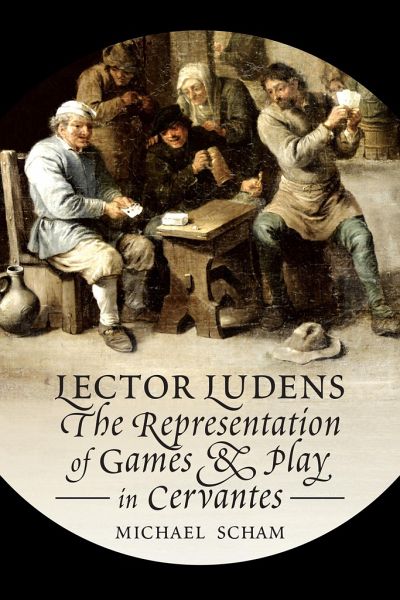
Michael Scham uses Cervantes's Don Quijote and Novelas ejemplares as the basis for a wide-ranging exploration of early modern Spanish views on recreations ranging from cards and dice to hunting, attending the theater, and reading fiction.
Michael Scham uses Cervantes's Don Quijote and Novelas ejemplares as the basis for a wide-ranging exploration of early modern Spanish views on recreations ranging from cards and dice to hunting, attending the theater, and reading fiction.
Michael Scham is an associate professor of Spanish at the University of St Thomas in Minnesota.
Inhaltsangabe
Acknowledgments List of Illustrations Introduction 1. Leisure and Recreation in Early Modern Spain * Theoretical Contexts * Prerational and Rational Play in the Epic, the Picaresque, and the Quixotic * The Space and Function of Eutrapelia * Cristóbal Méndez, Rodrigo Caro, Fray Alonso Remon: Therapeutic Exercise * Human Divinity and Depravity: Vives, Erasmus, Montaigne * Play types in Golden Age Spain * Chess * Games of Chance * Physical activity and competition * Mimesis * Ilinx * Regulating play in the Indias 2. Solitary, Collaborative and Complicit Play in Don Quijote * Cervantes and the Ambivalent Freedom of Play * Players and Games in Don Quijote * Play and Laughter in Don Quijote * Laughing At, Laughing With * Comic Doubt and Delusion in Don Quijote * Ludic Scepticism in Don Quijote II 3. The Novelas ejemplares: Ocio, Exemplarity, and Community * Agonistic and Restrictive Play in El licenciado Vidriera * The Agonistic Intellect: Cruel Comedy and Vidriera’s Humourless Vision * The Picaresque and Play in El coloquio de los perros * Play and the Liminal Underworld Experience * Dialogue and the Digressive Quest for Meaning in El coloquio de los perros * Play and the Exemplarity of Process * Picaresque Freedom and Festive Play * The Festive Mode of the Picaresque * Monipodio’s Criminal and Ludic Community in Rinconete y Cortadillo * Distance, Morality, and the Allure of the Aesthetic Experience * Generic Interplay in La ilustre fregona * Interrogation and Validation of the Fictional World Conclusion Notes Bibliography
Acknowledgments List of Illustrations Introduction 1. Leisure and Recreation in Early Modern Spain * Theoretical Contexts * Prerational and Rational Play in the Epic, the Picaresque, and the Quixotic * The Space and Function of Eutrapelia * Cristóbal Méndez, Rodrigo Caro, Fray Alonso Remon: Therapeutic Exercise * Human Divinity and Depravity: Vives, Erasmus, Montaigne * Play types in Golden Age Spain * Chess * Games of Chance * Physical activity and competition * Mimesis * Ilinx * Regulating play in the Indias 2. Solitary, Collaborative and Complicit Play in Don Quijote * Cervantes and the Ambivalent Freedom of Play * Players and Games in Don Quijote * Play and Laughter in Don Quijote * Laughing At, Laughing With * Comic Doubt and Delusion in Don Quijote * Ludic Scepticism in Don Quijote II 3. The Novelas ejemplares: Ocio, Exemplarity, and Community * Agonistic and Restrictive Play in El licenciado Vidriera * The Agonistic Intellect: Cruel Comedy and Vidriera’s Humourless Vision * The Picaresque and Play in El coloquio de los perros * Play and the Liminal Underworld Experience * Dialogue and the Digressive Quest for Meaning in El coloquio de los perros * Play and the Exemplarity of Process * Picaresque Freedom and Festive Play * The Festive Mode of the Picaresque * Monipodio’s Criminal and Ludic Community in Rinconete y Cortadillo * Distance, Morality, and the Allure of the Aesthetic Experience * Generic Interplay in La ilustre fregona * Interrogation and Validation of the Fictional World Conclusion Notes Bibliography
Es gelten unsere Allgemeinen Geschäftsbedingungen: www.buecher.de/agb
Impressum
www.buecher.de ist ein Internetauftritt der buecher.de internetstores GmbH
Geschäftsführung: Monica Sawhney | Roland Kölbl | Günter Hilger
Sitz der Gesellschaft: Batheyer Straße 115 - 117, 58099 Hagen
Postanschrift: Bürgermeister-Wegele-Str. 12, 86167 Augsburg
Amtsgericht Hagen HRB 13257
Steuernummer: 321/5800/1497
USt-IdNr: DE450055826