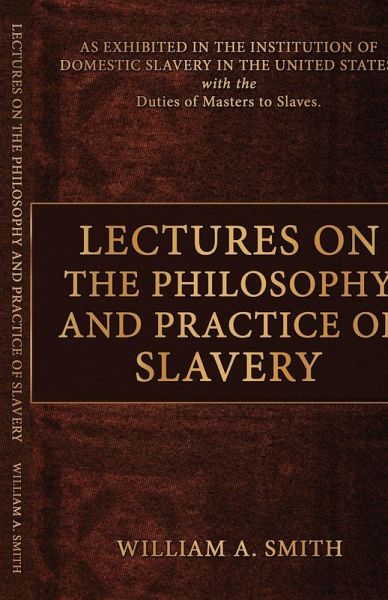
Lectures on the Philosophy and Practice of Slavery is a nineteenth-century work by William A. Smith that presents a detailed examination of slavery as an institution in the United States. Through a series of lectures, Smith discusses the moral, social, and economic arguments surrounding slavery, offering insight into the justifications used to defend the practice during a period of intense national debate. The work addresses the structure and management of slavery, the role of enslaved labor in society, and the philosophical underpinnings that supporters used to legitimize bondage. While…mehr
Lectures on the Philosophy and Practice of Slavery is a nineteenth-century work by William A. Smith that presents a detailed examination of slavery as an institution in the United States. Through a series of lectures, Smith discusses the moral, social, and economic arguments surrounding slavery, offering insight into the justifications used to defend the practice during a period of intense national debate. The work addresses the structure and management of slavery, the role of enslaved labor in society, and the philosophical underpinnings that supporters used to legitimize bondage. While reflective of its historical context, the text provides contemporary readers with a valuable primary source for understanding the mindset and rationalizations of pro-slavery advocates. Preserved as a public domain work, Lectures on the Philosophy and Practice of Slavery is essential reading for historians, scholars, and anyone seeking a deeper understanding of the ideological and social complexities of slavery in nineteenth-century America.
William A. Smith was a 19th-century American author, renowned for his controversial work, 'Lectures on the Philosophy and Practice of Slavery,' published in 1856. This book comprises a series of lectures he delivered at the Central Methodist Episcopal Church South in Summerfield, Alabama, aimed at discussing the moral, social, and political dimensions of slavery. Smith, an ardent defender of the institution, sought to justify slavery from a biblical and philosophical perspective, aligning with the antebellum South's ideologies. His writing showcased the literary style of his era-marked by elaborate narratives and a didactic tone, as he endeavored to merge Christian doctrine with pro-slavery arguments. Smith's work represents a segment of American literary history that provided intellectual scaffolding for justifying slavery, reflecting the deep-seated tensions leading up to the Civil War. This book serves as a historical artifact, illuminating the ideologies and rhetoric used by proponents of slavery in the antebellum United States. Although Smith's views are deemed anathema in contemporary society, his writings provide crucial insights for scholars studying the intersections of religion, morality, and socio-political issues of his time.
Es gelten unsere Allgemeinen Geschäftsbedingungen: www.buecher.de/agb
Impressum
www.buecher.de ist ein Internetauftritt der buecher.de internetstores GmbH
Geschäftsführung: Monica Sawhney | Roland Kölbl | Günter Hilger
Sitz der Gesellschaft: Batheyer Straße 115 - 117, 58099 Hagen
Postanschrift: Bürgermeister-Wegele-Str. 12, 86167 Augsburg
Amtsgericht Hagen HRB 13257
Steuernummer: 321/5800/1497
USt-IdNr: DE450055826