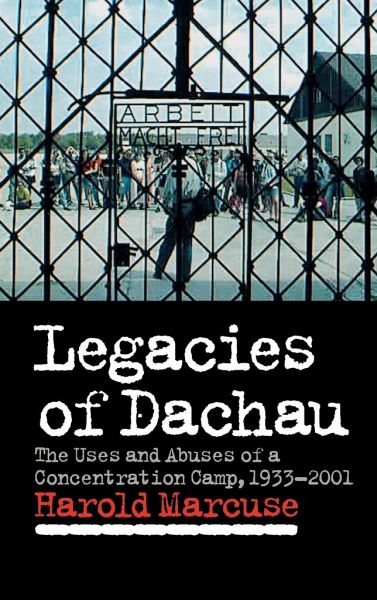
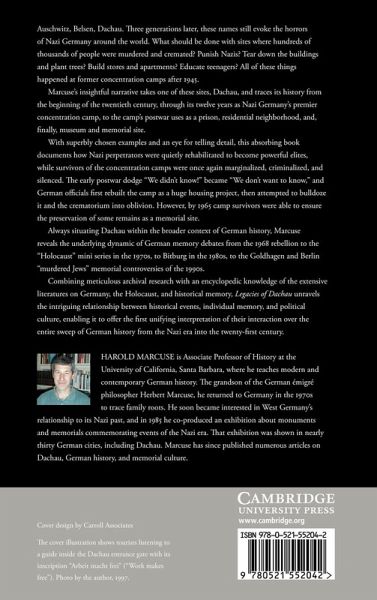
Auschwitz, Belsen, Dachau. These names still evoke the horrors of Nazi Germany around the world. This 2001 book takes one of these sites, Dachau, and traces its history from the beginning of the twentieth century, through its twelve years as Nazi Germany's premier concentration camp, to the camp's postwar uses as prison, residential neighborhood, and, finally, museum and memorial site. With superbly chosen examples and an eye for telling detail, Legacies of Dachau documents how Nazi perpetrators were quietly rehabilitated to become powerful elites, while survivors of the concentration camps…mehr
Auschwitz, Belsen, Dachau. These names still evoke the horrors of Nazi Germany around the world. This 2001 book takes one of these sites, Dachau, and traces its history from the beginning of the twentieth century, through its twelve years as Nazi Germany's premier concentration camp, to the camp's postwar uses as prison, residential neighborhood, and, finally, museum and memorial site. With superbly chosen examples and an eye for telling detail, Legacies of Dachau documents how Nazi perpetrators were quietly rehabilitated to become powerful elites, while survivors of the concentration camps were once again marginalized, criminalized and silenced. Combining meticulous archival research with an encyclopedic knowledge of the extensive literatures on Germany, the Holocaust, and historical memory, Marcuse unravels the intriguing relationship between historical events, individual memory, and political culture, to offer a unified interpretation of their interaction from the Nazi era to the twenty-first century.
Harold Marcuse received an MA from Hamburg University and a PhD from the University of Michigan, and lived and studied in Germany from the 1970s to the 1990s. He has been teaching German and Public History at the University of California since 1992. His research focuses on the reception of historical events, in particular events in twentieth-century German history.
Inhaltsangabe
Dachau: past, present, future; Part I. Dachau 1890-1945: A Town, A Camp, A Symbol of Genocide: 1. Dachau: a town and a camp; 2. Dachau: a symbol of genocide; Part II. Dachau 1945-55: Three Myths and Three Inversions: 3. 'Good' Nazis; 4. 'Bad' inmates; 5. 'Clean' camps; Part III. Dachau 1955-70: Groups and Their Memories: 6. The first representations of Dachau, 1945-52; 7. Rising public interest, 1955-65; 8. Catholics celebrate at Dachau; 9. The survivors negotiate a memorial site; 10. Jews represent the Holocaust at Dachau; 11. Protestants make amends at Dachau; 12. The 1968 generation: new legacies of old myths; Part IV. Dachau 1970-2000: New Age Cohorts Challenge Mythic Legacies: 13. Redefining the three myths and ending ignorance: the 1970s; 14. The 1980s: relinquishing victimisation; 15. The 1990s: resistance vs. education.
Dachau: past, present, future Part I. Dachau 1890-1945: A Town, A Camp, A Symbol of Genocide: 1. Dachau: a town and a camp 2. Dachau: a symbol of genocide Part II. Dachau 1945-55: Three Myths and Three Inversions: 3. 'Good' Nazis 4. 'Bad' inmates 5. 'Clean' camps Part III. Dachau 1955-70: Groups and Their Memories: 6. The first representations of Dachau, 1945-52 7. Rising public interest, 1955-65 8. Catholics celebrate at Dachau 9. The survivors negotiate a memorial site 10. Jews represent the Holocaust at Dachau 11. Protestants make amends at Dachau 12. The 1968 generation: new legacies of old myths Part IV. Dachau 1970-2000: New Age Cohorts Challenge Mythic Legacies: 13. Redefining the three myths and ending ignorance: the 1970s 14. The 1980s: relinquishing victimisation 15. The 1990s: resistance vs. education.
Dachau: past, present, future; Part I. Dachau 1890-1945: A Town, A Camp, A Symbol of Genocide: 1. Dachau: a town and a camp; 2. Dachau: a symbol of genocide; Part II. Dachau 1945-55: Three Myths and Three Inversions: 3. 'Good' Nazis; 4. 'Bad' inmates; 5. 'Clean' camps; Part III. Dachau 1955-70: Groups and Their Memories: 6. The first representations of Dachau, 1945-52; 7. Rising public interest, 1955-65; 8. Catholics celebrate at Dachau; 9. The survivors negotiate a memorial site; 10. Jews represent the Holocaust at Dachau; 11. Protestants make amends at Dachau; 12. The 1968 generation: new legacies of old myths; Part IV. Dachau 1970-2000: New Age Cohorts Challenge Mythic Legacies: 13. Redefining the three myths and ending ignorance: the 1970s; 14. The 1980s: relinquishing victimisation; 15. The 1990s: resistance vs. education.
Dachau: past, present, future Part I. Dachau 1890-1945: A Town, A Camp, A Symbol of Genocide: 1. Dachau: a town and a camp 2. Dachau: a symbol of genocide Part II. Dachau 1945-55: Three Myths and Three Inversions: 3. 'Good' Nazis 4. 'Bad' inmates 5. 'Clean' camps Part III. Dachau 1955-70: Groups and Their Memories: 6. The first representations of Dachau, 1945-52 7. Rising public interest, 1955-65 8. Catholics celebrate at Dachau 9. The survivors negotiate a memorial site 10. Jews represent the Holocaust at Dachau 11. Protestants make amends at Dachau 12. The 1968 generation: new legacies of old myths Part IV. Dachau 1970-2000: New Age Cohorts Challenge Mythic Legacies: 13. Redefining the three myths and ending ignorance: the 1970s 14. The 1980s: relinquishing victimisation 15. The 1990s: resistance vs. education.
Rezensionen
Review of the hardback: '... Marcuse has definitely identified something both strangely disturbing and of great symbolic importance.' The Times Literary Supplement
Es gelten unsere Allgemeinen Geschäftsbedingungen: www.buecher.de/agb
Impressum
www.buecher.de ist ein Internetauftritt der buecher.de internetstores GmbH
Geschäftsführung: Monica Sawhney | Roland Kölbl | Günter Hilger
Sitz der Gesellschaft: Batheyer Straße 115 - 117, 58099 Hagen
Postanschrift: Bürgermeister-Wegele-Str. 12, 86167 Augsburg
Amtsgericht Hagen HRB 13257
Steuernummer: 321/5800/1497
USt-IdNr: DE450055826