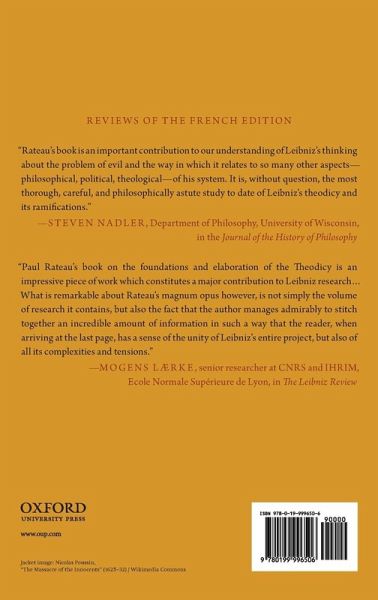
Rateau's clear mastery of the context and content of Leibniz's theodical project, from its origins to its final form, is worthy of the universal genius himslef. -- Kristen Irwin, The Leibniz Review This scholarly work on Leibniz demonstrates Rateau's erudition and thorough mastery of Leibniz's published oeuvre and relevant secondary literature (collected in a useful bibliography and in chapter endnotes). The book is extremely readable, so it has much to offer nonspecialists interested in the problem of evil. Highly recommended. Upper-division undergraduates and above. -- M. Latzer, Gannon University, CHOICE…mehr
Rateau's clear mastery of the context and content of Leibniz's theodical project, from its origins to its final form, is worthy of the universal genius himslef. -- Kristen Irwin, The Leibniz Review This scholarly work on Leibniz demonstrates Rateau's erudition and thorough mastery of Leibniz's published oeuvre and relevant secondary literature (collected in a useful bibliography and in chapter endnotes). The book is extremely readable, so it has much to offer nonspecialists interested in the problem of evil. Highly recommended. Upper-division undergraduates and above. -- M. Latzer, Gannon University, CHOICE
Paul Rateau (Ph.D., 2005, Philosophy, University of Strasbourg, France) teaches early modern philosophy at Pantheon-Sorbonne University (Paris, France) since 2008. He is an alumnus of the Ecole Normale Supérieure (Fontenay/SaintCloud, France).
Inhaltsangabe
* Table of Contents * Acknowledgments * List of Abbreviations * Introduction * 1. The Existence of Evil * 2. Evil Considered in Relation to Justice * 3. A Vocation: To Defend God's Justice * Chapter 1: Difficulties Concerning the Justification of God in the Years Prior to 1673 * 1.1 Early Reading and the Relation of Justice to Power * 1.2 A Just God, who is nevertheless author of sin? * Chapter 2: The Confession of a Philosopher: Divine Justice and the Necessity of Sin * 2.1 God as Ground, but not Author of Evil * 2.2 Permission of Evil and the Distinction of Two Kinds of Necessity: A Limited Rehabilitation * Chapter 3: Theoretical Changes after the Confession of a Philosopher: Towards a New Conception of God, the Possible and Divine Concurrence with Evil * 3.1 A Revised Theology and Metaphysics * 3.2 The Origin of Evil and God's Physical Concurrence * 3.3 God's Moral Concurrence with Evil and the Relation of Part to Whole * Chapter 4: The Genesis of Theodicy: Its Scientific and Apologetic Aims * 4.1 From the Project of "Theodicies" to the Composition of the Essays on Theodicy: Systematic Necessity and Occasional Cause * 4.2 Theodicy as Defense: Ignorance of Detail, Presumptions and Probabilities * Chapter 5: The Best of All Possible Worlds and Divine Permission of Evil * 5.1 The Thesis of the Best of All Possible Worlds * 5.2 The Moral Necessity of the Divine Choice * 5.3 God's Moral Concurrence with Evil: the Doctrine of Permission * Chapter 6: Evil in Being and in the Actions of Creatures: Reality or Appearance? * 6.1 God's Physical Concurrence, the Origin and Nature of Evil * 6.2 The Inertial Model and its Application to Creaturely Actions: From Peccability to Malice * 6.3 Real Defect or False Appearance: A Dual Conception of Evil * Chapter 7: Human Freedom and Principles of Action * 7.1 The Labyrinth of the Free and the Necessary and the Prerequisites of Freedom * 7.2 From the Ideal to the Real: the Exercise of Freedom and the Maxims of Leibnizian Ethics * Conclusion * Bibliography * Index
* Table of Contents * Acknowledgments * List of Abbreviations * Introduction * 1. The Existence of Evil * 2. Evil Considered in Relation to Justice * 3. A Vocation: To Defend God's Justice * Chapter 1: Difficulties Concerning the Justification of God in the Years Prior to 1673 * 1.1 Early Reading and the Relation of Justice to Power * 1.2 A Just God, who is nevertheless author of sin? * Chapter 2: The Confession of a Philosopher: Divine Justice and the Necessity of Sin * 2.1 God as Ground, but not Author of Evil * 2.2 Permission of Evil and the Distinction of Two Kinds of Necessity: A Limited Rehabilitation * Chapter 3: Theoretical Changes after the Confession of a Philosopher: Towards a New Conception of God, the Possible and Divine Concurrence with Evil * 3.1 A Revised Theology and Metaphysics * 3.2 The Origin of Evil and God's Physical Concurrence * 3.3 God's Moral Concurrence with Evil and the Relation of Part to Whole * Chapter 4: The Genesis of Theodicy: Its Scientific and Apologetic Aims * 4.1 From the Project of "Theodicies" to the Composition of the Essays on Theodicy: Systematic Necessity and Occasional Cause * 4.2 Theodicy as Defense: Ignorance of Detail, Presumptions and Probabilities * Chapter 5: The Best of All Possible Worlds and Divine Permission of Evil * 5.1 The Thesis of the Best of All Possible Worlds * 5.2 The Moral Necessity of the Divine Choice * 5.3 God's Moral Concurrence with Evil: the Doctrine of Permission * Chapter 6: Evil in Being and in the Actions of Creatures: Reality or Appearance? * 6.1 God's Physical Concurrence, the Origin and Nature of Evil * 6.2 The Inertial Model and its Application to Creaturely Actions: From Peccability to Malice * 6.3 Real Defect or False Appearance: A Dual Conception of Evil * Chapter 7: Human Freedom and Principles of Action * 7.1 The Labyrinth of the Free and the Necessary and the Prerequisites of Freedom * 7.2 From the Ideal to the Real: the Exercise of Freedom and the Maxims of Leibnizian Ethics * Conclusion * Bibliography * Index
Es gelten unsere Allgemeinen Geschäftsbedingungen: www.buecher.de/agb
Impressum
www.buecher.de ist ein Internetauftritt der buecher.de internetstores GmbH
Geschäftsführung: Monica Sawhney | Roland Kölbl | Günter Hilger
Sitz der Gesellschaft: Batheyer Straße 115 - 117, 58099 Hagen
Postanschrift: Bürgermeister-Wegele-Str. 12, 86167 Augsburg
Amtsgericht Hagen HRB 13257
Steuernummer: 321/5800/1497
USt-IdNr: DE450055826