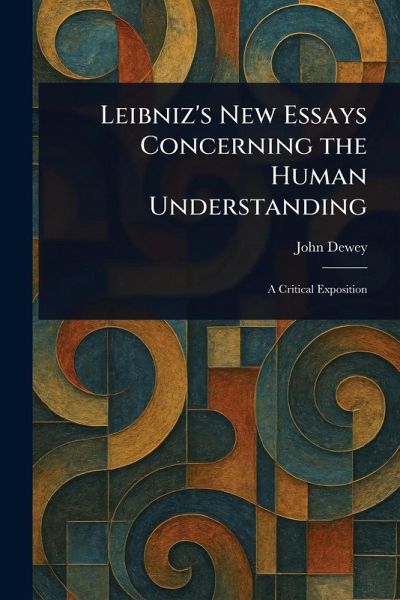
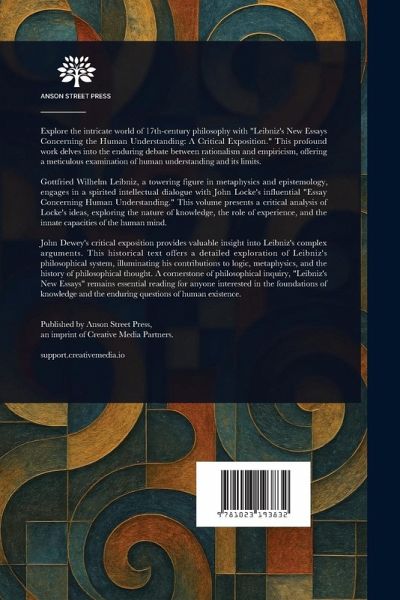
Explore the intricate world of 17th-century philosophy with "Leibniz's New Essays Concerning the Human Understanding: A Critical Exposition." This profound work delves into the enduring debate between rationalism and empiricism, offering a meticulous examination of human understanding and its limits. Gottfried Wilhelm Leibniz, a towering figure in metaphysics and epistemology, engages in a spirited intellectual dialogue with John Locke's influential "Essay Concerning Human Understanding." This volume presents a critical analysis of Locke's ideas, exploring the nature of knowledge, the role of…mehr
Explore the intricate world of 17th-century philosophy with "Leibniz's New Essays Concerning the Human Understanding: A Critical Exposition." This profound work delves into the enduring debate between rationalism and empiricism, offering a meticulous examination of human understanding and its limits. Gottfried Wilhelm Leibniz, a towering figure in metaphysics and epistemology, engages in a spirited intellectual dialogue with John Locke's influential "Essay Concerning Human Understanding." This volume presents a critical analysis of Locke's ideas, exploring the nature of knowledge, the role of experience, and the innate capacities of the human mind. John Dewey's critical exposition provides valuable insight into Leibniz's complex arguments. This historical text offers a detailed exploration of Leibniz's philosophical system, illuminating his contributions to logic, metaphysics, and the history of philosophical thought. A cornerstone of philosophical inquiry, "Leibniz's New Essays" remains essential reading for anyone interested in the foundations of knowledge and the enduring questions of human existence. This work has been selected by scholars as being culturally important, and is part of the knowledge base of civilization as we know it. This work is in the public domain in the United States of America, and possibly other nations. Within the United States, you may freely copy and distribute this work, as no entity (individual or corporate) has a copyright on the body of the work. Scholars believe, and we concur, that this work is important enough to be preserved, reproduced, and made generally available to the public. We appreciate your support of the preservation process, and thank you for being an important part of keeping this knowledge alive and relevant.
Leibniz's New Essays on Human UnderstandingJohn Dewey "HE who knows me only by my writings does not know me," said Leibniz. These words-true, indeed, of every writer, but true of Leibniz in a way which gives a peculiar interest and charm to his life-must be our excuse for prefacing what is to be said of his "New Essays concerning the Human Understanding" with a brief biographical sketch. Gottfried Wilhelm Leibniz was born in Leipzig June 21, 1646. His father, who died when Leibniz was only six years old, was a professor in the university and a notary of considerable practice. From him the future philosopher seems to have derived his extraordinary industry and love of detail. Such accounts as we have of him show no traces of the wonderful intellectual genius of his son, but only a diligent, plodding, faithful, and religious man, a thoroughly conscientious husband, jurist, and professor. Nor in the lines of physical heredity can we account for the unique career of Leibniz by his mother's endowments. The fact, however, that she was patient in all trial, living in peace with her neighbors, anxious for unity and concord with all people, even with those not well disposed to her, throws great light upon the fundamental trait of Leibniz's ethical nature. As in so many cases, it is the inherited moral characteristics which form the basis of the intellectual nature. The love of unity which was a moral trait in Leibniz's mother became in him the hunger for a harmonious and unified mental world the father's devotion to detail showed itself as the desire for knowledge as minute and comprehensive as it was inter-related. Left without his father, he was by the advice of a discerning friend allowed free access to the library. Leibniz never ceased to count this one of the greatest fortunes of his life. Writing in after years to a friend, he says:- "When I lost my father, and was left without any direction in my studies, I had the luck to get at books in all languages, of all religions, upon all sciences, and to read them without any regular order, just as my own impulse led me. From this I obtained the great advantage that I was freed from ordinary prejudices, and introduced to many things of which I should otherwise never have thought.
Es gelten unsere Allgemeinen Geschäftsbedingungen: www.buecher.de/agb
Impressum
www.buecher.de ist ein Internetauftritt der buecher.de internetstores GmbH
Geschäftsführung: Monica Sawhney | Roland Kölbl | Günter Hilger
Sitz der Gesellschaft: Batheyer Straße 115 - 117, 58099 Hagen
Postanschrift: Bürgermeister-Wegele-Str. 12, 86167 Augsburg
Amtsgericht Hagen HRB 13257
Steuernummer: 321/5800/1497
USt-IdNr: DE450055826