
Andere Kunden interessierten sich auch für
 Leonhard Euler and the Foundations of Celestial Mechanics113,99 €
 Position and Motion of Celestial Bodies61,99 €
 Theory of Orbits63,99 €
 Theory of Orbits75,99 €
 Theory of Orbits64,99 €
 Theory of Orbits67,99 €
 Albert Einstein-Italian Memories62,99 €
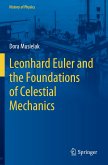


The intention of this book is to shine a bright light on the intellectual context of Euler's contributions to physics and mathematical astronomy. Leonhard Euler is one of the most important figures in the history of science, a blind genius who introduced mathematical concepts and many analytical tools to help us understand and describe the universe. Euler also made a monumental contribution to astronomy and orbital mechanics, developing what he called astronomia mechanica. Orbital mechanics of artificial satellites and spacecraft is based on Euler's analysis of astromechanics. However, previous books have often neglected many of his discoveries in this field. For example, orbital mechanics texts refer to the five equilibrium points in the Sun-Earth-Moon system as Lagrange points, failing to credit Euler who first derived the differential equations for the general n-body problem and who discovered the three collinear points in the three-body problem of celestial mechanics. These equilibrium points are essential today in space exploration; the James Webb Space Telescope (successor to the Hubble), for example, now orbits the Sun near L2, one of the collinear points of the Sun-Earth-Moon system, while future missions to study the universe will place observatories in orbit around Sun-Earth and Earth-Moon equilibrium points that should be properly called Euler-Lagrange points. In this book, the author uses Euler's memoirs, correspondence, and other scholarly sources to explore how he established the mathematical groundwork for the rigorous study of motion in our Solar System. The reader will learn how he studied comets and eclipses, derived planetary orbits, and pioneered the study of planetary perturbations, and how, old and blind, Euler put forward the most advanced lunar theory of his time.
"The book is very readable ... . The technical material is patiently explained while assuming little background in the field ... . general readers who are looking for math history popularization will find some enjoyable passages ... . Thankfully, thorough references ensure that the book could serve as a useful entry point to the literature." (Viktor Blåsjö, zbMATH 1509.01004, 2023)