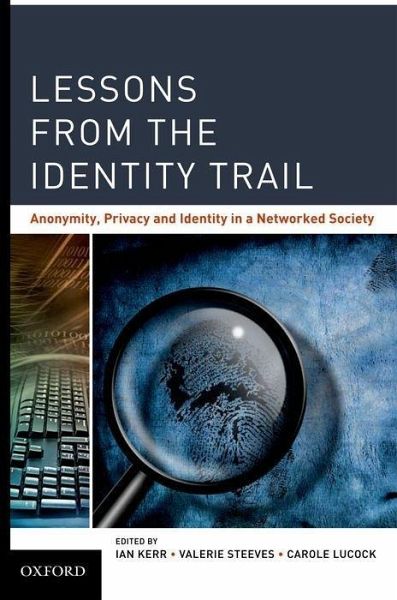
During the past decade, rapid developments in information and communications technology have transformed key social, commercial and political realities. Within that same time period, working at something less than internet speed, much of the academic and policy debates arising from these new and emerging technologies have been fragmented. There have been few examples of interdisciplinary dialogue about the potential for anonymity and privacy in a networked society. Lessons from the Identity Trail fills that gap, and examines key questions about anonymity, privacy and identity in an environment…mehr
During the past decade, rapid developments in information and communications technology have transformed key social, commercial and political realities. Within that same time period, working at something less than internet speed, much of the academic and policy debates arising from these new and emerging technologies have been fragmented. There have been few examples of interdisciplinary dialogue about the potential for anonymity and privacy in a networked society. Lessons from the Identity Trail fills that gap, and examines key questions about anonymity, privacy and identity in an environment that increasingly automates the collection of personal information and uses surveillance to reduce corporate and security risks.
Ian Kerr holds a three-way appointment in the Faculty of Law, the Faculty of Medicine and the Department of Philosophy at the University of Ottawa. Dr. Kerr teaches in the areas of moral philosophy and applied ethics, internet and ecommerce law, contract law and legal theory. He has published extensively in journals on ethical and legal aspects of digital copyright, automated electronic commerce, artificial intelligence, cybercrime, nanotechnology, internet regulation, ISP and intermediary liability, and online defamation. He is also the co-author of Managing the Law (Prentice Hall).
Inhaltsangabe
* PART 1: PRIVACY * Soft Surveillance, Hard Consent: The Law and Psychology of Engineering Consent * Approaches to Consent in Canadian Data Protection Law * Learning from Data Protection Law at the Nexus of Copyright and Privacy * A Heuristics Approach to Understanding Privacy-Protecting Behaviors in Digital Social Environments * Ubiquitous Computing and Spatial Privacy * Core Privacy: A Privacy for Predictive Data Mining * Privacy Versus National Security: Clarifying the Trade-Off * Privacy's Second Home: Building a New Home for Privacy under Section 15 of the Charter * What Have You Done for Me Lately? Reflections on Redeeming Privacy for Battered Women Genetic Technologies and Medicine: Privacy, Identity and Informed Consent * Reclaiming the Social Value of Privacy * * * PART II: IDENTITY * A Conceptual Analysis of Identity * Identity: Difference and Categorization * Identity Cards and Identity Romaticism * What's in a Name? Who Benefits from the Publication Ban in Sexual Assault Trials? * Life in the Fish Bowl: Feminist Interrogations of Webcamming * Ubiquitous Computing, Spatiality, and the Construction of Identity: Directions for Policy Response * Dignity and Selective Self-Presentation * The Internet of People? Reflections on the Future Regulation of Human-Implantable Radio Frequency Identification * Usig Biometrics to Re-Visualize the Canada-US Border * Soul Train: The New Surveillance in Popular Music * Exit Node Repudiation for Anonymity Networks * TrackMeNot: Resisting Surveillance in Web Search * * * PART III: ANONYMITY * Anonymity and the Law in the USA * Anonymity and the Law in the United Kingdom * Anonymity and the Law in Canada * Anonymity and the Law in the Netherlands * Anonymity and the Law in Italy
* PART 1: PRIVACY * Soft Surveillance, Hard Consent: The Law and Psychology of Engineering Consent * Approaches to Consent in Canadian Data Protection Law * Learning from Data Protection Law at the Nexus of Copyright and Privacy * A Heuristics Approach to Understanding Privacy-Protecting Behaviors in Digital Social Environments * Ubiquitous Computing and Spatial Privacy * Core Privacy: A Privacy for Predictive Data Mining * Privacy Versus National Security: Clarifying the Trade-Off * Privacy's Second Home: Building a New Home for Privacy under Section 15 of the Charter * What Have You Done for Me Lately? Reflections on Redeeming Privacy for Battered Women Genetic Technologies and Medicine: Privacy, Identity and Informed Consent * Reclaiming the Social Value of Privacy * * * PART II: IDENTITY * A Conceptual Analysis of Identity * Identity: Difference and Categorization * Identity Cards and Identity Romaticism * What's in a Name? Who Benefits from the Publication Ban in Sexual Assault Trials? * Life in the Fish Bowl: Feminist Interrogations of Webcamming * Ubiquitous Computing, Spatiality, and the Construction of Identity: Directions for Policy Response * Dignity and Selective Self-Presentation * The Internet of People? Reflections on the Future Regulation of Human-Implantable Radio Frequency Identification * Usig Biometrics to Re-Visualize the Canada-US Border * Soul Train: The New Surveillance in Popular Music * Exit Node Repudiation for Anonymity Networks * TrackMeNot: Resisting Surveillance in Web Search * * * PART III: ANONYMITY * Anonymity and the Law in the USA * Anonymity and the Law in the United Kingdom * Anonymity and the Law in Canada * Anonymity and the Law in the Netherlands * Anonymity and the Law in Italy
Es gelten unsere Allgemeinen Geschäftsbedingungen: www.buecher.de/agb
Impressum
www.buecher.de ist ein Internetauftritt der buecher.de internetstores GmbH
Geschäftsführung: Monica Sawhney | Roland Kölbl | Günter Hilger
Sitz der Gesellschaft: Batheyer Straße 115 - 117, 58099 Hagen
Postanschrift: Bürgermeister-Wegele-Str. 12, 86167 Augsburg
Amtsgericht Hagen HRB 13257
Steuernummer: 321/5800/1497
USt-IdNr: DE450055826