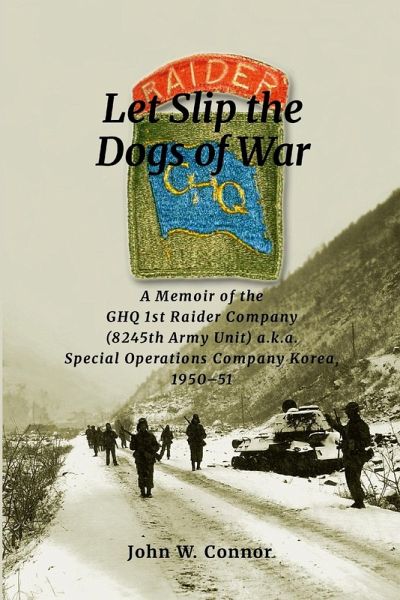
A few weeks after North Korea invaded South Korea, Gen. MacArthur authorized the creation of a Provisional Raider Co. to blow up bridges and railway tunnels behind enemy lines. Of 800 volunteers, 115 made the cut, enduring weeks of grueling training. Raiders went ashore at Inchon with the Marines, and X Corps at Wonsan. They conducted long-range intelligence-gathering patrols in which they also inserted and removed Korean agents. During the Chosin Reservoir campaign they took and held open the mountain passes for the withdrawal of the Marines and the 7th Division. The Raiders were evacuated…mehr
A few weeks after North Korea invaded South Korea, Gen. MacArthur authorized the creation of a Provisional Raider Co. to blow up bridges and railway tunnels behind enemy lines. Of 800 volunteers, 115 made the cut, enduring weeks of grueling training. Raiders went ashore at Inchon with the Marines, and X Corps at Wonsan. They conducted long-range intelligence-gathering patrols in which they also inserted and removed Korean agents. During the Chosin Reservoir campaign they took and held open the mountain passes for the withdrawal of the Marines and the 7th Division. The Raiders were evacuated from North Korea on 14 December 1950, and assigned anti-guerrilla activities in South Korea. At Chang-to they were cut off and surrounded by two North Korean regiments. On 1 April 1951, all Ranger and Special Operations units were disbanded because the army high command believed they were not being utilized properly. This is their story, as told by a member of the unit. Contents Dedication Preface Acknowledgements Introduction Prologue Childhood Basic Training Occupation Duty Camp McGill Kunsan Inchon and Kimpo North Korea Chosin Reservoir South Korea The Battle at Chang-To Business as Usual Deactivation Epilogue Afterword Appendices Bibliography 32 photos 7 documents
Ever hear of a young man who decided to abandon the dream assignment of a lifetime to jump into a thorn bush and then found that he also had to fight his way out? No? Well, I and 114 other young men did just that some fifty-seven years ago. Later, we would be asked, Why in the hell could we have done such a stupid damn thing? We could only answer that if you had known us at the time; it seemed like a perfectly natural thing to do. There were just 115 of us who volunteered, and not many more than that have ever heard of us. But in about seven months of almost continual fighting up and down the Korean peninsula in 1950-1951, we managed to accumulate four battle stars, a bronze arrowhead for a combat assault landing, Presidential Unit citations from both the U.S. Navy and the Republic of Korea, along with a special commendation from the commanding general of X Corps for imposing losses on the enemy far in excess of our own numbers. And so, how and why did we do it? Why would we abandon such a comfortable life to place ourselves in the middle of God knows what and where? Was it merely duty? It was that, and much more than that. We were also the product of our time. It was a time when Americans grew up feeling patriotic, proud, and extremely grateful to be living in a country that cherished freedom and such things as honor and love of country. All of us who fought in the Korean War were a product of that time and its values. They too have become the casualties of that forgotten war. So come along with me and discover how a group of men, reared in poverty, fattened by luxury during the occupation of Japan, and woefully ill-equipped, went on to fight and win one of the most brutal wars in U.S. military history.
Es gelten unsere Allgemeinen Geschäftsbedingungen: www.buecher.de/agb
Impressum
www.buecher.de ist ein Internetauftritt der buecher.de internetstores GmbH
Geschäftsführung: Monica Sawhney | Roland Kölbl | Günter Hilger
Sitz der Gesellschaft: Batheyer Straße 115 - 117, 58099 Hagen
Postanschrift: Bürgermeister-Wegele-Str. 12, 86167 Augsburg
Amtsgericht Hagen HRB 13257
Steuernummer: 321/5800/1497
USt-IdNr: DE450055826