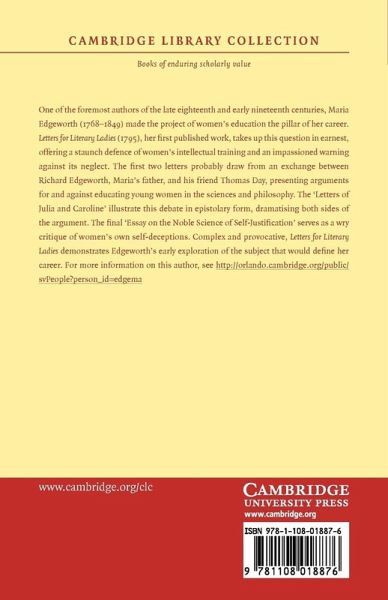
One of the foremost authors of the late eighteenth and early nineteenth centuries, Maria Edgeworth (1768-1849) made the project of women's education the pillar of her career. Letters for Literary Ladies (1795), her first published work, takes up this question in earnest, offering a staunch defence of women's intellectual training and an impassioned warning against its neglect. The first two letters likely draw from an exchange between Richard Edgeworth, Maria's father, and his friend Thomas Day, presenting arguments for and against educating young women in the sciences and philosophy. The…mehr
One of the foremost authors of the late eighteenth and early nineteenth centuries, Maria Edgeworth (1768-1849) made the project of women's education the pillar of her career. Letters for Literary Ladies (1795), her first published work, takes up this question in earnest, offering a staunch defence of women's intellectual training and an impassioned warning against its neglect. The first two letters likely draw from an exchange between Richard Edgeworth, Maria's father, and his friend Thomas Day, presenting arguments for and against educating young women in the sciences and philosophy. The 'Letters of Julia and Caroline' illustrate this debate in epistolary form, dramatising both sides of the argument. The final 'Essay on the Noble Science of Self-Justification' serves as a wry critique of women's own self-deceptions. Complex and provocative, Letters for Literary Ladies demonstrates Edgeworth's early exploration of the subject that would define her career.
Maria Edgeworth was an Irish novelist and educationalist, born in 1768, she is best known for her contributions to children's literature and her novels that explore social issues and moral themes, particularly in works like ""Tales and Novels."" This collection includes stories designed to impart moral lessons through engaging narratives, showcasing her belief in the importance of education and character development. Edgeworth's writing is characterized by its realism, wit, and keen observation of human behavior. Her most notable works, such as ""Castle Rackrent,"" employ innovative narrative techniques that reflect the complexities of Irish society. She often focused on themes of gender roles and the moral responsibilities of individuals within their communities. In addition to fiction, Edgeworth wrote essays on education and social reform, advocating for improved educational opportunities, especially for women. Her influence extended beyond her lifetime, and she remains an important figure in both Irish and British literature, celebrated for her insights into character and society.
Es gelten unsere Allgemeinen Geschäftsbedingungen: www.buecher.de/agb
Impressum
www.buecher.de ist ein Internetauftritt der buecher.de internetstores GmbH
Geschäftsführung: Monica Sawhney | Roland Kölbl | Günter Hilger
Sitz der Gesellschaft: Batheyer Straße 115 - 117, 58099 Hagen
Postanschrift: Bürgermeister-Wegele-Str. 12, 86167 Augsburg
Amtsgericht Hagen HRB 13257
Steuernummer: 321/5800/1497
USt-IdNr: DE450055826