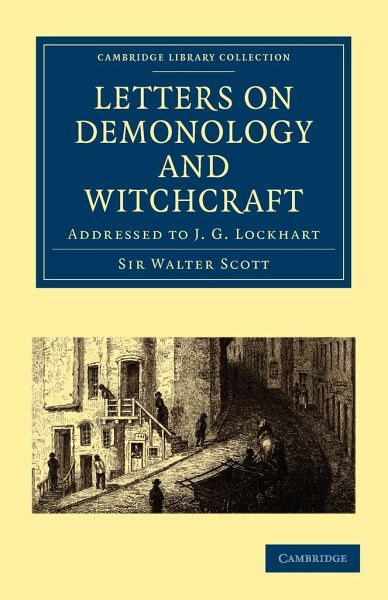
Sir Walter Scott (1771-1832) is best known for his poetry and for historical novels such as Ivanhoe and Rob Roy, but he also had a lifelong fascination with witchcraft and the occult. Following a spell of ill-health, Scott was encouraged by his son-in-law, publisher J. G. Lockhart, to put together a volume examining the causes of paranormal phenomena. This collection of letters, first published in 1830, is notable for both its scope (examining social, cultural, medical and psychological factors in peoples' paranormal experiences) and its clear, rational standpoint. Scott explores the influence…mehr
Sir Walter Scott (1771-1832) is best known for his poetry and for historical novels such as Ivanhoe and Rob Roy, but he also had a lifelong fascination with witchcraft and the occult. Following a spell of ill-health, Scott was encouraged by his son-in-law, publisher J. G. Lockhart, to put together a volume examining the causes of paranormal phenomena. This collection of letters, first published in 1830, is notable for both its scope (examining social, cultural, medical and psychological factors in peoples' paranormal experiences) and its clear, rational standpoint. Scott explores the influence of Christianity on evolving views of what is classified as 'witchcraft' or 'evil', and he explains the many (often innocuous) meanings of the word 'witch'. Written with palpable enthusiasm and from a strikingly modern perspective, this volume explores a range of topics including fairies, elves and fortune-telling as well as inquisitions and witch trials.
Sir Walter Scott, born on August 15, 1771, in Edinburgh, Scotland, was a seminal figure in the Romantic literature movement and is renowned for his contributions as a novelist, poet, and historian. His notable works include Ivanhoe, Rob Roy, and Waverley, which are celebrated for their vivid depictions of Scottish and European history. Scott's literary career began with translations and led to a revolution in historical writing that blended historical fact with fiction, greatly influencing both European and American literature.Educated as a lawyer, Scott's legal career intertwined with his writing; he served as a Clerk of Session and Sheriff-Depute of Selkirkshire, integrating his deep knowledge of Scottish culture and legal insights into his writing. He was also an active member of various scholarly societies in Edinburgh, contributing to his stature as a leading intellectual figure in Scottish society. His works not only entertain but provide insightful commentary on the social issues of his time, including the challenges of the Scottish Highlands and the preservation of Scottish cultural heritage.Scott's personal life was marked by a profound love for his homeland, which is evident in the detailed and affectionate portrayal of the Scottish landscape and traditions in his works. He married Charlotte Carpenter and had several children. Scott's literary legacy endures, with his innovations in the historical novel genre laying the groundwork for future writers and continuing to captivate readers around the world.
Inhaltsangabe
1. Origin of the general opinions respecting demonology among mankind 2. Consequence of the Fall on the communication between men and the spiritual world 3. Creed of Zoroaster 4. The fairy superstition is derived from different sources 5. Those who dealt in fortune-telling, mystical cures by charms, and the like, often claimed an intercourse with Fairy Land 6. Immediate effect of Christianity on articles of popular superstition 7. Penal laws unpopular when rigidly exercised 8. The effects of the witch superstition are to be traced in the laws of a kingdom 9. Scottish trials 10. Other mystic arts independent of witchcraft.
1. Origin of the general opinions respecting demonology among mankind 2. Consequence of the Fall on the communication between men and the spiritual world 3. Creed of Zoroaster 4. The fairy superstition is derived from different sources 5. Those who dealt in fortune-telling, mystical cures by charms, and the like, often claimed an intercourse with Fairy Land 6. Immediate effect of Christianity on articles of popular superstition 7. Penal laws unpopular when rigidly exercised 8. The effects of the witch superstition are to be traced in the laws of a kingdom 9. Scottish trials 10. Other mystic arts independent of witchcraft.
Es gelten unsere Allgemeinen Geschäftsbedingungen: www.buecher.de/agb
Impressum
www.buecher.de ist ein Internetauftritt der buecher.de internetstores GmbH
Geschäftsführung: Monica Sawhney | Roland Kölbl | Günter Hilger
Sitz der Gesellschaft: Batheyer Straße 115 - 117, 58099 Hagen
Postanschrift: Bürgermeister-Wegele-Str. 12, 86167 Augsburg
Amtsgericht Hagen HRB 13257
Steuernummer: 321/5800/1497
USt-IdNr: DE450055826