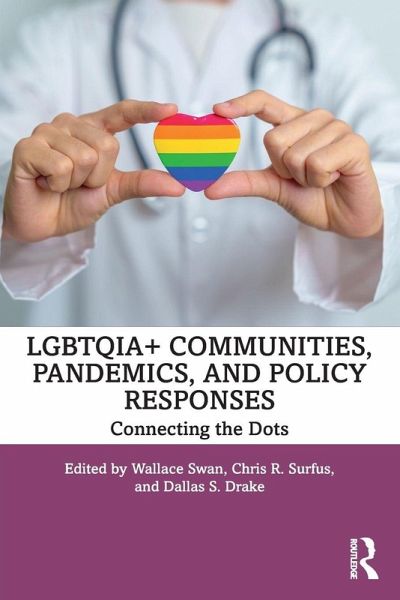
In this groundbreaking volume, editor Wallace Swan, and co-editors Chris R. Surfus, and Dallas S. Drake assemble an impressive collection of scholarly perspectives examining the complex relationship between LGBTQIA+ communities and public health crises.
In this groundbreaking volume, editor Wallace Swan, and co-editors Chris R. Surfus, and Dallas S. Drake assemble an impressive collection of scholarly perspectives examining the complex relationship between LGBTQIA+ communities and public health crises.
Wallace Swan - Contributing Faculty Member at Walden University, Minneapolis, United States, teaching the "Resource Development" and "Current Issues in Regional and Local Policy" courses in the MPA program. He is also a second member (qualitative methodology) on a doctoral student committee. His background includes teaching public policy; administrative ethics; public, private, and nonprofit finance; leadership; global transformational theory; and organization theory at Western International University, University of St. Thomas, Metropolitan State University, Nova Southeastern University, Hamline University, and University of Electronic Science and Technology of China. He held city-wide elected office at the Minneapolis Board of Estimate and Taxation (as the first openly gay citywide elected official). He currently serves as President of the Center for Homicide Research board. Swan is the Immediate Past Chair of the LGBT Advocacy Action Section of the American Society for Public Administration and is included in the 2021-2022 Marquis "Who's Who in America." He received the ASPA LGBT Advocacy Section Best Book Award for the book COVID-19, the LGBTQIA+ Community, and Public Policy (Routledge, 2023). Chris R. Surfus served as Faculty Specialist I of Public Administration at Western Michigan University's School of Public Affairs and Administration in the 2022-2023 academic year. Previously in the 2021-2022 academic year, Surfus was a Postdoctoral Research Associate at the University of New Hampshire's Institute on Disability in the National Institute on Disability, Independent Living and Rehabilitation Research (NIDILRR) federally funded Advanced Rehabilitation and Research Training (ARRT) program, where he researched the intersection of disability and LGBTIQ+ populations. Surfus holds a PhD in Public Administration, an MBA, an MPA, a Graduate Certificate in Nonprofit Leadership, and a Bachelor of Science in Business Administration (BSBA). He has 15 years of experience in nonprofit leadership, including as the Founding President of The Surfus Foundation, the Past Chairperson of the ASPA LGBT Advocacy Alliance, and the Past President of ASPA MICAP, in addition to serving in consultative capacities for a number of nonprofit organizations in West Michigan and advising local governments on diversity, equity, and inclusion. Dallas S. Drake is Senior Researcher at the Center for Homicide Research in Minneapolis, Minnesota, where his focus on homicide is viewed from a public health perspective. During this work, he has assisted law enforcement and families with reviews of active and cold case homicides. He is a member of the Wisconsin Homicide Investigators' Cold Case Review Team. His published works include two book chapters on LGBTQ+ populations and the COVID-19 pandemic and chapters in several academic books on LGBTQ+ homicide. He also published a groundbreaking research report about the rare phenomenon of necrophilia in an international volume. Drake was the 2013 recipient of the Carolyn Rebecca Block Award, for an "Outstanding Contribution to Homicide or Lethal Violence Research by a Practitioner." Before coming to homicide research, he worked as a professional firefighter for 22 years where he routinely responded to calls as an Emergency Medical Technician, assisting paramedics where he firsthand viewed the realities of America's healthcare system. During the AIDS pandemic, Drake was a public AIDS 101 trainer for the American Red Cross.
Inhaltsangabe
1. Pandemics unveiled: A comparative analysis 2. The policy process 3. The U.S. Census Household Pulse Survey and U.S. LGBTQ populations 4. Political attacks on the LGBTQIA+ community 5. Change is in the wind 6. The LGBTQIA+ experience of HIV/AIDS 7. The new HIV prevention medication: PrEP: An analysis of benefits and unintended consequences 8. The LGBTQIA+ experience of COVID-19 and Long-COVID-19 9. Mpox and emergent epidemiological threats facing the LGBTQIA+ community 10. Comparative political-bureaucratic response to pandemics: Social inequity in responses to three pandemics in the U.S. 11. The public health bureaucratic response 12. The policy and politics of public health funding 13. Intersectional health disparities in the LGBTQIA+ community 14. The transgender community: Data and disparities under COVID-19 and Mpox 15. The social/emotional role of LGBTQIA+ service organizations and safe spaces throughout pandemics 16. The role of nonprofits in pandemics: Supporting Pennsylvania's LGBTQ+ community 17. LGBTQ-specific public policy identification and implementation to combat public health pandemics 18. The challenge for the United States and the world
1. Pandemics unveiled: A comparative analysis 2. The policy process 3. The U.S. Census Household Pulse Survey and U.S. LGBTQ populations 4. Political attacks on the LGBTQIA+ community 5. Change is in the wind 6. The LGBTQIA+ experience of HIV/AIDS 7. The new HIV prevention medication: PrEP: An analysis of benefits and unintended consequences 8. The LGBTQIA+ experience of COVID-19 and Long-COVID-19 9. Mpox and emergent epidemiological threats facing the LGBTQIA+ community 10. Comparative political-bureaucratic response to pandemics: Social inequity in responses to three pandemics in the U.S. 11. The public health bureaucratic response 12. The policy and politics of public health funding 13. Intersectional health disparities in the LGBTQIA+ community 14. The transgender community: Data and disparities under COVID-19 and Mpox 15. The social/emotional role of LGBTQIA+ service organizations and safe spaces throughout pandemics 16. The role of nonprofits in pandemics: Supporting Pennsylvania's LGBTQ+ community 17. LGBTQ-specific public policy identification and implementation to combat public health pandemics 18. The challenge for the United States and the world
Es gelten unsere Allgemeinen Geschäftsbedingungen: www.buecher.de/agb
Impressum
www.buecher.de ist ein Internetauftritt der buecher.de internetstores GmbH
Geschäftsführung: Monica Sawhney | Roland Kölbl | Günter Hilger
Sitz der Gesellschaft: Batheyer Straße 115 - 117, 58099 Hagen
Postanschrift: Bürgermeister-Wegele-Str. 12, 86167 Augsburg
Amtsgericht Hagen HRB 13257
Steuernummer: 321/5800/1497
USt-IdNr: DE450055826