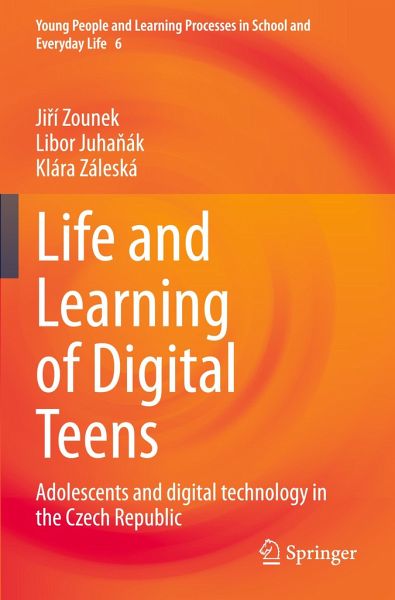
This book describes and explains how digital technologies enter adolescents' everyday life and learning in different contexts and environments. The book is based on research conducted in recent years in the Czech Republic, the results of which are set within a broad theoretical and international framework. The authors consider the theoretical and methodological anchoring of the topic, describing various approaches in an effort to comprehensively describe and understand the learning process of today's pupils. They focus on ways to explore learning in the digital era, domestication of digital…mehr
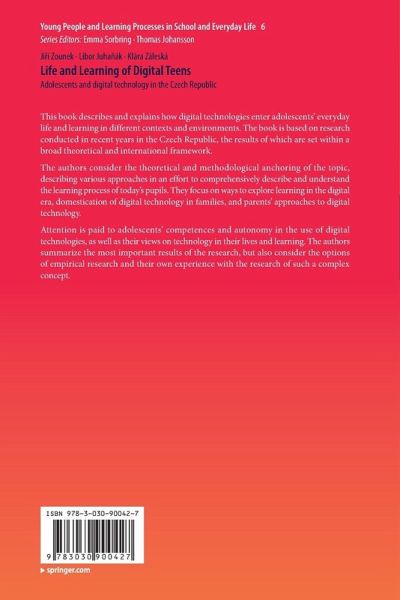
This book describes and explains how digital technologies enter adolescents' everyday life and learning in different contexts and environments. The book is based on research conducted in recent years in the Czech Republic, the results of which are set within a broad theoretical and international framework. The authors consider the theoretical and methodological anchoring of the topic, describing various approaches in an effort to comprehensively describe and understand the learning process of today's pupils. They focus on ways to explore learning in the digital era, domestication of digital technology in families, and parents' approaches to digital technology. Attention is paid to adolescents' competences and autonomy in the use of digital technologies, as well as their views on technology in their lives and learning. The authors summarize the most important results of the research, but also consider the options of empirical research and their own experience with the research of such a complex concept.
Produktdetails
Produktdetails
Young People and Learning Processes in School and Everyday Life 6
¿Ji¿í Zounek is an Associate Professor at the Department of Educational Sciences at the Faculty of Arts of Masaryk University, Czech Republic. For a long time, he has focused on the history of (Czech) pedagogy and the school system in the 20th century and on the use of digital technologies in education. Between 2020 and 2022, he was the main researcher in the research project Post-Socialist Transformation of Czech Primary Schools: Processes, Stories, Dilemmas. Between 2014 and 2016, he was the grantee of the research project Everyday life of basic schools in the normalization period as seen by teachers: Applying oral history to research in the history of contemporary education. He is a (co-)author of books about the history of Czech primary schools in communist Czechoslovakia. These include the monographs Normal Life in Not-So-Normal Times: Primary Schools and Their Teachers (Not Only) During the So-Called Normalization Period (2017) and Socialist Primary Schools as Seen by Eyewitnesses: Probing teachers' lives in the South Moravian Region (2017). He publishes in academic journals, such as Paedagogica Historica and History of Education. From 2017 to 2019, he was the main researcher on the research project Digital technologies in the everyday lives and learning of students (Czech Science Foundation, 17-06152S). He was a member of the large team responsible for the Czech National Strategy for Digital Education 2020. He publishes the results of his work in scientific journals and presents them at conferences such as the European Social Science History Conference, European Conference on Educational Research, and the International Conference of Education, Research, and Innovation. He is a member of the Czech Oral History Association and a member of the Czech Association of Educational Research (member of European Educational Research Association). He is also a member of the Science Advisory Board (SAB) of the vice rector for research at Masaryk University. Michal imán¿ is a graduate of the Department of Educational Sciences at the Faculty of Arts of Masaryk University, Czech Republic. He currently works as a head of the Department of Social Sciences and the deputy director of the Institute of Lifelong Learning at Mendel University in Brno, Czech Republic. His focus is on the history of pedagogy and education in the 19th and 20th centuries and on the problems of vocational education. Between 2019 and 2022, he was the main researcher in the research project Secondary Technical School in Socialist Czechoslovakia from the History of the Everyday Life Point of View: Oral History Interviews with Teachers. From 2014 to 2016, he was a member of the research team for the project Everyday life of basic schools in the normalization period as seen by teachers: Applying oral history to research in history of contemporary education. He is the author or co-author of several books on the history of Czechoslovak education in the interwar period and in the socialist period. These include the monographs C Secondary Technical Schools in Czechoslovakia During the Communist Era: Everyday Life from the Perspective of Teachers in South Moravian Region (2023), Czech Minority Education in the Czechoslovak Republic. To the Everyday Life of Primary Schools in Political District Ústí nad Labem (2019), Normal Life in Not-So-Normal Times: Primary Schools and Their Teachers (Not Only) During the So-Called Normalization Period (2017), and Socialist Primary School as Seen by Eyewitnesses: Probing teachers' lives in the South Moravian Region (2017). He regularly publishes in academic journals, such as Paedagogica Historica, History of Education, and Communist and Post-Communist Studies. He is on the editorial board of several academic journals.&a
Inhaltsangabe
Preface.- 1. Digital technologies and learning across a variety of contexts and environments.- 2. New challenges for educational research in the digital era.- 3. Education, life, and digital technologies in the Czech Republic: the story of a post-socialist country in Central Europe.- Part I: Teens and digital technologies in the school context.- 4. Teachers and their use of digital technologies in school.- 5. Availability and use of digital technologies in relation to students' school performance.- Part II Teens and digital technologies in the family/home context.- 6. Differences in the use of digital technologies by young people based on family characteristics.- 7. Ambivalent parental relationships to digital technologies.- Part III Teens and digital technologies in everyday life.- 8. Young people and the development of digital competence and autonomy.- 9. The life of today's teens: with and without digital technologies.- Conclusion.
Preface.- 1. Digital technologies and learning across a variety of contexts and environments.- 2. New challenges for educational research in the digital era.- 3. Education, life, and digital technologies in the Czech Republic: the story of a post-socialist country in Central Europe.- Part I: Teens and digital technologies in the school context.- 4. Teachers and their use of digital technologies in school.- 5. Availability and use of digital technologies in relation to students' school performance.- Part II Teens and digital technologies in the family/home context.- 6. Differences in the use of digital technologies by young people based on family characteristics.- 7. Ambivalent parental relationships to digital technologies.- Part III Teens and digital technologies in everyday life.- 8. Young people and the development of digital competence and autonomy.- 9. The life of today's teens: with and without digital technologies.- Conclusion.
Es gelten unsere Allgemeinen Geschäftsbedingungen: www.buecher.de/agb
Impressum
www.buecher.de ist ein Internetauftritt der buecher.de internetstores GmbH
Geschäftsführung: Monica Sawhney | Roland Kölbl | Günter Hilger
Sitz der Gesellschaft: Batheyer Straße 115 - 117, 58099 Hagen
Postanschrift: Bürgermeister-Wegele-Str. 12, 86167 Augsburg
Amtsgericht Hagen HRB 13257
Steuernummer: 321/5800/1497
USt-IdNr: DE450055826