

Andere Kunden interessierten sich auch für
 Linear and Nonlinear Programming83,99 €
 Introduction to Applied Optimization38,99 €
 Foundations of Optimization46,99 €
 Foundations of Optimization46,99 €
 Introduction to Nonlinear and Global Optimization38,99 €
 Numerical Optimization49,99 €
 Combinatorial, Linear, Integer and Nonlinear Optimization Apps42,99 €
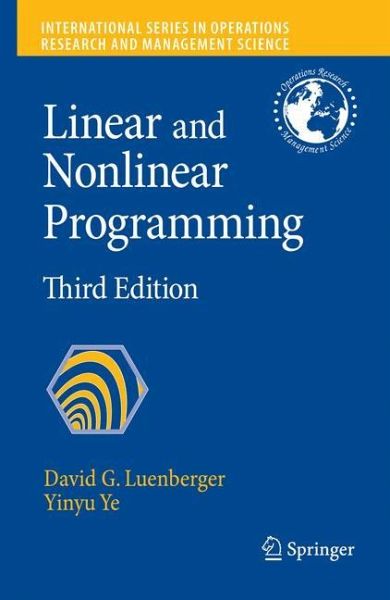
This third edition of the classic textbook in Optimization has been fully revised and updated. It comprehensively covers modern theoretical insights in this crucial computing area, and will be required reading for analysts and operations researchers in a variety of fields. The book connects the purely analytical character of an optimization problem, and the behavior of algorithms used to solve it. Now, the third edition has been completely updated with recent Optimization Methods. The book also has a new co-author, Yinyu Ye of California's Stanford University, who has written lots of extra material including some on Interior Point Methods.
"Linear and Nonlinear Programming" is considered a classic textbook in Optimization. While it is a classic, it also reflects modern theoretical insights. These insights provide structure to what might otherwise be simply a collection of techniques and results, and this is valuable both as a means for learning existing material and for developing new results. One major insight of this type is the connection between the purely analytical character of an optimization problem, expressed perhaps by properties of the necessary conditions, and the behavior of algorithms used to solve a problem. This was a major theme of the first and second editions. Now the third edition has been completely updated with recent Optimization Methods. The new co-author, Yinyu Ye, has written chapters and chapter material on a number of these areas including Interior Point Methods.
"Linear and Nonlinear Programming" is considered a classic textbook in Optimization. While it is a classic, it also reflects modern theoretical insights. These insights provide structure to what might otherwise be simply a collection of techniques and results, and this is valuable both as a means for learning existing material and for developing new results. One major insight of this type is the connection between the purely analytical character of an optimization problem, expressed perhaps by properties of the necessary conditions, and the behavior of algorithms used to solve a problem. This was a major theme of the first and second editions. Now the third edition has been completely updated with recent Optimization Methods. The new co-author, Yinyu Ye, has written chapters and chapter material on a number of these areas including Interior Point Methods.
From the reviews of the second edition:
"I have profitably used the book to apply constrained minimization procedures in the field of computational contact mechanics. I think it is not a secret that quite often books on mathematics are written from mathematicians for mathematicians. Hence it is quite hard for engineers to read and to extract valuable information from them. With this respect this book is a shining star. It presents the topics in a very precise but clear and understandable way." -- Giorgio Azvaris, Turin, Italy
"I have the 1977 edition from my father's MIT days. I am a Mathematician and I can verify that the book written in 1977 is of the same style that good books have today. A book is not made obsolete because some new "elegant" terms arise." -- A reader from Greece
"In this second edition ... David Luenberger focuses on practical optimization techniques. ... the book would be appropriate for graduate students or for self-study by professionals. ... I recommend the book for those who are familiar with elements of linear algebra ... . The book concludes with three short appendices ... and a bibliography and a short index. ... is intended for those who want to look deeply into optimization techniques, linear and nonlinear. ... will be useful to researchers, engineers, and graduate students." -- Sergio Ubeda, Interfaces, Vol. 37 (1), 2007
"I have profitably used the book to apply constrained minimization procedures in the field of computational contact mechanics. I think it is not a secret that quite often books on mathematics are written from mathematicians for mathematicians. Hence it is quite hard for engineers to read and to extract valuable information from them. With this respect this book is a shining star. It presents the topics in a very precise but clear and understandable way." -- Giorgio Azvaris, Turin, Italy
"I have the 1977 edition from my father's MIT days. I am a Mathematician and I can verify that the book written in 1977 is of the same style that good books have today. A book is not made obsolete because some new "elegant" terms arise." -- A reader from Greece
"In this second edition ... David Luenberger focuses on practical optimization techniques. ... the book would be appropriate for graduate students or for self-study by professionals. ... I recommend the book for those who are familiar with elements of linear algebra ... . The book concludes with three short appendices ... and a bibliography and a short index. ... is intended for those who want to look deeply into optimization techniques, linear and nonlinear. ... will be useful to researchers, engineers, and graduate students." -- Sergio Ubeda, Interfaces, Vol. 37 (1), 2007