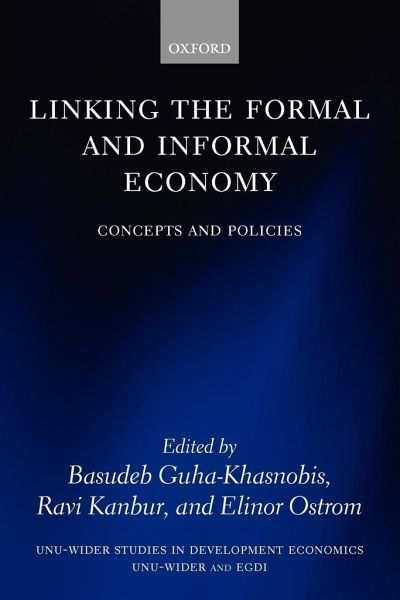
The concepts of formal and informal remain central to the theory and practice of development more than half a century after they were introduced into the debate. They help structure the way that statistical services collect data on the economies of developing countries, the development of theoretical and empirical analysis, and, most important, the formulation and implementation of policy. This volume brings together a significant new collection of studies on formality and informality in developing countries. The volume is multidisciplinary in nature, with contributions from anthropologists,…mehr
The concepts of formal and informal remain central to the theory and practice of development more than half a century after they were introduced into the debate. They help structure the way that statistical services collect data on the economies of developing countries, the development of theoretical and empirical analysis, and, most important, the formulation and implementation of policy. This volume brings together a significant new collection of studies on formality and informality in developing countries. The volume is multidisciplinary in nature, with contributions from anthropologists, economists, sociologists, and political scientists. It contains contributions from among the very best analysts in development studies. Between them the chapters argue for moving beyond the formal-informal dichotomy. Useful as it has proven to be, a more nuanced approach is needed in light of conceptual and empirical advances, and in light of the policy failures brought about by a characterization of the 'informal' as 'disorganized'. The wealth of empirical information in these studies, and in the literature more widely, can be used to develop guiding principles for intervention that are based on ground level reality.
Basudeb Guha-Khasnobis is a Senior Research Fellow at UNU-WIDER. He is a PhD from the University of Rochester and worked for IGIDR (Mumbai), ICRIER (New Delhi) and The Exim Bank of India. His research interests include international economics, development economics and financial economics. Ravi Kanbur is T.H. Lee Professor of World Affairs, International Professor of Applied Economics and Management, and Professor of Economics at Cornell University, and previously Professor of Economics at the University of Warwick, and Chief Economist for Africa at the World Bank. Elinor Ostrom was Arthur F. Bentley Professor of Political Science at Indiana University. She was also Co-Director, Workshop in Political Theory and Policy Analysis and Co-Director, Center for the Study of Institutions, Population and Environmental Change (CIPEC) at Indiana University. She was a member of the Expert Group on Development Issues of the Swedish Ministry for Foreign Affairs.
Inhaltsangabe
* 1: Basudeb Guha-Khasnobis, Ravi Kanbur, and Elinor Ostrom: Beyond Formality and Informality * Concepts and Measurement * 2: Keith Hart: Bureaucratic Form and the Informal Economy * 3: Robert K. Christensen: The Global Path: Soft Law and Non-sovereigns Formalizing the Potency of the Informal Sector * 4: Alice Sindzingre: The Relevance of the Concepts of Formality and Informality: A Theoretical Appraisal * 5: Martha Alter Chen: Rethinking the Informal Economy: Linkages with the Formal Economy and the Formal Regulatory Environment * 6: M. R. Narayana: Formal and Informal Enterprises: Concept, Definition, and Measurement Issues in India * Empirical Studies of Policies and Interlinking * 7: Norman V. Loayza, Ana MarÃa Oviedo, and Luis ServÃ(c)n: The Impact of Regulation on Growth and Informality: Cross-Country Evidence * 8: Robert Lensink, Mark McGillivray, and Pham Thi Thu Trà : Financial Liberalization in Vietnam: Impact on Loans from Informal, Formal, and Semi-formal Providers * 9: Fredrik Söderbaum: Blocking Human Potential: How Formal Policies Block the Informal Economy in the Maputo Corridor * 10: Basudeb Guha-Khasnobis and Rajeev Ahuja: Microinsurance for the Informal Economy Workers in India * 11: Krister Andersson and Diego Pacheco: Turning to Forestry for a Way Out of Poverty: Is Formalizing Property Rights Enough? * 12: Jeffrey B. Nugent and Shailender Swaminathan: Voluntary Contributions to Informal Activities Producing Public Goods: Can These be Induced by Government and other Formal Sector Agents? Some Evidence from Indonesian Posyandus * 13: Amos Sawyer: Social Capital, Survival Strategies, and their Potential for Post-Conflict Governance in Liberia * 14: Sally Roever: Enforcement and Compliance in Lima's Street Markets: The Origins and Consequences of Policy Incoherence Toward Informal Traders * 15: Liz Alden Wily: Formalizing the Informal: Is There a Way to Safely Unlock Human Potential Through Land Entitlement? A Review of Changing Land Administration in Africa
* 1: Basudeb Guha-Khasnobis, Ravi Kanbur, and Elinor Ostrom: Beyond Formality and Informality * Concepts and Measurement * 2: Keith Hart: Bureaucratic Form and the Informal Economy * 3: Robert K. Christensen: The Global Path: Soft Law and Non-sovereigns Formalizing the Potency of the Informal Sector * 4: Alice Sindzingre: The Relevance of the Concepts of Formality and Informality: A Theoretical Appraisal * 5: Martha Alter Chen: Rethinking the Informal Economy: Linkages with the Formal Economy and the Formal Regulatory Environment * 6: M. R. Narayana: Formal and Informal Enterprises: Concept, Definition, and Measurement Issues in India * Empirical Studies of Policies and Interlinking * 7: Norman V. Loayza, Ana MarÃa Oviedo, and Luis ServÃ(c)n: The Impact of Regulation on Growth and Informality: Cross-Country Evidence * 8: Robert Lensink, Mark McGillivray, and Pham Thi Thu Trà : Financial Liberalization in Vietnam: Impact on Loans from Informal, Formal, and Semi-formal Providers * 9: Fredrik Söderbaum: Blocking Human Potential: How Formal Policies Block the Informal Economy in the Maputo Corridor * 10: Basudeb Guha-Khasnobis and Rajeev Ahuja: Microinsurance for the Informal Economy Workers in India * 11: Krister Andersson and Diego Pacheco: Turning to Forestry for a Way Out of Poverty: Is Formalizing Property Rights Enough? * 12: Jeffrey B. Nugent and Shailender Swaminathan: Voluntary Contributions to Informal Activities Producing Public Goods: Can These be Induced by Government and other Formal Sector Agents? Some Evidence from Indonesian Posyandus * 13: Amos Sawyer: Social Capital, Survival Strategies, and their Potential for Post-Conflict Governance in Liberia * 14: Sally Roever: Enforcement and Compliance in Lima's Street Markets: The Origins and Consequences of Policy Incoherence Toward Informal Traders * 15: Liz Alden Wily: Formalizing the Informal: Is There a Way to Safely Unlock Human Potential Through Land Entitlement? A Review of Changing Land Administration in Africa
Es gelten unsere Allgemeinen Geschäftsbedingungen: www.buecher.de/agb
Impressum
www.buecher.de ist ein Internetauftritt der buecher.de internetstores GmbH
Geschäftsführung: Monica Sawhney | Roland Kölbl | Günter Hilger
Sitz der Gesellschaft: Batheyer Straße 115 - 117, 58099 Hagen
Postanschrift: Bürgermeister-Wegele-Str. 12, 86167 Augsburg
Amtsgericht Hagen HRB 13257
Steuernummer: 321/5800/1497
USt-IdNr: DE450055826