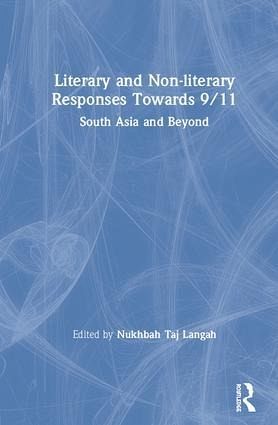
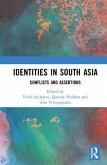
This book presents a range of analytical responses towards 9/11 through a critical review of literary, non-literary and cultural representations. The contributors examine the ways in which this event has shaped and complicated the relationship between various national and religious identities in contemporary world history. Unlike earlier studies on the topic, this work reconciles both eclectic and pragmatic approaches by analyzing the stereotypes of nationhood and identities while also questioning theoretical concepts in the context of the latest political developments. ,The chapters focus on…mehr
This book presents a range of analytical responses towards 9/11 through a critical review of literary, non-literary and cultural representations. The contributors examine the ways in which this event has shaped and complicated the relationship between various national and religious identities in contemporary world history. Unlike earlier studies on the topic, this work reconciles both eclectic and pragmatic approaches by analyzing the stereotypes of nationhood and identities while also questioning theoretical concepts in the context of the latest political developments. ,The chapters focus on discourses, themes, imagery and symbolism from across fiction and non-fiction, films, art, music, and political, literary and artistic movements. The volume addresses complexities arising within different local contexts (e.g., Hunza and state development); surveys broader frameworks in South Asia (representations of Muslims in Bollywood films); and gauges international impact (U.S. drone attacks in Islamic countries; treatment meted out to Muslims in Europe). It also connects these with relevant theories (e.g., Orientalism) and policy perspectives (e.g., Patriotic Act). The authors further discuss the consequences for minorities and marginalization, cultural relativism vs. ethnocentrism, the clash of civilizations, fundamentalism, Islamization and post-9/11 'Islamophobia'. ,This book will be useful to scholars and researchers of South Asian literature, Islamic studies, literary criticism, political sociology, anthropology and cultural studies, those in the media and the general reader.
Nukhbah Taj Langah is Associate Professor of English and Dean of Humanities, Forman Christian College University, Lahore, Pakistan. She specializes in contemporary resistance literature from South Asia. Her publications include Poetry as Resistance: Islam and Ethnicity in Postcolonial Pakistan (2011) and Poems: Noshi Gillani (co-translated with Lavinia Greenlaw, 2008). She is a freelance translator, a political activist, and a proponent of interdisciplinary approaches in postcolonial studies through pedagogical approaches and academic research. She was selected as a Charles Wallace Fellow at School of Oriental and African Studies in 2018.
Inhaltsangabe
Introduction. PART I: Post-9/11 Clash of Civilizations 1. The Discourse after 9/11: Cultural Relativism vs. Ethnocentrism 2. Orientalist: Friend or Foe? PART II: Post-9/11 Literary Genres vs. Policies 3. Contrasts and Reflections: Critiques of 9/11 Policies and Reflections in English Literature 4. Why They Hate Us: The Rise of Fundamentalism After 9/11 5. Islamization and post-9/11 'Islamophobia': 'The Power of Genre' - a response from Pakistani writers. PART III: Bollywood, Drones and Images 6. Drones, State of Exception and Truck Art 7. Bollywood Audio-Visual Responses Towards 9/11 Through Kurbaan and My Name Is Khan. PART IV: Who else is marginalized? 8. Un-vanishing Angularities: placing Pakistani Christians in third-millennium Cultural Texts 9. Visualizing Hunza Post-9/11: Indeterminate State Development 10. Pakistan's Traditional Muslim Scholars and the West Post-9/11. Conclusion
Introduction. PART I: Post-9/11 Clash of Civilizations 1. The Discourse after 9/11: Cultural Relativism vs. Ethnocentrism 2. Orientalist: Friend or Foe? PART II: Post-9/11 Literary Genres vs. Policies 3. Contrasts and Reflections: Critiques of 9/11 Policies and Reflections in English Literature 4. Why They Hate Us: The Rise of Fundamentalism After 9/11 5. Islamization and post-9/11 'Islamophobia': 'The Power of Genre' - a response from Pakistani writers. PART III: Bollywood, Drones and Images 6. Drones, State of Exception and Truck Art 7. Bollywood Audio-Visual Responses Towards 9/11 Through Kurbaan and My Name Is Khan. PART IV: Who else is marginalized? 8. Un-vanishing Angularities: placing Pakistani Christians in third-millennium Cultural Texts 9. Visualizing Hunza Post-9/11: Indeterminate State Development 10. Pakistan's Traditional Muslim Scholars and the West Post-9/11. Conclusion
Es gelten unsere Allgemeinen Geschäftsbedingungen: www.buecher.de/agb
Impressum
www.buecher.de ist ein Internetauftritt der buecher.de internetstores GmbH
Geschäftsführung: Monica Sawhney | Roland Kölbl | Günter Hilger
Sitz der Gesellschaft: Batheyer Straße 115 - 117, 58099 Hagen
Postanschrift: Bürgermeister-Wegele-Str. 12, 86167 Augsburg
Amtsgericht Hagen HRB 13257
Steuernummer: 321/5800/1497
USt-IdNr: DE450055826