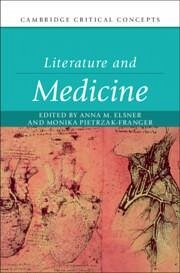
Literature and Medicine considers how these two dynamic fields have crossed over, and how they have developed alongside one another. It covers a broad spectrum of conceptual, thematic, theoretical, and methodological approaches that provide a solid foundation for understanding a vibrant interdisciplinary field.
Literature and Medicine considers how these two dynamic fields have crossed over, and how they have developed alongside one another. It covers a broad spectrum of conceptual, thematic, theoretical, and methodological approaches that provide a solid foundation for understanding a vibrant interdisciplinary field.
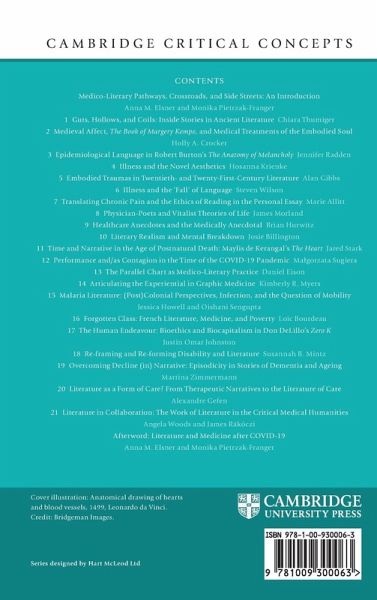
Part I. Origins: Histories: 1. Guts, hollows, and coils: Inside stories in ancient literature Chiara Thumiger; 2. Medieval affect, the book of Margery Kempe, and medical treatments of the embodied Self Holly A. Crocker; 3. Epidemiological language in Robert Burton's the anatomy of melancholy Jennifer Radden; 4. Illness and the novel aesthetics Hosanna Krienke; 5. Embodies traumas in twentieth and twenty-first century literature Alan Gibbs; Part II. Developments: Forms: 6. Illness and the 'fall' of language Steven Wilson; 7. Translating chronic pain and the ethics of reading in the personal essay Marie Allitt; 8. Physician-poets and vitalist theories of life James Morland; 9. Healthcare anecdotes and the medically anecdotal Brian Hurwitz; 10. Literary realism and mental breakdown Josie Billington; 11. Time and narrative in the age of postnatural death: Maylis de Kerangal's the heart Jared Stark; 12. Performance and/as contagion in the time of the COVID-19 pandemic Mägorzata Sugiera; 13. The parallel chart as medico-literary practice Daniel Eison; 14. Articulating the experiential in graphic medicine Kimberly R. Myers; Part III. Applications: Politics: 15. Malaria literature: (Post) colonial perspectives, infection, and the question of mobility Jessica Howell and Oishani Sengupta; 16. Forgotten class: French literature, medicine, and poverty Loïc Bourdeau; 17. The human endeavor: bioethics and biocapitalism in Don DeLillo's Zero K Justin Omar Johnston; 18. Re-framing and Re-forming disability and literature Susannah B. Mintz; 19. Overcoming decline (in) Narrative: Epdisodicity in stories of dementia and ageing Martina Zimmermann; 20. Literature as a form of care? From therapeutic narratives to the literature of care Alexandre Gefen; 21. Literature in collaboration: The work of literature in the critical medical humanities Angela Woods and James Rákóczi; Afterword: Medicine and literature after COVID-19 Anna M. Elsner and Monika Pietrzak-Franger.
Part I. Origins: Histories: 1. Guts, hollows, and coils: Inside stories in ancient literature Chiara Thumiger; 2. Medieval affect, the book of Margery Kempe, and medical treatments of the embodied Self Holly A. Crocker; 3. Epidemiological language in Robert Burton's the anatomy of melancholy Jennifer Radden; 4. Illness and the novel aesthetics Hosanna Krienke; 5. Embodies traumas in twentieth and twenty-first century literature Alan Gibbs; Part II. Developments: Forms: 6. Illness and the 'fall' of language Steven Wilson; 7. Translating chronic pain and the ethics of reading in the personal essay Marie Allitt; 8. Physician-poets and vitalist theories of life James Morland; 9. Healthcare anecdotes and the medically anecdotal Brian Hurwitz; 10. Literary realism and mental breakdown Josie Billington; 11. Time and narrative in the age of postnatural death: Maylis de Kerangal's the heart Jared Stark; 12. Performance and/as contagion in the time of the COVID-19 pandemic Mägorzata Sugiera; 13. The parallel chart as medico-literary practice Daniel Eison; 14. Articulating the experiential in graphic medicine Kimberly R. Myers; Part III. Applications: Politics: 15. Malaria literature: (Post) colonial perspectives, infection, and the question of mobility Jessica Howell and Oishani Sengupta; 16. Forgotten class: French literature, medicine, and poverty Loïc Bourdeau; 17. The human endeavor: bioethics and biocapitalism in Don DeLillo's Zero K Justin Omar Johnston; 18. Re-framing and Re-forming disability and literature Susannah B. Mintz; 19. Overcoming decline (in) Narrative: Epdisodicity in stories of dementia and ageing Martina Zimmermann; 20. Literature as a form of care? From therapeutic narratives to the literature of care Alexandre Gefen; 21. Literature in collaboration: The work of literature in the critical medical humanities Angela Woods and James Rákóczi; Afterword: Medicine and literature after COVID-19 Anna M. Elsner and Monika Pietrzak-Franger.
Es gelten unsere Allgemeinen Geschäftsbedingungen: www.buecher.de/agb
Impressum
www.buecher.de ist ein Internetauftritt der buecher.de internetstores GmbH
Geschäftsführung: Monica Sawhney | Roland Kölbl | Günter Hilger
Sitz der Gesellschaft: Batheyer Straße 115 - 117, 58099 Hagen
Postanschrift: Bürgermeister-Wegele-Str. 12, 86167 Augsburg
Amtsgericht Hagen HRB 13257
Steuernummer: 321/5800/1497
USt-IdNr: DE450055826