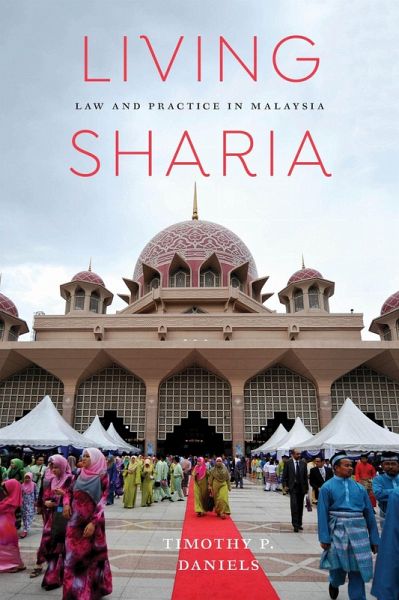
Drawing on ethnographic research, Living Sharia examines the role of sharia in the sociopolitical processes of contemporary Malaysia. The book traces the contested implementation of Islamic family and criminal laws and sharia economics to provide cultural frameworks for understanding sharia among Muslims and non-Muslims. Timothy Daniels explores how the way people think about sharia is often entangled with notions about race, gender equality, nationhood, liberal pluralism, citizenship, and universal human rights. He reveals that Malaysians' ideas about sharia are not isolated from-nor always…mehr
Drawing on ethnographic research, Living Sharia examines the role of sharia in the sociopolitical processes of contemporary Malaysia. The book traces the contested implementation of Islamic family and criminal laws and sharia economics to provide cultural frameworks for understanding sharia among Muslims and non-Muslims. Timothy Daniels explores how the way people think about sharia is often entangled with notions about race, gender equality, nationhood, liberal pluralism, citizenship, and universal human rights. He reveals that Malaysians' ideas about sharia are not isolated from-nor always opposed to-liberal pluralism and secularism. Living Sharia will be of interest to scholars as well as to policy makers, consultants, and professionals working with global NGOs.
Timothy P. Daniels is associate professor in anthropology at Hofstra University. He is the author of Performance, Popular Culture, and Piety in Muslim Southeast Asia (Palgrave Macmillan, 2013), Islamic Spectrum in Java (Ashgate, 2009), and Building Cultural Nationalism in Malaysia: Identity, Representation, and Citizenship (Routledge, 2005).
Inhaltsangabe
Acknowledgments Note on Transcription Chronology Introduction: Sharia and the Anthropology of Knowledge 1. Sharia in Malaysia: The Historical Background 2. Family Law: Religious Officials, Reasoning Style, and Controversies 3. Criminal Law: Taking the Middle Road 4. Economics: The Malaysian State, Darul Arqam, and the Islamic Party of Malaysia 5. Pro-Sharia Discourses: Race, Religion, and Nation 6. Contra-Sharia Discourses: Islamic and Secular Human Rights 7. Individuals: Views, Voices, and Practices Conclusion: Sharia Cultural Models and Sociopolitical Projects Notes Glossary References Index
Es gelten unsere Allgemeinen Geschäftsbedingungen: www.buecher.de/agb
Impressum
www.buecher.de ist ein Internetauftritt der buecher.de internetstores GmbH
Geschäftsführung: Monica Sawhney | Roland Kölbl | Günter Hilger
Sitz der Gesellschaft: Batheyer Straße 115 - 117, 58099 Hagen
Postanschrift: Bürgermeister-Wegele-Str. 12, 86167 Augsburg
Amtsgericht Hagen HRB 13257
Steuernummer: 321/5800/1497
USt-IdNr: DE450055826