
Andere Kunden interessierten sich auch für
 Lna-Esd Co-Design for Fully Integrated CMOS Wireless Receivers158,99 €
 High-Speed Photodiodes in Standard CMOS Technology102,99 €
 High-Speed Photodiodes in Standard CMOS Technology76,99 €
 CMOS Multichannel Single-Chip Receivers for Multi-Gigabit Optical Data Communications76,99 €
 Modeling and Simulation for RF System Design158,99 €
 Wideband Low Noise Amplifiers Exploiting Thermal Noise Cancellation106,99 €
 Microwave Electronic Devices115,99 €
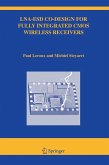
LNA-ESD Co-Design for Fully Integrated CMOS Wireless Receivers fits in the quest for complete CMOS integration of wireless receiver front-ends. With a combined discussion of both RF and ESD performance, it tackles one of the final obstacles on the road to CMOS integration. The book is conceived as a design guide for those actively involved in the design of CMOS wireless receivers.
The book starts with a comprehensive introduction to the performance requirements of low-noise amplifiers in wireless receivers. Several popular topologies are explained and compared with respect to future technology and frequency scaling. The ESD requirements are introduced and related to the state-of-the-art protection devices and circuits.
LNA-ESD Co-Design for Fully Integrated CMOS Wireless Receivers provides an extensive theoretical treatment of the performance of CMOS low-noise amplifiers in the presence of ESD-protection circuitry. The influence of the ESD-protection parasitics on noise figure, gain, linearity, and matching are investigated. Several RF-ESD co-design solutions are discussed allowing both high RF-performance and good ESD-immunity for frequencies up to and beyond 5 GHz. Special attention is also paid to the layout of both active and passive components.
LNA-ESD Co-Design for Fully Integrated CMOS Wireless Receivers offers the reader intuitive insight in the LNA's behavior, as well as the necessary mathematical background to optimize its performance. All material is experimentally verified with several CMOS implementations, among which a fully integrated GPS receiver front-end. The book is essential reading for RF design engineers and researchers in the field and is also suitable as a text book for an advanced course on the subject.
The book starts with a comprehensive introduction to the performance requirements of low-noise amplifiers in wireless receivers. Several popular topologies are explained and compared with respect to future technology and frequency scaling. The ESD requirements are introduced and related to the state-of-the-art protection devices and circuits.
LNA-ESD Co-Design for Fully Integrated CMOS Wireless Receivers provides an extensive theoretical treatment of the performance of CMOS low-noise amplifiers in the presence of ESD-protection circuitry. The influence of the ESD-protection parasitics on noise figure, gain, linearity, and matching are investigated. Several RF-ESD co-design solutions are discussed allowing both high RF-performance and good ESD-immunity for frequencies up to and beyond 5 GHz. Special attention is also paid to the layout of both active and passive components.
LNA-ESD Co-Design for Fully Integrated CMOS Wireless Receivers offers the reader intuitive insight in the LNA's behavior, as well as the necessary mathematical background to optimize its performance. All material is experimentally verified with several CMOS implementations, among which a fully integrated GPS receiver front-end. The book is essential reading for RF design engineers and researchers in the field and is also suitable as a text book for an advanced course on the subject.