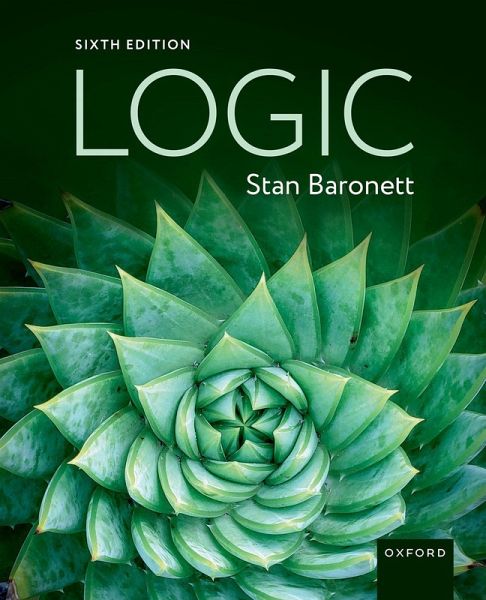
Stan Baronett
Logic
Versandkostenfrei innerhalb Deutschlands
129,99 €
inkl. MwSt.
Versandkostenfrei*
Erscheint vorauss. 9. Februar 2026
Melden Sie sich
hier
hier
für den Produktalarm an, um über die Verfügbarkeit des Produkts informiert zu werden.

65 °P sammeln
Stan Baronett
Logic
- Broschiertes Buch
Featuring an exceptionally clear writing style and a wealth of real-world examples and exercises, Logic, Sixth Edition shows how logic relates to everyday life, demonstrating its applications in such areas as the workplace, media and entertainment, politics, science and technology, student life, and elsewhere. The examples and exercises were chosen to be interesting, thought-provoking, and relevant to students.
Andere Kunden interessierten sich auch für
 Bo BennettRules of Reason12,99 €
![Illustrations of Logic [microform]]( "Illustrations of Logic [microform]") Illustrations of Logic [microform]17,99 €
Illustrations of Logic [microform]17,99 € Henry SturtThe Principles of Understanding an Introduction to Logic From the Standpoint of Personal Idealism22,99 €
 Arnold KoslowA Structuralist Theory of Logic81,99 €
![Symbolic Logic [microform]]( "Symbolic Logic [microform]") John VennSymbolic Logic [microform]22,99 €
John VennSymbolic Logic [microform]22,99 € H. W. B. (Horace William Brindley) J.An Introduction to Logic28,99 €
 Bernard BosanquetLogic or the Morphology of Knowledge Part One24,99 €
-
-
-
![Illustrations of Logic [microform]](https://bilder.buecher.de/produkte/66/66126/66126429m.jpg "Illustrations of Logic [microform]")
![Symbolic Logic [microform]](https://bilder.buecher.de/produkte/65/65595/65595325m.jpg "Symbolic Logic [microform]")
Featuring an exceptionally clear writing style and a wealth of real-world examples and exercises, Logic, Sixth Edition shows how logic relates to everyday life, demonstrating its applications in such areas as the workplace, media and entertainment, politics, science and technology, student life, and elsewhere. The examples and exercises were chosen to be interesting, thought-provoking, and relevant to students.
Produktdetails
- Produktdetails
- Verlag: Oxford University Press Inc
- 6 Revised edition
- Seitenzahl: 824
- Erscheinungstermin: 9. Februar 2026
- Englisch
- ISBN-13: 9780197838358
- ISBN-10: 0197838359
- Artikelnr.: 75833099
- Herstellerkennzeichnung
- Libri GmbH
- Europaallee 1
- 36244 Bad Hersfeld
- gpsr@libri.de
- Verlag: Oxford University Press Inc
- 6 Revised edition
- Seitenzahl: 824
- Erscheinungstermin: 9. Februar 2026
- Englisch
- ISBN-13: 9780197838358
- ISBN-10: 0197838359
- Artikelnr.: 75833099
- Herstellerkennzeichnung
- Libri GmbH
- Europaallee 1
- 36244 Bad Hersfeld
- gpsr@libri.de
Stan Baronett is a master teacher and the author of Theories of Norm Violations (Indiana University Press, 1985), Journey into Philosophy: An Introduction with Classic and Contemporary Readings (Routledge, 2017), and Logic, Fifth Edition (OUP, 2022).
* Preface
* Part I Setting the Stage
* Chapter 1 What Logic Studies
* A. Statements and Arguments
* B. Recognizing Arguments
* Exercises 1B
* C. Arguments and Explanations
* Exercises 1C
* D. Truth and Logic
* E. Deductive and Inductive Arguments
* Exercises 1E
* F. Deductive Arguments: Validity and Soundness
* Argument Form
* Counterexamples
* Part II Informal Logic
* Chapter 2 Language Matters
* A. Intension and Extension
* Terms, Use, and Mention
* Two Kinds of Meaning
* Proper Names
* Exercises 2A
* B. Using Intensional Definitions
* Synonymous Definitions
* Word Origin Definitions
* Operational Definitions
* Definition by Genus and Difference
* C. Using Extensional Definitions
* Ostensive Definitions
* Enumerative Definitions
* Definition by Subclass
* Exercises 2C
* D. Applying Definitions
* Stipulative Definitions
* Lexical Definitions
* Functional Definitions
* Precising Definitions
* Theoretical Definitions
* Persuasive Definitions
* Exercises 2D
* E. Guidelines for Informative Definitions
* Exercises 2E
* F. Cognitive and Emotive Meaning
* Exercises 2F
* G. Factual and Verbal Disputes
* Exercises 2G
* SUMMARY
* KEY TERMS
* LOGIC CHALLENGE: THE PATH
* Chapter 3 Diagramming Arguments
* A. The Basics of Diagramming Arguments
* B. Diagramming Extended Arguments
* Exercises 3B
* SUMMARY
* KEY TERMS
* LOGIC CHALLENGE: THE TRAIN TO VEGAS
* Chapter 4 Informal Fallacies
* A. Why Study Fallacies?
* B. Fallacies Based on Personal Attacks or Emotional Appeals
* Fallacies Based on Personal Attacks
* 1. Ad Hominem Abusive
* 2. Ad Hominem Circumstantial
* 3. Poisoning the Well
* 4. Tu Quoque
* Fallacies Based on Emotional Appeals
* 5. Appeal to the People
* 6. Appeal to Pity
* 7. Appeal to Fear or Force
* Summary of Fallacies Based on Personal Attacks
* Summary of Fallacies Based on Emotional Appeals
* Exercises 4B
* C. Weak Inductive Argument Fallacies
* Generalization Fallacies
* 8. Rigid Application of a Generalization
* 9. Hasty Generalization
* 10. Composition
* 11. Division
* 12. Biased Sample
* False Cause Fallacies
* 13. Post Hoc
* 14. Slippery Slope
* Summary of Weak Inductive Argument Fallacies
* Exercises 4C
* D. Fallacies of Unwarranted Assumption or Diversion
* Unwarranted Assumption
* 15. Begging the Question
* 16. Complex Question
* 17. Appeal to Ignorance
* 18. Appeal to an Unqualified Authority
* 19. False Dichotomy
* Fallacies of Diversion
* 20. Equivocation
* 21. Straw Man
* 22. Red Herring
* 23. Misleading Precision
* 24. Missing the Point
* Summary of Fallacies of Unwarranted Assumption and Diversion
* Exercises 4D
* E. Recognizing Fallacies in Ordinary Language
* Exercises 4E
* SUMMARY
* KEY TERMS
* LOGIC CHALLENGE: A CLEVER PROBLEM
* Part III Formal Logic
* Chapter 5 Categorical Propositions
* A. Categorical Propositions
* Exercises 5A
* B. Quantity, Quality, and Distribution
* Exercises 5B
* C. Existential Import
* D. The Modern Square of Opposition and Venn Diagrams
* Venn Diagrams
* Exercises 5D
* E. Conversion, Obversion, and Contraposition in the Modern Square
* Conversion
* Obversion
* Contraposition
* Diagrams
* Summary of Conversion, Obversion, and Contraposition
* Exercises 5E
* F. The Traditional Square of Opposition and Venn Diagrams
* Exercises 5F.1
* Venn Diagrams and the Traditional Square
* Exercises 5F.2
* G. Conversion, Obversion, and Contraposition in the Traditional
Square
* Summary of Conversion, Obversion, and Contraposition
* Conversion
* Obversion
* Contraposition
* Exercises 5G
* H. Translating Ordinary Language into Categorical Propositions
* Missing Plural Nouns
* Nonstandard Verbs
* Singular Propositions
* Adverbs and Pronouns
* "It Is False That..."
* Implied Quantifiers
* Nonstandard Quantifiers
* Conditional Statements
* Exclusive Propositions
* "The Only"
* Propositions Requiring Two Translations
* Exercises 5H
* SUMMARY
* KEY TERMS
* LOGIC CHALLENGE: GROUP RELATIONSHIP
* Chapter 6 Categorical Syllogisms
* A. Standard-Form Categorical Syllogisms
* B. Mood and Figure
* Exercises 6B
* C. Diagramming in the Modern Interpretation
* Diagramming A-Propositions
* Diagramming E-Propositions
* Diagramming I-Propositions
* Diagramming O-Propositions
* Wrapping Up the X
* Is the Syllogism Valid?
* Exercises 6C
* D. Rules and Fallacies Under the Modern Interpretation
* Rule 1: The middle term must be distributed in at least one premise.
* Associated Fallacy: Undistributed Middle
* Rule 2: If a term is distributed in the conclusion, then it must be
distributed in a premise.
* Associated Fallacies: Illicit Major/Illicit Minor
* Rule 3: A categorical syllogism cannot have two negative premises.
* Associated Fallacy: Exclusive Premises
* Rule 4: A negative premise must have a negative conclusion.
* Associated Fallacy: Affirmative Conclusion/Negative Premise
* Rule 5: A negative conclusion must have a negative premise.
* Associated Fallacy: Negative Conclusion/Affirmative Premises
* Rule 6: Two universal premises cannot have a particular conclusion.
* Associated Fallacy: Existential Fallacy
* Summary of Rules
* Exercises 6D
* E. Diagramming in the Traditional Interpretation
* A-Propositions
* E-Propositions
* Exercises 6E
* F. Rules and Fallacies Under the Traditional Interpretation
* Exercises 6F
* G. Ordinary Language Arguments
* Reducing the Number of Terms in an Argument
* Exercises 6G.1
* Paraphrasing Ordinary Language Arguments
* Categorical Propositions and Multiple Arguments
* Exercises 6G.2
* H. Enthymemes
* Exercises 6H
* I. Sorites
* Exercises 6I
* SUMMARY
* KEY TERMS
* LOGIC CHALLENGE: RELATIONSHIPS REVISITED
* Chapter 7 Propositional Logic
* A. Logical Operators and Translations
* Simple and Compound Statements
* Negation
* Conjunction
* Disjunction
* Conditional
* Distinguishing "If" from "Only If"
* Sufficient and Necessary Conditions
* Biconditional
* Summary of Operators and Ordinary Language
* Exercises 7A
* B. Compound Statements
* Well-Formed Formulas
* Exercises 7B.1
* Main Operator
* Exercises 7B.2
* Translations and the Main Operator
* Exercises 7B.3
* C. Truth Functions
* Defining the Five Logical Operators
* Negation
* Conjunction
* Disjunction
* Conditional
* Biconditional
* Exercises 7C.1
* Operator Truth Tables and Ordinary Language
* Propositions with Assigned Truth Values
* Exercises 7C.2
* D. Truth Tables for Propositions
* Arranging the Truth Values
* The Order of Operations
* Exercises 7D
* E. Contingent and Noncontingent Statements
* Tautology
* Self-Contradiction
* Exercises 7E
* F. Logical Equivalence and Contradictory, Consistent, and
Inconsistent Statements
* Logical Equivalence
* Exercises 7F.1
* Contradictory, Consistent, and Inconsistent Statements
* Exercises 7F.2
* G. Truth Tables for Arguments
* Validity
* Analyzing Sufficient and Necessary Conditions in Arguments
* Technical Validity
* Exercises 7G.1
* Argument Forms
* Exercises 7G.2
* H. Indirect Truth Tables
* Thinking Through an Argument
* A Shorter Truth Table
* Exercises 7H.1
* Using Indirect Truth Tables to Examine Statements for Consistency
* Exercises 7H.2
* SUMMARY
* KEY TERMS
* LOGIC CHALLENGE: A CARD PROBLEM
* Chapter 8 Natural Deduction
* A. Natural Deduction
* B. Implication Rules I
* Modus Ponens (MP)
* Modus Tollens (MT)
* Hypothetical Syllogism (HS)
* Disjunctive Syllogism (DS)
* Justification: Applying the Rules of Inference
* Exercises 8B
* C. Tactics and Strategy
* Applying the First Four Implication Rules
* Exercises 8C
* D. Implication Rules II
* Simplification (Simp)
* Conjunction (Conj)
* Addition (Add)
* Constructive Dilemma (CD)
* Applying the Second Four Implication Rules
* Exercises 8D
* E. Replacement Rules I
* De Morgan (DM)
* Double Negation (DN)
* Commutation (Com)
* Association (Assoc)
* Distribution (Dist)
* Applying the First Five Replacement Rules
* Exercises 8E
* F. Replacement Rules II
* Transposition (Trans)
* Material Implication (Impl)
* Material Equivalence (Equiv)
* Exportation (Exp)
* Tautology (Taut)
* Applying the Second Five Replacement Rules
* Exercises 8F
* G. Conditional Proof
* Exercises 8G
* H. Indirect Proof
* Exercises 8H
* I. Proving Logical Truths
* Exercises 8I
* SUMMARY
* KEY TERMS
* LOGIC CHALLENGE: THE TRUTH
* Chapter 9 Predicate Logic
* A. Translating Ordinary Language
* Singular Statements
* Universal Statements
* Particular Statements
* Paying Attention to Meaning
* Exercises 9A
* B. Four New Rules of Inference
* Universal Instantiation (UI)
* Universal Generalization (UG)
* Existential Generalization (EG)
* Existential Instantiation (EI)
* Summary of the Four Rules
* Tactics and Strategy
* Exercises 9B
* C. Change of Quantifier (CQ)
* Exercises 9C
* D. Conditional and Indirect Proof
* Conditional Proof (CP)
* Indirect Proof (IP)
* Exercises 9D
* E. Demonstrating Invalidity
* Counterexample Method
* Finite Universe Method
* Indirect Truth Tables
* Exercises 9E
* F. Relational Predicates
* Translations
* Exercises 9F.1
* Proofs
* A New Restriction
* Change of Quantifier
* Conditional Proof and Indirect Proof
* Exercises 9F.2
* G. Identity
* Simple Identity Statements
* "Only"
* "The Only"
* "No... Except"
* "All Except"
* Superlatives
* "At Most"
* "At Least"
* "Exactly"
* Definite Descriptions
* Summary of Identity Translations
* Exercises 9G.1
* Proofs
* Exercises 9G.2
* SUMMARY
* KEY TERMS
* LOGIC CHALLENGE: YOUR NAME AND AGE, PLEASE
* Part IV Inductive Logic?
* Chapter 10 Analogical Arguments
* A. The Framework of Analogical Arguments
* Exercises 10A
* B. Analyzing Analogical Arguments
* Criteria for Analyzing Analogical Arguments
* Exercises 10B
* C. Strategies of Evaluation
* Disanalogies
* Counteranalogy
* Unintended Consequences
* Combining Strategies
* Exercises 10C
* SUMMARY
* KEY TERMS
* LOGIC CHALLENGE: BEAT THE CHEAT
* Chapter 11 Legal Arguments
* A. Deductive and Inductive Reasoning
* B. Conditional Statements
* C. Sufficient and Necessary Conditions
* D. Disjunction and Conjunction
* E. Analyzing a Complex Rule
* Exercises 11E
* F. Analogies
* G. The Role of Precedent
* Exercises 11G
* SUMMARY
* KEY TERMS
* LOGIC CHALLENGE: A GUILTY PROBLEM
* Chapter 12 Moral Arguments
* A. Value Judgments
* Justifying "Should"
* Types of Value Judgments
* Taste and Value
* Exercises 12A
* B. Moral Theories
* Emotivism
* Consequentialism
* Egoism
* Utilitarianism
* Deontology
* Relativism
* Contrasting Moral Theories
* Exercises 12B
* C. The Naturalistic Fallacy
* D. The Structure of Moral Arguments
* E. Analogies and Moral Arguments
* Exercises 12E
* SUMMARY
* KEY TERMS
* LOGIC CHALLENGE: DANGEROUS CARGO
* Chapter 13 Statistical Arguments and Probability
* A. Samples and Populations
* Exercises 13A
* B. Statistical Averages
* Exercises 13B
* C. Standard Deviation
* Dividing the Curve
* The Size of the Standard Deviation
* How to Calculate the Standard Deviation
* Exercises 13C 625
* D. What If the Results Are Skewed?
* E. The Misuse of Statistics
* Exercises 13E
* F. Probability Theories
* A Priori Theory
* Relative Frequency Theory
* Subjectivist Theory
* G. Probability Calculus
* Conjunction Methods
* Disjunction Methods
* Negation Method
* Exercises 13G
* H. True Odds in Games of Chance
* I. Bayesian Theory
* Exercises 13I
* SUMMARY
* KEY TERMS
* LOGIC CHALLENGE: THE SECOND CHILD
* Chapter 14 Causality and Scientific Arguments
* A. Sufficient and Necessary Conditions
* Exercises 14A
* B. Causality
* C. Mill's Methods
* Method of Agreement
* Method of Difference
* Joint Method of Agreement and Difference
* Method of Residues
* Method of Concomitant Variations
* Exercises 14C
* D. Limitations of Mill's Methods
* E. Theoretical and Experimental Science
* F. Inference to the Best Explanation
* G. Hypothesis Testing, Experiments, and Predictions
* Controlled Experiments
* Determining Causality
* H. Science and Superstition
* The Need for a Fair Test
* Verifiable Predictions
* Nontrivial Predictions
* Connecting the Hypothesis and Prediction
* Putting It All Together
* Science and Superstition
* The Allure of Superstition
* Exercises 14H
* SUMMARY
* KEY TERMS
* LOGIC CHALLENGE: THE SCALE AND THE COINS
* Online Chapter 15 Analyzing a Long Essay
* A. Childbed Fever
* B. Vienna
* Exercises 15B
* C. Miasm and Contagion
* Exercises 15C
* D. Semmelweis's Account of the Discovery
* Exercises 15D
* E. Initial Questions
* Exercises 15E
* F. A New Interpretation
* Exercises 15F
* SUMMARY
* BIBLIOGRAPHY
* Appendix A Cognitive Bias
* Heuristics
* Heuristics and Algorithms
* The Link Between Heuristics and Cognitive Biases
* Theories of Judgment
* Cognitive Biases
* 1. Belief Bias
* 2. Confirmation Bias
* 3. Status Quo Bias
* 4. Availability Bias
* 5. Halo Bias
* 6. Functional Fixedness Bias
* 7. Anchoring Bias
* 8. Gambling Biases
* 9. Frequency Bias
* 10. Ingroup Bias
* 11. Fundamental Attribution Bias
* Can We Overcome Cognitive Biases?
* Appendix B The LSAT and Logical Reasoning
* Introduction
* 1. Logical Reasoning
* 2. Deductive and Inductive Arguments
* 3. Identifying Conclusions and Premises
* A. Identifying the Conclusion
* B. Choosing the Best Missing Conclusion
* C. Assumptions: Choosing the Best Missing Premise
* 4. Additional Information that Strengthens or Weakens an Argument
* 5. Arguments that Use Either Analogical, Statistical, or Causal
Reasoning
* A. Analogical Reasoning
* B. Statistical Reasoning
* C. Causal Reasoning
* 6. Explaining or Resolving Given Information
* 7. Argument Flaws
* A. Fallacies Based on Personal Attacks or Emotional Appeals
* B. Weak Inductive Argument Fallacies
* C. Fallacies of Unwarranted Assumption or Diversion
* 8.Recognizing Reasoning Patterns
* A. Class Terms
* B. Conditional Statements
* C. Translating Conditional Statements
* D. Distinguishing "If" from "Only If"
* E. Conditionals and Arguments
* F. Sufficient and Necessary Conditions
* 9. Continuing the Process
* Glossary
* Answers to Selected Exercises
* Index
* Part I Setting the Stage
* Chapter 1 What Logic Studies
* A. Statements and Arguments
* B. Recognizing Arguments
* Exercises 1B
* C. Arguments and Explanations
* Exercises 1C
* D. Truth and Logic
* E. Deductive and Inductive Arguments
* Exercises 1E
* F. Deductive Arguments: Validity and Soundness
* Argument Form
* Counterexamples
* Part II Informal Logic
* Chapter 2 Language Matters
* A. Intension and Extension
* Terms, Use, and Mention
* Two Kinds of Meaning
* Proper Names
* Exercises 2A
* B. Using Intensional Definitions
* Synonymous Definitions
* Word Origin Definitions
* Operational Definitions
* Definition by Genus and Difference
* C. Using Extensional Definitions
* Ostensive Definitions
* Enumerative Definitions
* Definition by Subclass
* Exercises 2C
* D. Applying Definitions
* Stipulative Definitions
* Lexical Definitions
* Functional Definitions
* Precising Definitions
* Theoretical Definitions
* Persuasive Definitions
* Exercises 2D
* E. Guidelines for Informative Definitions
* Exercises 2E
* F. Cognitive and Emotive Meaning
* Exercises 2F
* G. Factual and Verbal Disputes
* Exercises 2G
* SUMMARY
* KEY TERMS
* LOGIC CHALLENGE: THE PATH
* Chapter 3 Diagramming Arguments
* A. The Basics of Diagramming Arguments
* B. Diagramming Extended Arguments
* Exercises 3B
* SUMMARY
* KEY TERMS
* LOGIC CHALLENGE: THE TRAIN TO VEGAS
* Chapter 4 Informal Fallacies
* A. Why Study Fallacies?
* B. Fallacies Based on Personal Attacks or Emotional Appeals
* Fallacies Based on Personal Attacks
* 1. Ad Hominem Abusive
* 2. Ad Hominem Circumstantial
* 3. Poisoning the Well
* 4. Tu Quoque
* Fallacies Based on Emotional Appeals
* 5. Appeal to the People
* 6. Appeal to Pity
* 7. Appeal to Fear or Force
* Summary of Fallacies Based on Personal Attacks
* Summary of Fallacies Based on Emotional Appeals
* Exercises 4B
* C. Weak Inductive Argument Fallacies
* Generalization Fallacies
* 8. Rigid Application of a Generalization
* 9. Hasty Generalization
* 10. Composition
* 11. Division
* 12. Biased Sample
* False Cause Fallacies
* 13. Post Hoc
* 14. Slippery Slope
* Summary of Weak Inductive Argument Fallacies
* Exercises 4C
* D. Fallacies of Unwarranted Assumption or Diversion
* Unwarranted Assumption
* 15. Begging the Question
* 16. Complex Question
* 17. Appeal to Ignorance
* 18. Appeal to an Unqualified Authority
* 19. False Dichotomy
* Fallacies of Diversion
* 20. Equivocation
* 21. Straw Man
* 22. Red Herring
* 23. Misleading Precision
* 24. Missing the Point
* Summary of Fallacies of Unwarranted Assumption and Diversion
* Exercises 4D
* E. Recognizing Fallacies in Ordinary Language
* Exercises 4E
* SUMMARY
* KEY TERMS
* LOGIC CHALLENGE: A CLEVER PROBLEM
* Part III Formal Logic
* Chapter 5 Categorical Propositions
* A. Categorical Propositions
* Exercises 5A
* B. Quantity, Quality, and Distribution
* Exercises 5B
* C. Existential Import
* D. The Modern Square of Opposition and Venn Diagrams
* Venn Diagrams
* Exercises 5D
* E. Conversion, Obversion, and Contraposition in the Modern Square
* Conversion
* Obversion
* Contraposition
* Diagrams
* Summary of Conversion, Obversion, and Contraposition
* Exercises 5E
* F. The Traditional Square of Opposition and Venn Diagrams
* Exercises 5F.1
* Venn Diagrams and the Traditional Square
* Exercises 5F.2
* G. Conversion, Obversion, and Contraposition in the Traditional
Square
* Summary of Conversion, Obversion, and Contraposition
* Conversion
* Obversion
* Contraposition
* Exercises 5G
* H. Translating Ordinary Language into Categorical Propositions
* Missing Plural Nouns
* Nonstandard Verbs
* Singular Propositions
* Adverbs and Pronouns
* "It Is False That..."
* Implied Quantifiers
* Nonstandard Quantifiers
* Conditional Statements
* Exclusive Propositions
* "The Only"
* Propositions Requiring Two Translations
* Exercises 5H
* SUMMARY
* KEY TERMS
* LOGIC CHALLENGE: GROUP RELATIONSHIP
* Chapter 6 Categorical Syllogisms
* A. Standard-Form Categorical Syllogisms
* B. Mood and Figure
* Exercises 6B
* C. Diagramming in the Modern Interpretation
* Diagramming A-Propositions
* Diagramming E-Propositions
* Diagramming I-Propositions
* Diagramming O-Propositions
* Wrapping Up the X
* Is the Syllogism Valid?
* Exercises 6C
* D. Rules and Fallacies Under the Modern Interpretation
* Rule 1: The middle term must be distributed in at least one premise.
* Associated Fallacy: Undistributed Middle
* Rule 2: If a term is distributed in the conclusion, then it must be
distributed in a premise.
* Associated Fallacies: Illicit Major/Illicit Minor
* Rule 3: A categorical syllogism cannot have two negative premises.
* Associated Fallacy: Exclusive Premises
* Rule 4: A negative premise must have a negative conclusion.
* Associated Fallacy: Affirmative Conclusion/Negative Premise
* Rule 5: A negative conclusion must have a negative premise.
* Associated Fallacy: Negative Conclusion/Affirmative Premises
* Rule 6: Two universal premises cannot have a particular conclusion.
* Associated Fallacy: Existential Fallacy
* Summary of Rules
* Exercises 6D
* E. Diagramming in the Traditional Interpretation
* A-Propositions
* E-Propositions
* Exercises 6E
* F. Rules and Fallacies Under the Traditional Interpretation
* Exercises 6F
* G. Ordinary Language Arguments
* Reducing the Number of Terms in an Argument
* Exercises 6G.1
* Paraphrasing Ordinary Language Arguments
* Categorical Propositions and Multiple Arguments
* Exercises 6G.2
* H. Enthymemes
* Exercises 6H
* I. Sorites
* Exercises 6I
* SUMMARY
* KEY TERMS
* LOGIC CHALLENGE: RELATIONSHIPS REVISITED
* Chapter 7 Propositional Logic
* A. Logical Operators and Translations
* Simple and Compound Statements
* Negation
* Conjunction
* Disjunction
* Conditional
* Distinguishing "If" from "Only If"
* Sufficient and Necessary Conditions
* Biconditional
* Summary of Operators and Ordinary Language
* Exercises 7A
* B. Compound Statements
* Well-Formed Formulas
* Exercises 7B.1
* Main Operator
* Exercises 7B.2
* Translations and the Main Operator
* Exercises 7B.3
* C. Truth Functions
* Defining the Five Logical Operators
* Negation
* Conjunction
* Disjunction
* Conditional
* Biconditional
* Exercises 7C.1
* Operator Truth Tables and Ordinary Language
* Propositions with Assigned Truth Values
* Exercises 7C.2
* D. Truth Tables for Propositions
* Arranging the Truth Values
* The Order of Operations
* Exercises 7D
* E. Contingent and Noncontingent Statements
* Tautology
* Self-Contradiction
* Exercises 7E
* F. Logical Equivalence and Contradictory, Consistent, and
Inconsistent Statements
* Logical Equivalence
* Exercises 7F.1
* Contradictory, Consistent, and Inconsistent Statements
* Exercises 7F.2
* G. Truth Tables for Arguments
* Validity
* Analyzing Sufficient and Necessary Conditions in Arguments
* Technical Validity
* Exercises 7G.1
* Argument Forms
* Exercises 7G.2
* H. Indirect Truth Tables
* Thinking Through an Argument
* A Shorter Truth Table
* Exercises 7H.1
* Using Indirect Truth Tables to Examine Statements for Consistency
* Exercises 7H.2
* SUMMARY
* KEY TERMS
* LOGIC CHALLENGE: A CARD PROBLEM
* Chapter 8 Natural Deduction
* A. Natural Deduction
* B. Implication Rules I
* Modus Ponens (MP)
* Modus Tollens (MT)
* Hypothetical Syllogism (HS)
* Disjunctive Syllogism (DS)
* Justification: Applying the Rules of Inference
* Exercises 8B
* C. Tactics and Strategy
* Applying the First Four Implication Rules
* Exercises 8C
* D. Implication Rules II
* Simplification (Simp)
* Conjunction (Conj)
* Addition (Add)
* Constructive Dilemma (CD)
* Applying the Second Four Implication Rules
* Exercises 8D
* E. Replacement Rules I
* De Morgan (DM)
* Double Negation (DN)
* Commutation (Com)
* Association (Assoc)
* Distribution (Dist)
* Applying the First Five Replacement Rules
* Exercises 8E
* F. Replacement Rules II
* Transposition (Trans)
* Material Implication (Impl)
* Material Equivalence (Equiv)
* Exportation (Exp)
* Tautology (Taut)
* Applying the Second Five Replacement Rules
* Exercises 8F
* G. Conditional Proof
* Exercises 8G
* H. Indirect Proof
* Exercises 8H
* I. Proving Logical Truths
* Exercises 8I
* SUMMARY
* KEY TERMS
* LOGIC CHALLENGE: THE TRUTH
* Chapter 9 Predicate Logic
* A. Translating Ordinary Language
* Singular Statements
* Universal Statements
* Particular Statements
* Paying Attention to Meaning
* Exercises 9A
* B. Four New Rules of Inference
* Universal Instantiation (UI)
* Universal Generalization (UG)
* Existential Generalization (EG)
* Existential Instantiation (EI)
* Summary of the Four Rules
* Tactics and Strategy
* Exercises 9B
* C. Change of Quantifier (CQ)
* Exercises 9C
* D. Conditional and Indirect Proof
* Conditional Proof (CP)
* Indirect Proof (IP)
* Exercises 9D
* E. Demonstrating Invalidity
* Counterexample Method
* Finite Universe Method
* Indirect Truth Tables
* Exercises 9E
* F. Relational Predicates
* Translations
* Exercises 9F.1
* Proofs
* A New Restriction
* Change of Quantifier
* Conditional Proof and Indirect Proof
* Exercises 9F.2
* G. Identity
* Simple Identity Statements
* "Only"
* "The Only"
* "No... Except"
* "All Except"
* Superlatives
* "At Most"
* "At Least"
* "Exactly"
* Definite Descriptions
* Summary of Identity Translations
* Exercises 9G.1
* Proofs
* Exercises 9G.2
* SUMMARY
* KEY TERMS
* LOGIC CHALLENGE: YOUR NAME AND AGE, PLEASE
* Part IV Inductive Logic?
* Chapter 10 Analogical Arguments
* A. The Framework of Analogical Arguments
* Exercises 10A
* B. Analyzing Analogical Arguments
* Criteria for Analyzing Analogical Arguments
* Exercises 10B
* C. Strategies of Evaluation
* Disanalogies
* Counteranalogy
* Unintended Consequences
* Combining Strategies
* Exercises 10C
* SUMMARY
* KEY TERMS
* LOGIC CHALLENGE: BEAT THE CHEAT
* Chapter 11 Legal Arguments
* A. Deductive and Inductive Reasoning
* B. Conditional Statements
* C. Sufficient and Necessary Conditions
* D. Disjunction and Conjunction
* E. Analyzing a Complex Rule
* Exercises 11E
* F. Analogies
* G. The Role of Precedent
* Exercises 11G
* SUMMARY
* KEY TERMS
* LOGIC CHALLENGE: A GUILTY PROBLEM
* Chapter 12 Moral Arguments
* A. Value Judgments
* Justifying "Should"
* Types of Value Judgments
* Taste and Value
* Exercises 12A
* B. Moral Theories
* Emotivism
* Consequentialism
* Egoism
* Utilitarianism
* Deontology
* Relativism
* Contrasting Moral Theories
* Exercises 12B
* C. The Naturalistic Fallacy
* D. The Structure of Moral Arguments
* E. Analogies and Moral Arguments
* Exercises 12E
* SUMMARY
* KEY TERMS
* LOGIC CHALLENGE: DANGEROUS CARGO
* Chapter 13 Statistical Arguments and Probability
* A. Samples and Populations
* Exercises 13A
* B. Statistical Averages
* Exercises 13B
* C. Standard Deviation
* Dividing the Curve
* The Size of the Standard Deviation
* How to Calculate the Standard Deviation
* Exercises 13C 625
* D. What If the Results Are Skewed?
* E. The Misuse of Statistics
* Exercises 13E
* F. Probability Theories
* A Priori Theory
* Relative Frequency Theory
* Subjectivist Theory
* G. Probability Calculus
* Conjunction Methods
* Disjunction Methods
* Negation Method
* Exercises 13G
* H. True Odds in Games of Chance
* I. Bayesian Theory
* Exercises 13I
* SUMMARY
* KEY TERMS
* LOGIC CHALLENGE: THE SECOND CHILD
* Chapter 14 Causality and Scientific Arguments
* A. Sufficient and Necessary Conditions
* Exercises 14A
* B. Causality
* C. Mill's Methods
* Method of Agreement
* Method of Difference
* Joint Method of Agreement and Difference
* Method of Residues
* Method of Concomitant Variations
* Exercises 14C
* D. Limitations of Mill's Methods
* E. Theoretical and Experimental Science
* F. Inference to the Best Explanation
* G. Hypothesis Testing, Experiments, and Predictions
* Controlled Experiments
* Determining Causality
* H. Science and Superstition
* The Need for a Fair Test
* Verifiable Predictions
* Nontrivial Predictions
* Connecting the Hypothesis and Prediction
* Putting It All Together
* Science and Superstition
* The Allure of Superstition
* Exercises 14H
* SUMMARY
* KEY TERMS
* LOGIC CHALLENGE: THE SCALE AND THE COINS
* Online Chapter 15 Analyzing a Long Essay
* A. Childbed Fever
* B. Vienna
* Exercises 15B
* C. Miasm and Contagion
* Exercises 15C
* D. Semmelweis's Account of the Discovery
* Exercises 15D
* E. Initial Questions
* Exercises 15E
* F. A New Interpretation
* Exercises 15F
* SUMMARY
* BIBLIOGRAPHY
* Appendix A Cognitive Bias
* Heuristics
* Heuristics and Algorithms
* The Link Between Heuristics and Cognitive Biases
* Theories of Judgment
* Cognitive Biases
* 1. Belief Bias
* 2. Confirmation Bias
* 3. Status Quo Bias
* 4. Availability Bias
* 5. Halo Bias
* 6. Functional Fixedness Bias
* 7. Anchoring Bias
* 8. Gambling Biases
* 9. Frequency Bias
* 10. Ingroup Bias
* 11. Fundamental Attribution Bias
* Can We Overcome Cognitive Biases?
* Appendix B The LSAT and Logical Reasoning
* Introduction
* 1. Logical Reasoning
* 2. Deductive and Inductive Arguments
* 3. Identifying Conclusions and Premises
* A. Identifying the Conclusion
* B. Choosing the Best Missing Conclusion
* C. Assumptions: Choosing the Best Missing Premise
* 4. Additional Information that Strengthens or Weakens an Argument
* 5. Arguments that Use Either Analogical, Statistical, or Causal
Reasoning
* A. Analogical Reasoning
* B. Statistical Reasoning
* C. Causal Reasoning
* 6. Explaining or Resolving Given Information
* 7. Argument Flaws
* A. Fallacies Based on Personal Attacks or Emotional Appeals
* B. Weak Inductive Argument Fallacies
* C. Fallacies of Unwarranted Assumption or Diversion
* 8.Recognizing Reasoning Patterns
* A. Class Terms
* B. Conditional Statements
* C. Translating Conditional Statements
* D. Distinguishing "If" from "Only If"
* E. Conditionals and Arguments
* F. Sufficient and Necessary Conditions
* 9. Continuing the Process
* Glossary
* Answers to Selected Exercises
* Index
* Preface
* Part I Setting the Stage
* Chapter 1 What Logic Studies
* A. Statements and Arguments
* B. Recognizing Arguments
* Exercises 1B
* C. Arguments and Explanations
* Exercises 1C
* D. Truth and Logic
* E. Deductive and Inductive Arguments
* Exercises 1E
* F. Deductive Arguments: Validity and Soundness
* Argument Form
* Counterexamples
* Part II Informal Logic
* Chapter 2 Language Matters
* A. Intension and Extension
* Terms, Use, and Mention
* Two Kinds of Meaning
* Proper Names
* Exercises 2A
* B. Using Intensional Definitions
* Synonymous Definitions
* Word Origin Definitions
* Operational Definitions
* Definition by Genus and Difference
* C. Using Extensional Definitions
* Ostensive Definitions
* Enumerative Definitions
* Definition by Subclass
* Exercises 2C
* D. Applying Definitions
* Stipulative Definitions
* Lexical Definitions
* Functional Definitions
* Precising Definitions
* Theoretical Definitions
* Persuasive Definitions
* Exercises 2D
* E. Guidelines for Informative Definitions
* Exercises 2E
* F. Cognitive and Emotive Meaning
* Exercises 2F
* G. Factual and Verbal Disputes
* Exercises 2G
* SUMMARY
* KEY TERMS
* LOGIC CHALLENGE: THE PATH
* Chapter 3 Diagramming Arguments
* A. The Basics of Diagramming Arguments
* B. Diagramming Extended Arguments
* Exercises 3B
* SUMMARY
* KEY TERMS
* LOGIC CHALLENGE: THE TRAIN TO VEGAS
* Chapter 4 Informal Fallacies
* A. Why Study Fallacies?
* B. Fallacies Based on Personal Attacks or Emotional Appeals
* Fallacies Based on Personal Attacks
* 1. Ad Hominem Abusive
* 2. Ad Hominem Circumstantial
* 3. Poisoning the Well
* 4. Tu Quoque
* Fallacies Based on Emotional Appeals
* 5. Appeal to the People
* 6. Appeal to Pity
* 7. Appeal to Fear or Force
* Summary of Fallacies Based on Personal Attacks
* Summary of Fallacies Based on Emotional Appeals
* Exercises 4B
* C. Weak Inductive Argument Fallacies
* Generalization Fallacies
* 8. Rigid Application of a Generalization
* 9. Hasty Generalization
* 10. Composition
* 11. Division
* 12. Biased Sample
* False Cause Fallacies
* 13. Post Hoc
* 14. Slippery Slope
* Summary of Weak Inductive Argument Fallacies
* Exercises 4C
* D. Fallacies of Unwarranted Assumption or Diversion
* Unwarranted Assumption
* 15. Begging the Question
* 16. Complex Question
* 17. Appeal to Ignorance
* 18. Appeal to an Unqualified Authority
* 19. False Dichotomy
* Fallacies of Diversion
* 20. Equivocation
* 21. Straw Man
* 22. Red Herring
* 23. Misleading Precision
* 24. Missing the Point
* Summary of Fallacies of Unwarranted Assumption and Diversion
* Exercises 4D
* E. Recognizing Fallacies in Ordinary Language
* Exercises 4E
* SUMMARY
* KEY TERMS
* LOGIC CHALLENGE: A CLEVER PROBLEM
* Part III Formal Logic
* Chapter 5 Categorical Propositions
* A. Categorical Propositions
* Exercises 5A
* B. Quantity, Quality, and Distribution
* Exercises 5B
* C. Existential Import
* D. The Modern Square of Opposition and Venn Diagrams
* Venn Diagrams
* Exercises 5D
* E. Conversion, Obversion, and Contraposition in the Modern Square
* Conversion
* Obversion
* Contraposition
* Diagrams
* Summary of Conversion, Obversion, and Contraposition
* Exercises 5E
* F. The Traditional Square of Opposition and Venn Diagrams
* Exercises 5F.1
* Venn Diagrams and the Traditional Square
* Exercises 5F.2
* G. Conversion, Obversion, and Contraposition in the Traditional
Square
* Summary of Conversion, Obversion, and Contraposition
* Conversion
* Obversion
* Contraposition
* Exercises 5G
* H. Translating Ordinary Language into Categorical Propositions
* Missing Plural Nouns
* Nonstandard Verbs
* Singular Propositions
* Adverbs and Pronouns
* "It Is False That..."
* Implied Quantifiers
* Nonstandard Quantifiers
* Conditional Statements
* Exclusive Propositions
* "The Only"
* Propositions Requiring Two Translations
* Exercises 5H
* SUMMARY
* KEY TERMS
* LOGIC CHALLENGE: GROUP RELATIONSHIP
* Chapter 6 Categorical Syllogisms
* A. Standard-Form Categorical Syllogisms
* B. Mood and Figure
* Exercises 6B
* C. Diagramming in the Modern Interpretation
* Diagramming A-Propositions
* Diagramming E-Propositions
* Diagramming I-Propositions
* Diagramming O-Propositions
* Wrapping Up the X
* Is the Syllogism Valid?
* Exercises 6C
* D. Rules and Fallacies Under the Modern Interpretation
* Rule 1: The middle term must be distributed in at least one premise.
* Associated Fallacy: Undistributed Middle
* Rule 2: If a term is distributed in the conclusion, then it must be
distributed in a premise.
* Associated Fallacies: Illicit Major/Illicit Minor
* Rule 3: A categorical syllogism cannot have two negative premises.
* Associated Fallacy: Exclusive Premises
* Rule 4: A negative premise must have a negative conclusion.
* Associated Fallacy: Affirmative Conclusion/Negative Premise
* Rule 5: A negative conclusion must have a negative premise.
* Associated Fallacy: Negative Conclusion/Affirmative Premises
* Rule 6: Two universal premises cannot have a particular conclusion.
* Associated Fallacy: Existential Fallacy
* Summary of Rules
* Exercises 6D
* E. Diagramming in the Traditional Interpretation
* A-Propositions
* E-Propositions
* Exercises 6E
* F. Rules and Fallacies Under the Traditional Interpretation
* Exercises 6F
* G. Ordinary Language Arguments
* Reducing the Number of Terms in an Argument
* Exercises 6G.1
* Paraphrasing Ordinary Language Arguments
* Categorical Propositions and Multiple Arguments
* Exercises 6G.2
* H. Enthymemes
* Exercises 6H
* I. Sorites
* Exercises 6I
* SUMMARY
* KEY TERMS
* LOGIC CHALLENGE: RELATIONSHIPS REVISITED
* Chapter 7 Propositional Logic
* A. Logical Operators and Translations
* Simple and Compound Statements
* Negation
* Conjunction
* Disjunction
* Conditional
* Distinguishing "If" from "Only If"
* Sufficient and Necessary Conditions
* Biconditional
* Summary of Operators and Ordinary Language
* Exercises 7A
* B. Compound Statements
* Well-Formed Formulas
* Exercises 7B.1
* Main Operator
* Exercises 7B.2
* Translations and the Main Operator
* Exercises 7B.3
* C. Truth Functions
* Defining the Five Logical Operators
* Negation
* Conjunction
* Disjunction
* Conditional
* Biconditional
* Exercises 7C.1
* Operator Truth Tables and Ordinary Language
* Propositions with Assigned Truth Values
* Exercises 7C.2
* D. Truth Tables for Propositions
* Arranging the Truth Values
* The Order of Operations
* Exercises 7D
* E. Contingent and Noncontingent Statements
* Tautology
* Self-Contradiction
* Exercises 7E
* F. Logical Equivalence and Contradictory, Consistent, and
Inconsistent Statements
* Logical Equivalence
* Exercises 7F.1
* Contradictory, Consistent, and Inconsistent Statements
* Exercises 7F.2
* G. Truth Tables for Arguments
* Validity
* Analyzing Sufficient and Necessary Conditions in Arguments
* Technical Validity
* Exercises 7G.1
* Argument Forms
* Exercises 7G.2
* H. Indirect Truth Tables
* Thinking Through an Argument
* A Shorter Truth Table
* Exercises 7H.1
* Using Indirect Truth Tables to Examine Statements for Consistency
* Exercises 7H.2
* SUMMARY
* KEY TERMS
* LOGIC CHALLENGE: A CARD PROBLEM
* Chapter 8 Natural Deduction
* A. Natural Deduction
* B. Implication Rules I
* Modus Ponens (MP)
* Modus Tollens (MT)
* Hypothetical Syllogism (HS)
* Disjunctive Syllogism (DS)
* Justification: Applying the Rules of Inference
* Exercises 8B
* C. Tactics and Strategy
* Applying the First Four Implication Rules
* Exercises 8C
* D. Implication Rules II
* Simplification (Simp)
* Conjunction (Conj)
* Addition (Add)
* Constructive Dilemma (CD)
* Applying the Second Four Implication Rules
* Exercises 8D
* E. Replacement Rules I
* De Morgan (DM)
* Double Negation (DN)
* Commutation (Com)
* Association (Assoc)
* Distribution (Dist)
* Applying the First Five Replacement Rules
* Exercises 8E
* F. Replacement Rules II
* Transposition (Trans)
* Material Implication (Impl)
* Material Equivalence (Equiv)
* Exportation (Exp)
* Tautology (Taut)
* Applying the Second Five Replacement Rules
* Exercises 8F
* G. Conditional Proof
* Exercises 8G
* H. Indirect Proof
* Exercises 8H
* I. Proving Logical Truths
* Exercises 8I
* SUMMARY
* KEY TERMS
* LOGIC CHALLENGE: THE TRUTH
* Chapter 9 Predicate Logic
* A. Translating Ordinary Language
* Singular Statements
* Universal Statements
* Particular Statements
* Paying Attention to Meaning
* Exercises 9A
* B. Four New Rules of Inference
* Universal Instantiation (UI)
* Universal Generalization (UG)
* Existential Generalization (EG)
* Existential Instantiation (EI)
* Summary of the Four Rules
* Tactics and Strategy
* Exercises 9B
* C. Change of Quantifier (CQ)
* Exercises 9C
* D. Conditional and Indirect Proof
* Conditional Proof (CP)
* Indirect Proof (IP)
* Exercises 9D
* E. Demonstrating Invalidity
* Counterexample Method
* Finite Universe Method
* Indirect Truth Tables
* Exercises 9E
* F. Relational Predicates
* Translations
* Exercises 9F.1
* Proofs
* A New Restriction
* Change of Quantifier
* Conditional Proof and Indirect Proof
* Exercises 9F.2
* G. Identity
* Simple Identity Statements
* "Only"
* "The Only"
* "No... Except"
* "All Except"
* Superlatives
* "At Most"
* "At Least"
* "Exactly"
* Definite Descriptions
* Summary of Identity Translations
* Exercises 9G.1
* Proofs
* Exercises 9G.2
* SUMMARY
* KEY TERMS
* LOGIC CHALLENGE: YOUR NAME AND AGE, PLEASE
* Part IV Inductive Logic?
* Chapter 10 Analogical Arguments
* A. The Framework of Analogical Arguments
* Exercises 10A
* B. Analyzing Analogical Arguments
* Criteria for Analyzing Analogical Arguments
* Exercises 10B
* C. Strategies of Evaluation
* Disanalogies
* Counteranalogy
* Unintended Consequences
* Combining Strategies
* Exercises 10C
* SUMMARY
* KEY TERMS
* LOGIC CHALLENGE: BEAT THE CHEAT
* Chapter 11 Legal Arguments
* A. Deductive and Inductive Reasoning
* B. Conditional Statements
* C. Sufficient and Necessary Conditions
* D. Disjunction and Conjunction
* E. Analyzing a Complex Rule
* Exercises 11E
* F. Analogies
* G. The Role of Precedent
* Exercises 11G
* SUMMARY
* KEY TERMS
* LOGIC CHALLENGE: A GUILTY PROBLEM
* Chapter 12 Moral Arguments
* A. Value Judgments
* Justifying "Should"
* Types of Value Judgments
* Taste and Value
* Exercises 12A
* B. Moral Theories
* Emotivism
* Consequentialism
* Egoism
* Utilitarianism
* Deontology
* Relativism
* Contrasting Moral Theories
* Exercises 12B
* C. The Naturalistic Fallacy
* D. The Structure of Moral Arguments
* E. Analogies and Moral Arguments
* Exercises 12E
* SUMMARY
* KEY TERMS
* LOGIC CHALLENGE: DANGEROUS CARGO
* Chapter 13 Statistical Arguments and Probability
* A. Samples and Populations
* Exercises 13A
* B. Statistical Averages
* Exercises 13B
* C. Standard Deviation
* Dividing the Curve
* The Size of the Standard Deviation
* How to Calculate the Standard Deviation
* Exercises 13C 625
* D. What If the Results Are Skewed?
* E. The Misuse of Statistics
* Exercises 13E
* F. Probability Theories
* A Priori Theory
* Relative Frequency Theory
* Subjectivist Theory
* G. Probability Calculus
* Conjunction Methods
* Disjunction Methods
* Negation Method
* Exercises 13G
* H. True Odds in Games of Chance
* I. Bayesian Theory
* Exercises 13I
* SUMMARY
* KEY TERMS
* LOGIC CHALLENGE: THE SECOND CHILD
* Chapter 14 Causality and Scientific Arguments
* A. Sufficient and Necessary Conditions
* Exercises 14A
* B. Causality
* C. Mill's Methods
* Method of Agreement
* Method of Difference
* Joint Method of Agreement and Difference
* Method of Residues
* Method of Concomitant Variations
* Exercises 14C
* D. Limitations of Mill's Methods
* E. Theoretical and Experimental Science
* F. Inference to the Best Explanation
* G. Hypothesis Testing, Experiments, and Predictions
* Controlled Experiments
* Determining Causality
* H. Science and Superstition
* The Need for a Fair Test
* Verifiable Predictions
* Nontrivial Predictions
* Connecting the Hypothesis and Prediction
* Putting It All Together
* Science and Superstition
* The Allure of Superstition
* Exercises 14H
* SUMMARY
* KEY TERMS
* LOGIC CHALLENGE: THE SCALE AND THE COINS
* Online Chapter 15 Analyzing a Long Essay
* A. Childbed Fever
* B. Vienna
* Exercises 15B
* C. Miasm and Contagion
* Exercises 15C
* D. Semmelweis's Account of the Discovery
* Exercises 15D
* E. Initial Questions
* Exercises 15E
* F. A New Interpretation
* Exercises 15F
* SUMMARY
* BIBLIOGRAPHY
* Appendix A Cognitive Bias
* Heuristics
* Heuristics and Algorithms
* The Link Between Heuristics and Cognitive Biases
* Theories of Judgment
* Cognitive Biases
* 1. Belief Bias
* 2. Confirmation Bias
* 3. Status Quo Bias
* 4. Availability Bias
* 5. Halo Bias
* 6. Functional Fixedness Bias
* 7. Anchoring Bias
* 8. Gambling Biases
* 9. Frequency Bias
* 10. Ingroup Bias
* 11. Fundamental Attribution Bias
* Can We Overcome Cognitive Biases?
* Appendix B The LSAT and Logical Reasoning
* Introduction
* 1. Logical Reasoning
* 2. Deductive and Inductive Arguments
* 3. Identifying Conclusions and Premises
* A. Identifying the Conclusion
* B. Choosing the Best Missing Conclusion
* C. Assumptions: Choosing the Best Missing Premise
* 4. Additional Information that Strengthens or Weakens an Argument
* 5. Arguments that Use Either Analogical, Statistical, or Causal
Reasoning
* A. Analogical Reasoning
* B. Statistical Reasoning
* C. Causal Reasoning
* 6. Explaining or Resolving Given Information
* 7. Argument Flaws
* A. Fallacies Based on Personal Attacks or Emotional Appeals
* B. Weak Inductive Argument Fallacies
* C. Fallacies of Unwarranted Assumption or Diversion
* 8.Recognizing Reasoning Patterns
* A. Class Terms
* B. Conditional Statements
* C. Translating Conditional Statements
* D. Distinguishing "If" from "Only If"
* E. Conditionals and Arguments
* F. Sufficient and Necessary Conditions
* 9. Continuing the Process
* Glossary
* Answers to Selected Exercises
* Index
* Part I Setting the Stage
* Chapter 1 What Logic Studies
* A. Statements and Arguments
* B. Recognizing Arguments
* Exercises 1B
* C. Arguments and Explanations
* Exercises 1C
* D. Truth and Logic
* E. Deductive and Inductive Arguments
* Exercises 1E
* F. Deductive Arguments: Validity and Soundness
* Argument Form
* Counterexamples
* Part II Informal Logic
* Chapter 2 Language Matters
* A. Intension and Extension
* Terms, Use, and Mention
* Two Kinds of Meaning
* Proper Names
* Exercises 2A
* B. Using Intensional Definitions
* Synonymous Definitions
* Word Origin Definitions
* Operational Definitions
* Definition by Genus and Difference
* C. Using Extensional Definitions
* Ostensive Definitions
* Enumerative Definitions
* Definition by Subclass
* Exercises 2C
* D. Applying Definitions
* Stipulative Definitions
* Lexical Definitions
* Functional Definitions
* Precising Definitions
* Theoretical Definitions
* Persuasive Definitions
* Exercises 2D
* E. Guidelines for Informative Definitions
* Exercises 2E
* F. Cognitive and Emotive Meaning
* Exercises 2F
* G. Factual and Verbal Disputes
* Exercises 2G
* SUMMARY
* KEY TERMS
* LOGIC CHALLENGE: THE PATH
* Chapter 3 Diagramming Arguments
* A. The Basics of Diagramming Arguments
* B. Diagramming Extended Arguments
* Exercises 3B
* SUMMARY
* KEY TERMS
* LOGIC CHALLENGE: THE TRAIN TO VEGAS
* Chapter 4 Informal Fallacies
* A. Why Study Fallacies?
* B. Fallacies Based on Personal Attacks or Emotional Appeals
* Fallacies Based on Personal Attacks
* 1. Ad Hominem Abusive
* 2. Ad Hominem Circumstantial
* 3. Poisoning the Well
* 4. Tu Quoque
* Fallacies Based on Emotional Appeals
* 5. Appeal to the People
* 6. Appeal to Pity
* 7. Appeal to Fear or Force
* Summary of Fallacies Based on Personal Attacks
* Summary of Fallacies Based on Emotional Appeals
* Exercises 4B
* C. Weak Inductive Argument Fallacies
* Generalization Fallacies
* 8. Rigid Application of a Generalization
* 9. Hasty Generalization
* 10. Composition
* 11. Division
* 12. Biased Sample
* False Cause Fallacies
* 13. Post Hoc
* 14. Slippery Slope
* Summary of Weak Inductive Argument Fallacies
* Exercises 4C
* D. Fallacies of Unwarranted Assumption or Diversion
* Unwarranted Assumption
* 15. Begging the Question
* 16. Complex Question
* 17. Appeal to Ignorance
* 18. Appeal to an Unqualified Authority
* 19. False Dichotomy
* Fallacies of Diversion
* 20. Equivocation
* 21. Straw Man
* 22. Red Herring
* 23. Misleading Precision
* 24. Missing the Point
* Summary of Fallacies of Unwarranted Assumption and Diversion
* Exercises 4D
* E. Recognizing Fallacies in Ordinary Language
* Exercises 4E
* SUMMARY
* KEY TERMS
* LOGIC CHALLENGE: A CLEVER PROBLEM
* Part III Formal Logic
* Chapter 5 Categorical Propositions
* A. Categorical Propositions
* Exercises 5A
* B. Quantity, Quality, and Distribution
* Exercises 5B
* C. Existential Import
* D. The Modern Square of Opposition and Venn Diagrams
* Venn Diagrams
* Exercises 5D
* E. Conversion, Obversion, and Contraposition in the Modern Square
* Conversion
* Obversion
* Contraposition
* Diagrams
* Summary of Conversion, Obversion, and Contraposition
* Exercises 5E
* F. The Traditional Square of Opposition and Venn Diagrams
* Exercises 5F.1
* Venn Diagrams and the Traditional Square
* Exercises 5F.2
* G. Conversion, Obversion, and Contraposition in the Traditional
Square
* Summary of Conversion, Obversion, and Contraposition
* Conversion
* Obversion
* Contraposition
* Exercises 5G
* H. Translating Ordinary Language into Categorical Propositions
* Missing Plural Nouns
* Nonstandard Verbs
* Singular Propositions
* Adverbs and Pronouns
* "It Is False That..."
* Implied Quantifiers
* Nonstandard Quantifiers
* Conditional Statements
* Exclusive Propositions
* "The Only"
* Propositions Requiring Two Translations
* Exercises 5H
* SUMMARY
* KEY TERMS
* LOGIC CHALLENGE: GROUP RELATIONSHIP
* Chapter 6 Categorical Syllogisms
* A. Standard-Form Categorical Syllogisms
* B. Mood and Figure
* Exercises 6B
* C. Diagramming in the Modern Interpretation
* Diagramming A-Propositions
* Diagramming E-Propositions
* Diagramming I-Propositions
* Diagramming O-Propositions
* Wrapping Up the X
* Is the Syllogism Valid?
* Exercises 6C
* D. Rules and Fallacies Under the Modern Interpretation
* Rule 1: The middle term must be distributed in at least one premise.
* Associated Fallacy: Undistributed Middle
* Rule 2: If a term is distributed in the conclusion, then it must be
distributed in a premise.
* Associated Fallacies: Illicit Major/Illicit Minor
* Rule 3: A categorical syllogism cannot have two negative premises.
* Associated Fallacy: Exclusive Premises
* Rule 4: A negative premise must have a negative conclusion.
* Associated Fallacy: Affirmative Conclusion/Negative Premise
* Rule 5: A negative conclusion must have a negative premise.
* Associated Fallacy: Negative Conclusion/Affirmative Premises
* Rule 6: Two universal premises cannot have a particular conclusion.
* Associated Fallacy: Existential Fallacy
* Summary of Rules
* Exercises 6D
* E. Diagramming in the Traditional Interpretation
* A-Propositions
* E-Propositions
* Exercises 6E
* F. Rules and Fallacies Under the Traditional Interpretation
* Exercises 6F
* G. Ordinary Language Arguments
* Reducing the Number of Terms in an Argument
* Exercises 6G.1
* Paraphrasing Ordinary Language Arguments
* Categorical Propositions and Multiple Arguments
* Exercises 6G.2
* H. Enthymemes
* Exercises 6H
* I. Sorites
* Exercises 6I
* SUMMARY
* KEY TERMS
* LOGIC CHALLENGE: RELATIONSHIPS REVISITED
* Chapter 7 Propositional Logic
* A. Logical Operators and Translations
* Simple and Compound Statements
* Negation
* Conjunction
* Disjunction
* Conditional
* Distinguishing "If" from "Only If"
* Sufficient and Necessary Conditions
* Biconditional
* Summary of Operators and Ordinary Language
* Exercises 7A
* B. Compound Statements
* Well-Formed Formulas
* Exercises 7B.1
* Main Operator
* Exercises 7B.2
* Translations and the Main Operator
* Exercises 7B.3
* C. Truth Functions
* Defining the Five Logical Operators
* Negation
* Conjunction
* Disjunction
* Conditional
* Biconditional
* Exercises 7C.1
* Operator Truth Tables and Ordinary Language
* Propositions with Assigned Truth Values
* Exercises 7C.2
* D. Truth Tables for Propositions
* Arranging the Truth Values
* The Order of Operations
* Exercises 7D
* E. Contingent and Noncontingent Statements
* Tautology
* Self-Contradiction
* Exercises 7E
* F. Logical Equivalence and Contradictory, Consistent, and
Inconsistent Statements
* Logical Equivalence
* Exercises 7F.1
* Contradictory, Consistent, and Inconsistent Statements
* Exercises 7F.2
* G. Truth Tables for Arguments
* Validity
* Analyzing Sufficient and Necessary Conditions in Arguments
* Technical Validity
* Exercises 7G.1
* Argument Forms
* Exercises 7G.2
* H. Indirect Truth Tables
* Thinking Through an Argument
* A Shorter Truth Table
* Exercises 7H.1
* Using Indirect Truth Tables to Examine Statements for Consistency
* Exercises 7H.2
* SUMMARY
* KEY TERMS
* LOGIC CHALLENGE: A CARD PROBLEM
* Chapter 8 Natural Deduction
* A. Natural Deduction
* B. Implication Rules I
* Modus Ponens (MP)
* Modus Tollens (MT)
* Hypothetical Syllogism (HS)
* Disjunctive Syllogism (DS)
* Justification: Applying the Rules of Inference
* Exercises 8B
* C. Tactics and Strategy
* Applying the First Four Implication Rules
* Exercises 8C
* D. Implication Rules II
* Simplification (Simp)
* Conjunction (Conj)
* Addition (Add)
* Constructive Dilemma (CD)
* Applying the Second Four Implication Rules
* Exercises 8D
* E. Replacement Rules I
* De Morgan (DM)
* Double Negation (DN)
* Commutation (Com)
* Association (Assoc)
* Distribution (Dist)
* Applying the First Five Replacement Rules
* Exercises 8E
* F. Replacement Rules II
* Transposition (Trans)
* Material Implication (Impl)
* Material Equivalence (Equiv)
* Exportation (Exp)
* Tautology (Taut)
* Applying the Second Five Replacement Rules
* Exercises 8F
* G. Conditional Proof
* Exercises 8G
* H. Indirect Proof
* Exercises 8H
* I. Proving Logical Truths
* Exercises 8I
* SUMMARY
* KEY TERMS
* LOGIC CHALLENGE: THE TRUTH
* Chapter 9 Predicate Logic
* A. Translating Ordinary Language
* Singular Statements
* Universal Statements
* Particular Statements
* Paying Attention to Meaning
* Exercises 9A
* B. Four New Rules of Inference
* Universal Instantiation (UI)
* Universal Generalization (UG)
* Existential Generalization (EG)
* Existential Instantiation (EI)
* Summary of the Four Rules
* Tactics and Strategy
* Exercises 9B
* C. Change of Quantifier (CQ)
* Exercises 9C
* D. Conditional and Indirect Proof
* Conditional Proof (CP)
* Indirect Proof (IP)
* Exercises 9D
* E. Demonstrating Invalidity
* Counterexample Method
* Finite Universe Method
* Indirect Truth Tables
* Exercises 9E
* F. Relational Predicates
* Translations
* Exercises 9F.1
* Proofs
* A New Restriction
* Change of Quantifier
* Conditional Proof and Indirect Proof
* Exercises 9F.2
* G. Identity
* Simple Identity Statements
* "Only"
* "The Only"
* "No... Except"
* "All Except"
* Superlatives
* "At Most"
* "At Least"
* "Exactly"
* Definite Descriptions
* Summary of Identity Translations
* Exercises 9G.1
* Proofs
* Exercises 9G.2
* SUMMARY
* KEY TERMS
* LOGIC CHALLENGE: YOUR NAME AND AGE, PLEASE
* Part IV Inductive Logic?
* Chapter 10 Analogical Arguments
* A. The Framework of Analogical Arguments
* Exercises 10A
* B. Analyzing Analogical Arguments
* Criteria for Analyzing Analogical Arguments
* Exercises 10B
* C. Strategies of Evaluation
* Disanalogies
* Counteranalogy
* Unintended Consequences
* Combining Strategies
* Exercises 10C
* SUMMARY
* KEY TERMS
* LOGIC CHALLENGE: BEAT THE CHEAT
* Chapter 11 Legal Arguments
* A. Deductive and Inductive Reasoning
* B. Conditional Statements
* C. Sufficient and Necessary Conditions
* D. Disjunction and Conjunction
* E. Analyzing a Complex Rule
* Exercises 11E
* F. Analogies
* G. The Role of Precedent
* Exercises 11G
* SUMMARY
* KEY TERMS
* LOGIC CHALLENGE: A GUILTY PROBLEM
* Chapter 12 Moral Arguments
* A. Value Judgments
* Justifying "Should"
* Types of Value Judgments
* Taste and Value
* Exercises 12A
* B. Moral Theories
* Emotivism
* Consequentialism
* Egoism
* Utilitarianism
* Deontology
* Relativism
* Contrasting Moral Theories
* Exercises 12B
* C. The Naturalistic Fallacy
* D. The Structure of Moral Arguments
* E. Analogies and Moral Arguments
* Exercises 12E
* SUMMARY
* KEY TERMS
* LOGIC CHALLENGE: DANGEROUS CARGO
* Chapter 13 Statistical Arguments and Probability
* A. Samples and Populations
* Exercises 13A
* B. Statistical Averages
* Exercises 13B
* C. Standard Deviation
* Dividing the Curve
* The Size of the Standard Deviation
* How to Calculate the Standard Deviation
* Exercises 13C 625
* D. What If the Results Are Skewed?
* E. The Misuse of Statistics
* Exercises 13E
* F. Probability Theories
* A Priori Theory
* Relative Frequency Theory
* Subjectivist Theory
* G. Probability Calculus
* Conjunction Methods
* Disjunction Methods
* Negation Method
* Exercises 13G
* H. True Odds in Games of Chance
* I. Bayesian Theory
* Exercises 13I
* SUMMARY
* KEY TERMS
* LOGIC CHALLENGE: THE SECOND CHILD
* Chapter 14 Causality and Scientific Arguments
* A. Sufficient and Necessary Conditions
* Exercises 14A
* B. Causality
* C. Mill's Methods
* Method of Agreement
* Method of Difference
* Joint Method of Agreement and Difference
* Method of Residues
* Method of Concomitant Variations
* Exercises 14C
* D. Limitations of Mill's Methods
* E. Theoretical and Experimental Science
* F. Inference to the Best Explanation
* G. Hypothesis Testing, Experiments, and Predictions
* Controlled Experiments
* Determining Causality
* H. Science and Superstition
* The Need for a Fair Test
* Verifiable Predictions
* Nontrivial Predictions
* Connecting the Hypothesis and Prediction
* Putting It All Together
* Science and Superstition
* The Allure of Superstition
* Exercises 14H
* SUMMARY
* KEY TERMS
* LOGIC CHALLENGE: THE SCALE AND THE COINS
* Online Chapter 15 Analyzing a Long Essay
* A. Childbed Fever
* B. Vienna
* Exercises 15B
* C. Miasm and Contagion
* Exercises 15C
* D. Semmelweis's Account of the Discovery
* Exercises 15D
* E. Initial Questions
* Exercises 15E
* F. A New Interpretation
* Exercises 15F
* SUMMARY
* BIBLIOGRAPHY
* Appendix A Cognitive Bias
* Heuristics
* Heuristics and Algorithms
* The Link Between Heuristics and Cognitive Biases
* Theories of Judgment
* Cognitive Biases
* 1. Belief Bias
* 2. Confirmation Bias
* 3. Status Quo Bias
* 4. Availability Bias
* 5. Halo Bias
* 6. Functional Fixedness Bias
* 7. Anchoring Bias
* 8. Gambling Biases
* 9. Frequency Bias
* 10. Ingroup Bias
* 11. Fundamental Attribution Bias
* Can We Overcome Cognitive Biases?
* Appendix B The LSAT and Logical Reasoning
* Introduction
* 1. Logical Reasoning
* 2. Deductive and Inductive Arguments
* 3. Identifying Conclusions and Premises
* A. Identifying the Conclusion
* B. Choosing the Best Missing Conclusion
* C. Assumptions: Choosing the Best Missing Premise
* 4. Additional Information that Strengthens or Weakens an Argument
* 5. Arguments that Use Either Analogical, Statistical, or Causal
Reasoning
* A. Analogical Reasoning
* B. Statistical Reasoning
* C. Causal Reasoning
* 6. Explaining or Resolving Given Information
* 7. Argument Flaws
* A. Fallacies Based on Personal Attacks or Emotional Appeals
* B. Weak Inductive Argument Fallacies
* C. Fallacies of Unwarranted Assumption or Diversion
* 8.Recognizing Reasoning Patterns
* A. Class Terms
* B. Conditional Statements
* C. Translating Conditional Statements
* D. Distinguishing "If" from "Only If"
* E. Conditionals and Arguments
* F. Sufficient and Necessary Conditions
* 9. Continuing the Process
* Glossary
* Answers to Selected Exercises
* Index