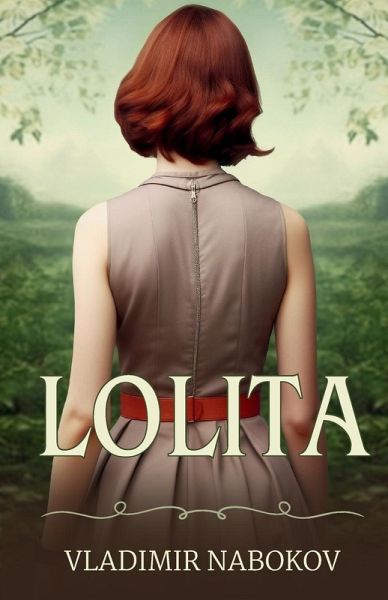
Lolita is a 1955 novel written by Russian-American novelist Vladimir Nabokov that addresses the controversial subject of hebephilia. The protagonist is a French literature professor who moves to New England and writes under the pseudonym Humbert Humbert. He details his obsession and victimization of a 12-year-old girl, Dolores Haze, whom he describes as a "nymphet". Humbert kidnaps and sexually abuses Dolores after becoming her stepfather. Privately, he calls her "Lolita", the Spanish diminutive for Dolores. The novel was written in English, but fear of censorship in the U.S. (where Nabokov…mehr
Lolita is a 1955 novel written by Russian-American novelist Vladimir Nabokov that addresses the controversial subject of hebephilia. The protagonist is a French literature professor who moves to New England and writes under the pseudonym Humbert Humbert. He details his obsession and victimization of a 12-year-old girl, Dolores Haze, whom he describes as a "nymphet". Humbert kidnaps and sexually abuses Dolores after becoming her stepfather. Privately, he calls her "Lolita", the Spanish diminutive for Dolores. The novel was written in English, but fear of censorship in the U.S. (where Nabokov lived) and Britain led to it being first published in Paris, France, in 1955 by Olympia Press.The book has received critical acclaim regardless of the controversy it caused with the public. It has been included in many lists of best books, such as Time's List of the 100 Best Novels, Le Monde's 100 Books of the Century, Bokklubben World Library, Modern Library's 100 Best Novels, and The Big Read. The novel has been twice adapted into film: first in 1962 by Stanley Kubrick, and later in 1997 by Adrian Lyne. It has also been adapted several times for the stage
VLADIMIR NABOKOV was born on April 23, 1899, in St. Petersburg, Russia. The Nabokovs were known for their high culture and commitment to public service, and the elder Nabokov was an outspoken opponent of antisemitism and one of the leaders of the opposition party, the Kadets. In 1919, following the Bolshevik revolution, he took his family into exile. Four years later he was shot and killed at a political rally in Berlin while trying to shield the speaker from right-wing assassins. The Nabokov household was trilingual, and as a child Nabokov was already reading Wells, Poe, Browning, Keats, Flaubert, Verlaine, Rimbaud, Tolstoy, and Chekhov, alongside the popular entertainments of Sir Arthur Conan Doyle and Jules Verne. As a young man, he studied Slavic and romance languages at Trinity College, Cambridge, taking his honors degree in 1922. For the next eighteen years he lived in Berlin and Paris, writing prolifically in Russian under the pseudonym Sirin and supporting himself through translations, lessons in English and tennis, and by composing the first crossword puzzles in Russian. In 1925 he married Vera Slonim, with whom he had one child, a son, Dmitri. Having already fled Russia and Germany, Nabokov became a refugee once more in 1940, when he was forced to leave France for the United States. There he taught at Wellesley, Harvard, and Cornell. He also gave up writing in Russian and began composing fiction in English. In his afterword to Lolita he claimed: "My private tragedy, which cannot, and indeed should not, be anybody's concern, is that I had to abandon my natural idiom, my untrammeled, rich, and infinitely docile Russian tongue for a second-rate brand of English, devoid of any of those apparatuses–the baffling mirror, the black velvet backdrop, the implied associations and traditions–which the native illusionist, frac-tails flying, can magically use to transcend the heritage in his own way." [p. 317] Yet Nabokov's American period saw the creation of what are arguably his greatest works, Bend Sinister (1947), Lolita (1955), Pnin (1957), and Pale Fire (1962), as well as the translation of his earlier Russian novels into English. He also undertook English translations of works by Lermontov and Pushkin and wrote several books of criticism. Vladimir Nabokov died in Montreux, Switzerland, in 1977.
Rezensionen
He did us all an honour by electing to use, and transform, our language. Anthony Burgess
Es gelten unsere Allgemeinen Geschäftsbedingungen: www.buecher.de/agb
Impressum
www.buecher.de ist ein Internetauftritt der buecher.de internetstores GmbH
Geschäftsführung: Monica Sawhney | Roland Kölbl | Günter Hilger
Sitz der Gesellschaft: Batheyer Straße 115 - 117, 58099 Hagen
Postanschrift: Bürgermeister-Wegele-Str. 12, 86167 Augsburg
Amtsgericht Hagen HRB 13257
Steuernummer: 321/5800/1497
USt-IdNr: DE450055826