

Andere Kunden interessierten sich auch für
 Laser Cooling and Trapping53,99 €
 The Physics of Laser-Atom Interactions130,99 €
 Coherent Atomic Manipulation and Cooling76,99 €
 Optical Cooling Using the Dipole Force76,99 €
 In-vessel retention via external reactor cooling32,99 €
 Corrosion Management of Seawater Cooling Systems165,99 €
 TRACE code validation for BWR spray cooling injection32,99 €







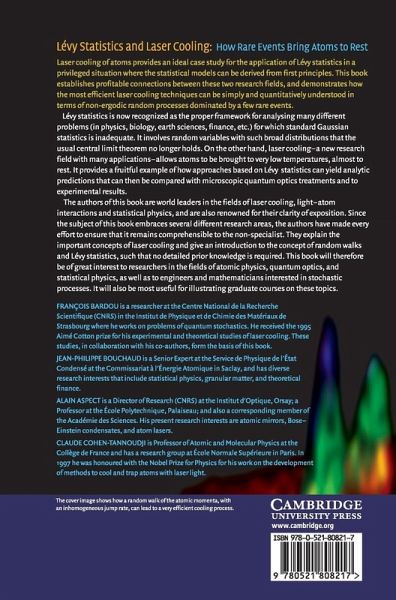
Laser cooling of atoms provides an ideal case study for the application of Lévy statistics in a privileged situation where the statistical model can be derived from first principles. This book demonstrates how the most efficient laser cooling techniques can be simply and quantitatively understood in terms of non-ergodic random processes dominated by a few rare events. Lévy statistics are now recognised as the proper tool for analysing many different problems for which standard Gaussian statistics are inadequate. Laser cooling provides a simple example of how Lévy statistics can yield analytic predictions that can be compared to other theoretical approaches and experimental results. The authors of this book are world leaders in the fields of laser cooling and light-atom interactions, and are renowned for their clear presentation. This book will therefore hold much interest for graduate students and researchers in the fields of atomic physics, quantum optics, and statistical physics.