
Andere Kunden interessierten sich auch für
 With Introduction And Commentary") M. Tullii Ciceronis De Natura Deorum, Libri Tres (Volume Ii) With Introduction And Commentary25,99 €
M. Tullii Ciceronis De Natura Deorum, Libri Tres (Volume Ii) With Introduction And Commentary25,99 €") M. Tullii Ciceronis De Officiis Ad Marcum Filium, Libri Tres (1778)33,99 €
M. Tullii Ciceronis De Officiis Ad Marcum Filium, Libri Tres (1778)33,99 € M. Tullii Ciceronis Libri Tres De Officiis...36,99 €
 M. Tulli Ciceronis De Officiis Libri Tres32,99 €
") M. Tullii Ciceronis Cato Major Sive De Senectute Liber (1852)21,99 €
M. Tullii Ciceronis Cato Major Sive De Senectute Liber (1852)21,99 € M. Tullii Ciceronis Cato Maior, Seu De Senectute21,99 €
![M. Tulli Ciceronis De Natura Deorum Liber Quartus, Ed. [or Rather Written By ] P. Seraphinus]( "M. Tulli Ciceronis De Natura Deorum Liber Quartus, Ed. [or Rather Written By ] P. Seraphinus") M. Tulli Ciceronis De Natura Deorum Liber Quartus, Ed. [or Rather Written By ] P. Seraphinus25,99 €
M. Tulli Ciceronis De Natura Deorum Liber Quartus, Ed. [or Rather Written By ] P. Seraphinus25,99 €





![M. Tulli Ciceronis De Natura Deorum Liber Quartus, Ed. [or Rather Written By ] P. Seraphinus](https://bilder.buecher.de/produkte/75/75119/75119706m.jpg "M. Tulli Ciceronis De Natura Deorum Liber Quartus, Ed. [or Rather Written By ] P. Seraphinus")
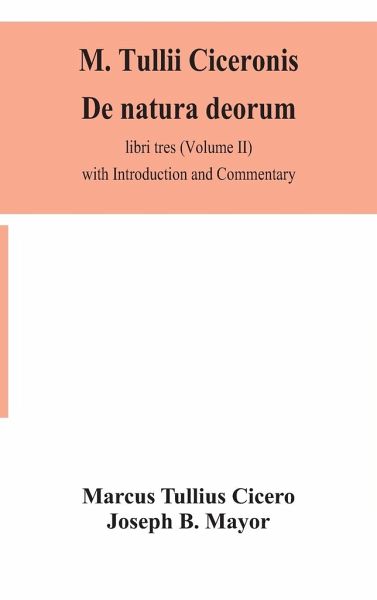
How do mortals comprehend the divine? Cicero's *De Natura Deorum* stands as the Roman Republic's most searching inquiry into the nature of the gods, weaving together wit, reason, and debate in a philosophical dialogue book that has shaped centuries of theological discourse. In this enduring masterpiece, Cicero brings together the leading schools of ancient Roman philosophy, exploring the mysteries of fate, providence, and human understanding with clarity and elegance. This volume, presented with an insightful introduction and scholarly commentary, offers both a gateway for newcomers and a rich resource for scholars of classical philosophy. Cicero's nuanced arguments, set against the vibrant backdrop of ancient Roman literature, illuminate the tensions and harmonies between Stoic, Epicurean, and Academic thought-dialogues that echo the works of Plato and Aristotle, yet distinctly Roman in their spirit and context. The text's careful restoration invites readers to grapple with questions that remain vital today, from the origins of belief to the limits of reason. Republished by Alpha Editions in a careful modern edition, this volume preserves the spirit of the original while making it effortless to enjoy today - a heritage title prepared for readers and collectors alike. For those drawn to Cicero's philosophical works, the intellectual ferment of the Roman Republic era, or the enduring allure of classical philosophy texts, this is more than a book: it is a cultural legacy, ready to inspire a new generation.