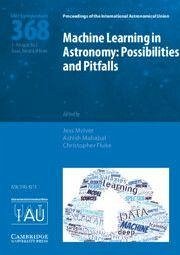
IAU S368 addresses graduate students and professional astronomers who wish to leverage machine learning to unlock the potential of modern data-rich surveys and deep images, as well as archival data. Researchers at the frontiers share best practices in applied machine learning that are relevant to astronomy and other data-rich fields.
IAU S368 addresses graduate students and professional astronomers who wish to leverage machine learning to unlock the potential of modern data-rich surveys and deep images, as well as archival data. Researchers at the frontiers share best practices in applied machine learning that are relevant to astronomy and other data-rich fields.
Produktdetails
Produktdetails
Proceedings of the International Astronomical Union Symposia and Colloquia
Enhancing exoplanet surveys via physics-informed machine earning Eric Ford; How do we design data sets for machine learning in astronomy? Renee Hlozek; Deep machine learning in cosmology: Evolution or revolution? Ofer Lahav; An astronomers guide to machine learning Sara Webb; Panel discussion: practical problem solving for machine learning David Parkinson; Panel discussion: methodology for fusion of large datasets Kai Polsterer; The entropy of galaxy spectra Ignacio Ferreras; Unsupervised classification: a necessary step for deep learning? Didier Fraix-Burnet; Spectral identi cation and classi cation of dusty stellar sources using spectroscopic and multiwavelength observations through machine learning Sepideh Ghaziasgar; Simulating transient burst noise with gengli Melissa Lopez; Detecting complex sources in large surveys using an apparent complexity measure David Parkinson; Machine learning in the study of star clusters with Gaia EDR3 Priya Shah; Assessing the quality of massive spectroscopic surveys with unsupervised machine learning John Suárez-Pérez; Neural networks for meteorite and meteor recognition Aisha Alowais; Unsupervised clustering visualisation tool for Gaia DR3 Marco Alvarez Gonzalez; Kinematic Planetary Signature Finder (KPSFinder): Convolutional neural network-based tool to search for exoplanets in ALMA data Jaehan Bae; Predicting physical parameters of Cepheid and RR Lyrae variables in an instant with machine learning Anupam Bhardwaj; Bayesian deconvolution of a rotating spectral line profile to a non-rotating one Michel Curé; A short study on the representation of gravitational waves data for convolutional neural network Margherita Grespan; Search for microlensing signature in gravitational waves from binary black hole events Kyungmin Kim; Deep learning and numerical simulations to infer the evolution of MaNGA galaxies Johan Knapen; Data pre-extraction for better classification of galaxy mergers William Pearson; Stellar spectra classification and clustering using deep learning Tomasz Ró äski; Is GMM effective in membership determination of open clusters? Priya Shah; Deep radio image segmentation Hattie Stewart; Computational techniques for high energy astrophysics and medical image processing Nicolás Vásquez; Deep learning proves to be an effective tool for detecting previously undiscovered exoplanets in Kepler data Amelia Yu.
Enhancing exoplanet surveys via physics-informed machine earning Eric Ford; How do we design data sets for machine learning in astronomy? Renee Hlozek; Deep machine learning in cosmology: Evolution or revolution? Ofer Lahav; An astronomers guide to machine learning Sara Webb; Panel discussion: practical problem solving for machine learning David Parkinson; Panel discussion: methodology for fusion of large datasets Kai Polsterer; The entropy of galaxy spectra Ignacio Ferreras; Unsupervised classification: a necessary step for deep learning? Didier Fraix-Burnet; Spectral identi cation and classi cation of dusty stellar sources using spectroscopic and multiwavelength observations through machine learning Sepideh Ghaziasgar; Simulating transient burst noise with gengli Melissa Lopez; Detecting complex sources in large surveys using an apparent complexity measure David Parkinson; Machine learning in the study of star clusters with Gaia EDR3 Priya Shah; Assessing the quality of massive spectroscopic surveys with unsupervised machine learning John Suárez-Pérez; Neural networks for meteorite and meteor recognition Aisha Alowais; Unsupervised clustering visualisation tool for Gaia DR3 Marco Alvarez Gonzalez; Kinematic Planetary Signature Finder (KPSFinder): Convolutional neural network-based tool to search for exoplanets in ALMA data Jaehan Bae; Predicting physical parameters of Cepheid and RR Lyrae variables in an instant with machine learning Anupam Bhardwaj; Bayesian deconvolution of a rotating spectral line profile to a non-rotating one Michel Curé; A short study on the representation of gravitational waves data for convolutional neural network Margherita Grespan; Search for microlensing signature in gravitational waves from binary black hole events Kyungmin Kim; Deep learning and numerical simulations to infer the evolution of MaNGA galaxies Johan Knapen; Data pre-extraction for better classification of galaxy mergers William Pearson; Stellar spectra classification and clustering using deep learning Tomasz Ró äski; Is GMM effective in membership determination of open clusters? Priya Shah; Deep radio image segmentation Hattie Stewart; Computational techniques for high energy astrophysics and medical image processing Nicolás Vásquez; Deep learning proves to be an effective tool for detecting previously undiscovered exoplanets in Kepler data Amelia Yu.
Es gelten unsere Allgemeinen Geschäftsbedingungen: www.buecher.de/agb
Impressum
www.buecher.de ist ein Internetauftritt der buecher.de internetstores GmbH
Geschäftsführung: Monica Sawhney | Roland Kölbl | Günter Hilger
Sitz der Gesellschaft: Batheyer Straße 115 - 117, 58099 Hagen
Postanschrift: Bürgermeister-Wegele-Str. 12, 86167 Augsburg
Amtsgericht Hagen HRB 13257
Steuernummer: 321/5800/1497
USt-IdNr: DE450055826