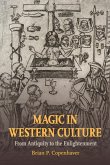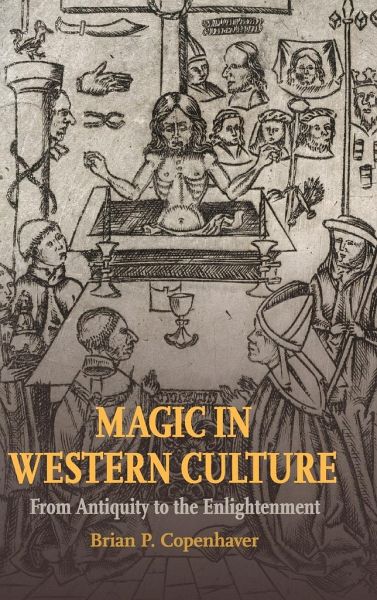
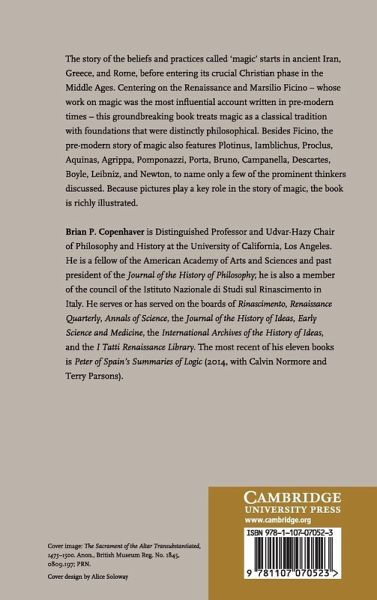
The story of the beliefs and practices called 'magic' starts in ancient Iran, Greece, and Rome, before entering its crucial Christian phase in the Middle Ages. Centering on the Renaissance and Marsilio Ficino - whose work on magic was the most influential account written in premodern times - this groundbreaking book treats magic as a classical tradition with foundations that were distinctly philosophical. Besides Ficino, the premodern story of magic also features Plotinus, Iamblichus, Proclus, Aquinas, Agrippa, Pomponazzi, Porta, Bruno, Campanella, Descartes, Boyle, Leibniz, and Newton, to…mehr
The story of the beliefs and practices called 'magic' starts in ancient Iran, Greece, and Rome, before entering its crucial Christian phase in the Middle Ages. Centering on the Renaissance and Marsilio Ficino - whose work on magic was the most influential account written in premodern times - this groundbreaking book treats magic as a classical tradition with foundations that were distinctly philosophical. Besides Ficino, the premodern story of magic also features Plotinus, Iamblichus, Proclus, Aquinas, Agrippa, Pomponazzi, Porta, Bruno, Campanella, Descartes, Boyle, Leibniz, and Newton, to name only a few of the prominent thinkers discussed in this book. Because pictures play a key role in the story of magic, this book is richly illustrated.
Brian P. Copenhaver is Distinguished Professor and Udvar-Hazy Chair of Philosophy and History at the University of California, Los Angeles. He is a fellow of the American Academy of Arts and Sciences and past president of the Journal of the History of Philosophy; he is also a member of the council of the Istituto Nazionale di Studi sul Rinascimento in Italy. He serves or has served on the boards of Rinascimento, Renaissance Quarterly, Annals of Science, the Journal of the History of Ideas, Early Science and Medicine, the International Archives of the History of Ideas, and the I Tatti Renaissance Library. The most recent of his eleven books is Peter of Spain's Summaries of Logic (2014, with Calvin Normore and Terry Parsons).
Inhaltsangabe
Part I. Introduction: 1. The scruples of J. G. Frazer 2. Magic as a classical tradition and its philosophical foundations Part II. Mageia: 3. Ancient philosophy in Ficino's magic I: Plotinus 4. Ancient philosophy in Ficinio's magic II: Neoplatonism and the Chaldaean Oracles 5. Ancient philosophy in Ficino's magic III: Hermes and Proclus 6. Scholastic philosophy in Ficino's magic 7. Data: a tale of two fish Part III. Hermetica: 8. Hermes the theologian 9. Hermes domesticated 10. Hermes on parade Part IV. Magic Revived and Rejected: 11. How to do magic, and why 12. Nature, magic, and the art of picturing 13. The power of magic and the poverty of erudition 14. Disenchantment Part V. Conclusion: 15. Who killed Dabholkar?
Es gelten unsere Allgemeinen Geschäftsbedingungen: www.buecher.de/agb
Impressum
www.buecher.de ist ein Internetauftritt der buecher.de internetstores GmbH
Geschäftsführung: Monica Sawhney | Roland Kölbl | Günter Hilger
Sitz der Gesellschaft: Batheyer Straße 115 - 117, 58099 Hagen
Postanschrift: Bürgermeister-Wegele-Str. 12, 86167 Augsburg
Amtsgericht Hagen HRB 13257
Steuernummer: 321/5800/1497
USt-IdNr: DE450055826