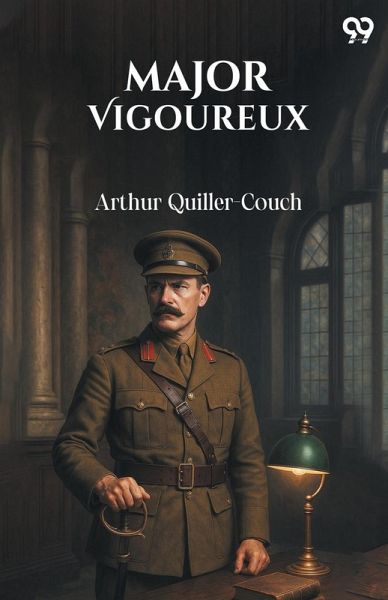
Major Vigoureux examines the tension between authority and absurdity within an isolated community shaped by outdated bureaucracy and uneven power. The narrative enhances questions of identity, responsibility, and the often-blurred boundary between service and selfhood. The novel draws on the struggles of leadership in a forgotten post, where tradition collides with logistical neglect and rigid systems fail to accommodate lived reality. It presents an environment where formal structure exists, but actual order is tenuous, revealing the strain on those expected to uphold it. Through the central…mehr
Major Vigoureux examines the tension between authority and absurdity within an isolated community shaped by outdated bureaucracy and uneven power. The narrative enhances questions of identity, responsibility, and the often-blurred boundary between service and selfhood. The novel draws on the struggles of leadership in a forgotten post, where tradition collides with logistical neglect and rigid systems fail to accommodate lived reality. It presents an environment where formal structure exists, but actual order is tenuous, revealing the strain on those expected to uphold it. Through the central figure s quiet introspection and persistent sense of honor, the text reflects on the burden of duty when recognition and resources are lacking. It portrays the subtle disintegration of official purpose into routine and comic frustration, while still allowing space for reflection on personal worth. Social status, civility, and the performance of authority become focal points, enriching the novel s ironic treatment of imperial responsibility. What emerges is a subdued yet compelling portrait of institutional inertia and the human need for relevance, set within a world where rules persist even when their reason fades.
Arthur Quiller-Couch was born in the town of Bodmin, Cornwall. He was the son of Dr. Thomas Quiller Couch, a renowned physician, folklorist, and historian who married Mary Ford and resided at 63 Fore Street, Bodmin, until his death in 1884. Thomas was the offspring of two historic local families, the Quiller and Couch dynasties. Arthur was the third generation of academics from the Couch family. His grandfather, Jonathan Couch, was a naturalist, physician, historian, classicist, pharmacist, and illustrator (especially of fish). His younger sisters, Florence Mabel and Lilian M., were both writers and folklorists. Quiller-Couch attended Newton Abbot Proprietary College between the late 1870s and the early 1880s. He later attended Clifton College and Trinity College, Oxford, where he earned a First in Classical Moderations (1884) and a Second in Greats (1886). Quiller-Couch briefly taught Classics at Trinity beginning in 1886. After gaining some journalistic experience in London, primarily as a writer to The Speaker (periodical), he settled in Fowey, Cornwall, in 1891.
Es gelten unsere Allgemeinen Geschäftsbedingungen: www.buecher.de/agb
Impressum
www.buecher.de ist ein Internetauftritt der buecher.de internetstores GmbH
Geschäftsführung: Monica Sawhney | Roland Kölbl | Günter Hilger
Sitz der Gesellschaft: Batheyer Straße 115 - 117, 58099 Hagen
Postanschrift: Bürgermeister-Wegele-Str. 12, 86167 Augsburg
Amtsgericht Hagen HRB 13257
Steuernummer: 321/5800/1497
USt-IdNr: DE450055826