Randolph C. Head
Making Archives in Early Modern Europe
Randolph C. Head
Making Archives in Early Modern Europe
- Gebundenes Buch
- Merkliste
- Auf die Merkliste
- Bewerten Bewerten
- Teilen
- Produkt teilen
- Produkterinnerung
- Produkterinnerung
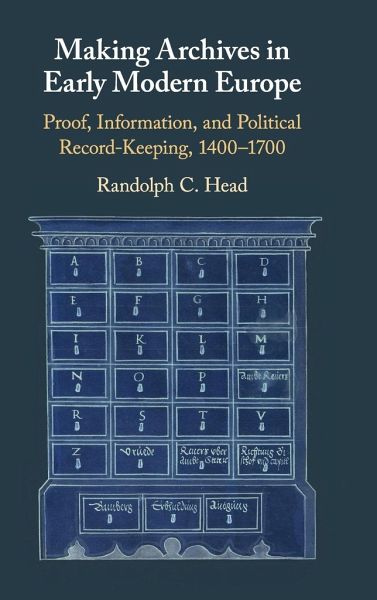
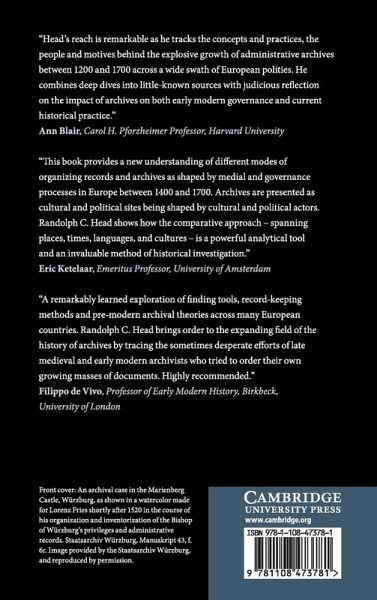
Compares the archives of European states after 1500 to reveal changes in how records supported memory, authority and power.
Andere Kunden interessierten sich auch für
Randolph C. HeadMaking Archives in Early Modern Europe47,99 €
David OnnekinkThe Dutch in the Early Modern World35,99 €
Jeff HornEconomic Development in Early Modern France104,99 €
Wayne P. Te BrakeReligious War and Religious Peace in Early Modern Europe101,99 €
Céline DauverdImperial Ambition in the Early Modern Mediterranean109,99 €
Gender in Early Modern German History47,99 €
Robert JuttePoverty and Deviance in Early Modern Europe45,99 €-
-
-
Compares the archives of European states after 1500 to reveal changes in how records supported memory, authority and power.
Produktdetails
- Produktdetails
- Verlag: Cambridge University Press
- Seitenzahl: 368
- Erscheinungstermin: 31. Mai 2019
- Englisch
- Abmessung: 235mm x 157mm x 24mm
- Gewicht: 683g
- ISBN-13: 9781108473781
- ISBN-10: 1108473784
- Artikelnr.: 55132123
- Herstellerkennzeichnung
- Libri GmbH
- Europaallee 1
- 36244 Bad Hersfeld
- gpsr@libri.de
- Verlag: Cambridge University Press
- Seitenzahl: 368
- Erscheinungstermin: 31. Mai 2019
- Englisch
- Abmessung: 235mm x 157mm x 24mm
- Gewicht: 683g
- ISBN-13: 9781108473781
- ISBN-10: 1108473784
- Artikelnr.: 55132123
- Herstellerkennzeichnung
- Libri GmbH
- Europaallee 1
- 36244 Bad Hersfeld
- gpsr@libri.de
Randolph C. Head is Professor of History at the University of California, Riverside. He has published extensively on democracy, religious conflict, and knowledge systems in early modern Europe, particularly Switzerland. His publications, which were recognized by the Max Geilinger Prize in 2017, include Early Modern Democracy in the Grisons (Cambridge, 1995), Jenatsch's Axe (2008), and A Concise History of Switzerland (with Clive Church, Cambridge, 2013).
Foreword: writing the history of archives; 1. Introduction: records, tools
and archives in Europe to 1700; 2. Archival history: literature and
outlook; Part I. The Work of Records (1200- ): 3. Probative objects and
Scholastic tools in the High Middle Ages; 4. A late medieval chancellery
and its books: Lisbon, 1460-1560; 5. Keeping and organizing information
from the Middle Ages to the sixteenth century; 6. Information management in
early modern Innsbruck, 1490-1530; Part II. The Challenges of Accumulation
(1400- ): 7. The accumulation of records and the evolution of inventories;
8. Early modern inventories: Habsburg Austria and Würzburg; 9.
Classification: the architecture of knowledge and the placement of records;
10. The formal logic of classification: topography and taxonomy in Swiss
urban records, 1500-1700; Part III. Comprehensive Visions and
Differentiating Practices (1550- ): 11. Evolving expectations about
archives, 1540-1650; 12. Registries: tracking the business of governance;
Part IV. Rethinking Records and State Archives (1550- ): 13. Understanding
records: new perspectives and new readings after 1550; 14. New disciplines
of authenticity and authority: Mabillon's diplomatics and the ius archive;
15. Conclusion: the era of chancellery books and beyond.
and archives in Europe to 1700; 2. Archival history: literature and
outlook; Part I. The Work of Records (1200- ): 3. Probative objects and
Scholastic tools in the High Middle Ages; 4. A late medieval chancellery
and its books: Lisbon, 1460-1560; 5. Keeping and organizing information
from the Middle Ages to the sixteenth century; 6. Information management in
early modern Innsbruck, 1490-1530; Part II. The Challenges of Accumulation
(1400- ): 7. The accumulation of records and the evolution of inventories;
8. Early modern inventories: Habsburg Austria and Würzburg; 9.
Classification: the architecture of knowledge and the placement of records;
10. The formal logic of classification: topography and taxonomy in Swiss
urban records, 1500-1700; Part III. Comprehensive Visions and
Differentiating Practices (1550- ): 11. Evolving expectations about
archives, 1540-1650; 12. Registries: tracking the business of governance;
Part IV. Rethinking Records and State Archives (1550- ): 13. Understanding
records: new perspectives and new readings after 1550; 14. New disciplines
of authenticity and authority: Mabillon's diplomatics and the ius archive;
15. Conclusion: the era of chancellery books and beyond.
Foreword: writing the history of archives; 1. Introduction: records, tools
and archives in Europe to 1700; 2. Archival history: literature and
outlook; Part I. The Work of Records (1200- ): 3. Probative objects and
Scholastic tools in the High Middle Ages; 4. A late medieval chancellery
and its books: Lisbon, 1460-1560; 5. Keeping and organizing information
from the Middle Ages to the sixteenth century; 6. Information management in
early modern Innsbruck, 1490-1530; Part II. The Challenges of Accumulation
(1400- ): 7. The accumulation of records and the evolution of inventories;
8. Early modern inventories: Habsburg Austria and Würzburg; 9.
Classification: the architecture of knowledge and the placement of records;
10. The formal logic of classification: topography and taxonomy in Swiss
urban records, 1500-1700; Part III. Comprehensive Visions and
Differentiating Practices (1550- ): 11. Evolving expectations about
archives, 1540-1650; 12. Registries: tracking the business of governance;
Part IV. Rethinking Records and State Archives (1550- ): 13. Understanding
records: new perspectives and new readings after 1550; 14. New disciplines
of authenticity and authority: Mabillon's diplomatics and the ius archive;
15. Conclusion: the era of chancellery books and beyond.
and archives in Europe to 1700; 2. Archival history: literature and
outlook; Part I. The Work of Records (1200- ): 3. Probative objects and
Scholastic tools in the High Middle Ages; 4. A late medieval chancellery
and its books: Lisbon, 1460-1560; 5. Keeping and organizing information
from the Middle Ages to the sixteenth century; 6. Information management in
early modern Innsbruck, 1490-1530; Part II. The Challenges of Accumulation
(1400- ): 7. The accumulation of records and the evolution of inventories;
8. Early modern inventories: Habsburg Austria and Würzburg; 9.
Classification: the architecture of knowledge and the placement of records;
10. The formal logic of classification: topography and taxonomy in Swiss
urban records, 1500-1700; Part III. Comprehensive Visions and
Differentiating Practices (1550- ): 11. Evolving expectations about
archives, 1540-1650; 12. Registries: tracking the business of governance;
Part IV. Rethinking Records and State Archives (1550- ): 13. Understanding
records: new perspectives and new readings after 1550; 14. New disciplines
of authenticity and authority: Mabillon's diplomatics and the ius archive;
15. Conclusion: the era of chancellery books and beyond.