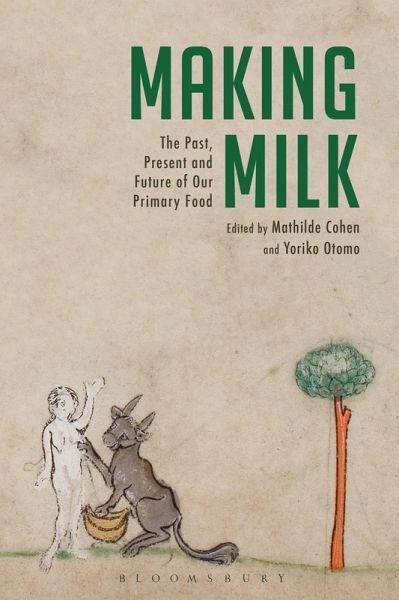
What is milk? Who is it for, and what work does it do? This collection of articles bring together an exciting group of the world's leading scholars from different disciplines to provide commentaries on multiple facets of the production, consumption, understanding and impact of milk on society. The book frames the emerging global discussion around philosophical and critical theoretical engagements with milk. In so doing, various chapters bring into consideration an awareness of animals, an aspect which has not yet been incorporated in these debates within these disciplines so far. This brand…mehr
What is milk? Who is it for, and what work does it do? This collection of articles bring together an exciting group of the world's leading scholars from different disciplines to provide commentaries on multiple facets of the production, consumption, understanding and impact of milk on society. The book frames the emerging global discussion around philosophical and critical theoretical engagements with milk. In so doing, various chapters bring into consideration an awareness of animals, an aspect which has not yet been incorporated in these debates within these disciplines so far. This brand new research from scholars includes writing from an array of perspectives, including jurisprudence, food law, history, geography, art theory, and gender studies. It will be of use to professionals and researchers in such disciplines as anthropology, visual culture, cultural studies, development studies, food studies, environment studies, critical animal studies, and gender studies.
Mathilde Cohen is Professor of Law and the Robert D. Glass Research Scholar at the University of Connecticut, USA. Cohen is a Research Fellow at the CNRS, France. Yoriko Otomo is Senior Lecturer in Law at SOAS, University of London, UK. She was recently a Visiting Fellow at the Oxford Centre for Global History, University of Oxford, UK and a Visiting Fellow at the University of New South Wales, Australia.
Inhaltsangabe
List of Tables List of Contributors Foreword Acknowledgments Introduction Part One: Drinking Milk: Histories and Representations 1. More than Food: Animals Men and Supernatural Lactation in Occidental Late Middle Ages Chloé Maillet (Musée du quai de Branly France) 2. Feminized Protein: Meaning Representations and Implications Carol J. Adams (independent scholar USA) 3. Growing a Nation: Milk Consumption in India since the Raj Andrea S. Wiley (Indiana University USA) Part Two: Making Milk: Technologies and Economies 4. Unreliable Matriarchs Melanie Jackson (UCL University of London UK) and Esther Leslie (Birkbeck University of London UK) 5. The Mechanical Calf: On the Making of a Multispecies Machine Richie Nimmo (University of Manchester UK) 6. Milk Adulteration Disgust: Making Legal Meaning Yofi Tirosh (Tel Aviv University Israel) and Yair Eldan (Ono Academic College Israel) 7. Markets in Mothers' Milk: Virtue Vice Promise or Problem?Julie P. Smith (Australian National University Australia) Part Three: Queering Milk: Male Feeding and Plant Milk 8. The Lactating Man Mathilde Cohen (University of Connecticut USA) 9. "Cow's Milk is for Calves Breastmilk is for Babies." Alfred Bosworth's Reconstituted Milk and the Women who Innovated Infant Feeding Amid an American Health Crisis Hannah Ryan (Cornell University USA) 10. Plant Milk: From Obscurity to Visions of a Post-Dairy Society Tobias Linné (Lund University Sweden) and Ally McCrow-Young (University of Copenhagen Denmark) 11. Critical Ecofeminism: Milk Fauna and Flora Greta Gaard (University of Wisconsin-River Falls USA) Part Four: Thinking about Plant Milk 12. Milk and Meaning: Puzzles in Posthumanist Method Jessica Eisen (Harvard Law School USA) 13. DIY Plant Milk: A Recipe-Manifesto and Method of Ethical Relations Care and Resistance Matilda Arvidsson (Lund University Sweden) Notes Bibliography Index
List of Tables List of Contributors Foreword Acknowledgments Introduction Part One: Drinking Milk: Histories and Representations 1. More than Food: Animals Men and Supernatural Lactation in Occidental Late Middle Ages Chloé Maillet (Musée du quai de Branly France) 2. Feminized Protein: Meaning Representations and Implications Carol J. Adams (independent scholar USA) 3. Growing a Nation: Milk Consumption in India since the Raj Andrea S. Wiley (Indiana University USA) Part Two: Making Milk: Technologies and Economies 4. Unreliable Matriarchs Melanie Jackson (UCL University of London UK) and Esther Leslie (Birkbeck University of London UK) 5. The Mechanical Calf: On the Making of a Multispecies Machine Richie Nimmo (University of Manchester UK) 6. Milk Adulteration Disgust: Making Legal Meaning Yofi Tirosh (Tel Aviv University Israel) and Yair Eldan (Ono Academic College Israel) 7. Markets in Mothers' Milk: Virtue Vice Promise or Problem?Julie P. Smith (Australian National University Australia) Part Three: Queering Milk: Male Feeding and Plant Milk 8. The Lactating Man Mathilde Cohen (University of Connecticut USA) 9. "Cow's Milk is for Calves Breastmilk is for Babies." Alfred Bosworth's Reconstituted Milk and the Women who Innovated Infant Feeding Amid an American Health Crisis Hannah Ryan (Cornell University USA) 10. Plant Milk: From Obscurity to Visions of a Post-Dairy Society Tobias Linné (Lund University Sweden) and Ally McCrow-Young (University of Copenhagen Denmark) 11. Critical Ecofeminism: Milk Fauna and Flora Greta Gaard (University of Wisconsin-River Falls USA) Part Four: Thinking about Plant Milk 12. Milk and Meaning: Puzzles in Posthumanist Method Jessica Eisen (Harvard Law School USA) 13. DIY Plant Milk: A Recipe-Manifesto and Method of Ethical Relations Care and Resistance Matilda Arvidsson (Lund University Sweden) Notes Bibliography Index
Es gelten unsere Allgemeinen Geschäftsbedingungen: www.buecher.de/agb
Impressum
www.buecher.de ist ein Internetauftritt der buecher.de internetstores GmbH
Geschäftsführung: Monica Sawhney | Roland Kölbl | Günter Hilger
Sitz der Gesellschaft: Batheyer Straße 115 - 117, 58099 Hagen
Postanschrift: Bürgermeister-Wegele-Str. 12, 86167 Augsburg
Amtsgericht Hagen HRB 13257
Steuernummer: 321/5800/1497
USt-IdNr: DE450055826