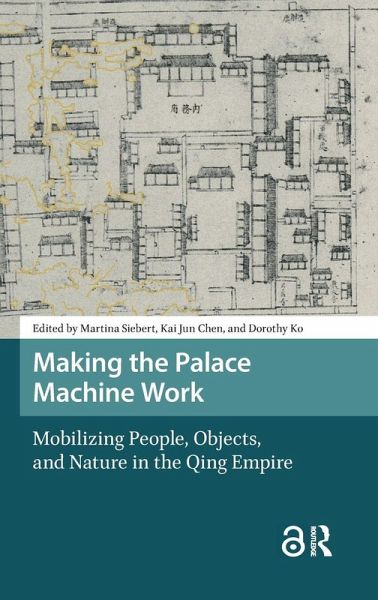
Making the Palace Machine Work: Mobilizing People, Objects, and Nature in the Qing Empire brings the studies of institutions, labour, and material cultures to bear on the history of science and technology by tracing the workings of the Imperial Household Department (Neiwufu) in the Qing court and empire.
Making the Palace Machine Work: Mobilizing People, Objects, and Nature in the Qing Empire brings the studies of institutions, labour, and material cultures to bear on the history of science and technology by tracing the workings of the Imperial Household Department (Neiwufu) in the Qing court and empire.
Martina Siebert works as subject librarian at the East Asia department of the Staatsbibliothek zu Berlin and as independent scholar. She researches and publishes on the history of Chinese exploration into nature and technology with a focus on the styles and agendas of presenting and organizing that knowledge in writing. Kai Jun Chen is Assistant Professor at Brown University. The author of a forthcoming monograph on the technocratic culture in the Qing Imperial Ceramic Industry, he specialises in the history of imperial institutions, handicraft technology, and material culture studies. A native of Hong Kong, Dorothy Ko is Professor of History at Barnard College, Columbia University. She is a cultural historian of early modern China whose research and publication focus on gender, technology, and material culture.
Inhaltsangabe
Map of Imperial and Forbidden City Map of Beijing and outskirts Map of Qing China (1820) Acknowledgments Conventions for the Notation of Time Weights and Measures Note on Translation List of Figures Tables Charts and Maps Introduction Part I. Operating the Machine: Personnel and Paper Trails Vignette essay. Moving Pieces: On the Reuse of Interior Decoration Objects in Qing Palaces (Shuxian Zhang) 1. Working the Qing Palace Machine: The Servants' Perspective (Christine Moll-Murata) 2. Manager or Craftsman: Skillful Bannermen of the Qing Dynasty (1644-1912) (Kai Jun Chen) 3. Kupiao and the Accounting System of the Imperial Household Workshops (Yijun Wang and Kyoungjin Bae) Part II. Producing the Court: Materials and Artefacts Vignette essay. The Story of An Image: Ding Guanpeng's 'Ultimate Bliss' and the Auspiciousness of Reproduction (Qiong Zhang) 4. Piecing Shards Together: The Uses and Manufacturing of Imperially Porcelain (Guangyao Wang) 5. Resplendent Innovations: Fire Gilding Techniques at the Qing Court (Hui-min Lai and Te-cheng Su) 6. Transporting Jade: Objects Ecology and Local Bureaucracy in Qing Xinjiang (Yulian Wu) Part III. Mobilizing Nature: Plants and Animals Vignette essay. Decluttering: On the Classification of Objects at the Imperial Household Department (Elif Akçetin) 7. Growing and Organizing Lotus in Qing Imperial Spaces: Interlocking Cycles of Money and Nature (Martina Siebert) 8. The Medicine Supply System of the Qing Court (Xueling Guan) 9. When There Is Peace There Are Elephants (Hui-chun Yu) Coda Bibliography Index
Map of Imperial and Forbidden City Map of Beijing and outskirts Map of Qing China (1820) Acknowledgments Conventions for the Notation of Time Weights and Measures Note on Translation List of Figures Tables Charts and Maps Introduction Part I. Operating the Machine: Personnel and Paper Trails Vignette essay. Moving Pieces: On the Reuse of Interior Decoration Objects in Qing Palaces (Shuxian Zhang) 1. Working the Qing Palace Machine: The Servants' Perspective (Christine Moll-Murata) 2. Manager or Craftsman: Skillful Bannermen of the Qing Dynasty (1644-1912) (Kai Jun Chen) 3. Kupiao and the Accounting System of the Imperial Household Workshops (Yijun Wang and Kyoungjin Bae) Part II. Producing the Court: Materials and Artefacts Vignette essay. The Story of An Image: Ding Guanpeng's 'Ultimate Bliss' and the Auspiciousness of Reproduction (Qiong Zhang) 4. Piecing Shards Together: The Uses and Manufacturing of Imperially Porcelain (Guangyao Wang) 5. Resplendent Innovations: Fire Gilding Techniques at the Qing Court (Hui-min Lai and Te-cheng Su) 6. Transporting Jade: Objects Ecology and Local Bureaucracy in Qing Xinjiang (Yulian Wu) Part III. Mobilizing Nature: Plants and Animals Vignette essay. Decluttering: On the Classification of Objects at the Imperial Household Department (Elif Akçetin) 7. Growing and Organizing Lotus in Qing Imperial Spaces: Interlocking Cycles of Money and Nature (Martina Siebert) 8. The Medicine Supply System of the Qing Court (Xueling Guan) 9. When There Is Peace There Are Elephants (Hui-chun Yu) Coda Bibliography Index
Es gelten unsere Allgemeinen Geschäftsbedingungen: www.buecher.de/agb
Impressum
www.buecher.de ist ein Internetauftritt der buecher.de internetstores GmbH
Geschäftsführung: Monica Sawhney | Roland Kölbl | Günter Hilger
Sitz der Gesellschaft: Batheyer Straße 115 - 117, 58099 Hagen
Postanschrift: Bürgermeister-Wegele-Str. 12, 86167 Augsburg
Amtsgericht Hagen HRB 13257
Steuernummer: 321/5800/1497
USt-IdNr: DE450055826