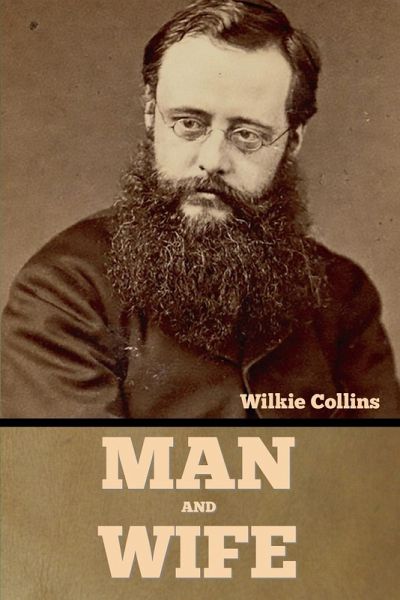
Man and Wife was Wilkie Collins's ninth published novel. It is the second of his novels (after No Name) in which social questions provide the main impetus of the plot. Collins increasingly used his novels to explore social abuses, which according to critics tends to detract from their qualities as fiction. The social issue which drives the plot is the state of Scots marriage law; at the time the novel was written, any couple who were legally entitled to marry and who asserted that they were married, either before witnesses or in writing, were regarded in Scotland as being legally married. The…mehr
Man and Wife was Wilkie Collins's ninth published novel. It is the second of his novels (after No Name) in which social questions provide the main impetus of the plot. Collins increasingly used his novels to explore social abuses, which according to critics tends to detract from their qualities as fiction. The social issue which drives the plot is the state of Scots marriage law; at the time the novel was written, any couple who were legally entitled to marry and who asserted that they were married, either before witnesses or in writing, were regarded in Scotland as being legally married. The novel, the next in sequence after Collins's highly successful The Moonstone, was a commercial success. Among modern critics, Peters holds a low opinion of its plot and characterisation, but Page argues that it should be classed with Collins's acclaimed 1860s fiction rather than with his later, and inferior, polemical novels. The novel has proved enduringly popular and remains in print. (wikipedia.org)
William Wilkie Collins was an English novelist and playwright best known for The Woman in White (1859), a mystery and early sensation novel, and The Moonstone (1868), which established many of the ground rules of the modern detective novel and may be the first clear example of the police procedural genre. Born to London painter William Collins and his wife, Harriet Geddes, he moved to Italy with them when he was twelve years old, spending two years there and in France learning both Italian and French. Collins was born at 11 New Cavendish Street in London, the son of William Collins, a well-known Royal Academician landscape painter, and his wife, Harriet Geddes. Named after his father, he quickly became recognized by his second name, which honors his godfather, painter David Wilkie. The family relocated to Pond Street, Hampstead, around 1826. In 1828, Collins' brother Charles Allston Collins was born. Between 1829 and 1830, the Collins family relocated twice: first to Hampstead Square and subsequently to Porchester Terrace in Bayswater. Wilkie and Charles received an early education from their mother at home. The Collins family was very religious, and Collins' mother insisted on strict church attendance for her boys, which Wilkie detested.
Es gelten unsere Allgemeinen Geschäftsbedingungen: www.buecher.de/agb
Impressum
www.buecher.de ist ein Internetauftritt der buecher.de internetstores GmbH
Geschäftsführung: Monica Sawhney | Roland Kölbl | Günter Hilger
Sitz der Gesellschaft: Batheyer Straße 115 - 117, 58099 Hagen
Postanschrift: Bürgermeister-Wegele-Str. 12, 86167 Augsburg
Amtsgericht Hagen HRB 13257
Steuernummer: 321/5800/1497
USt-IdNr: DE450055826