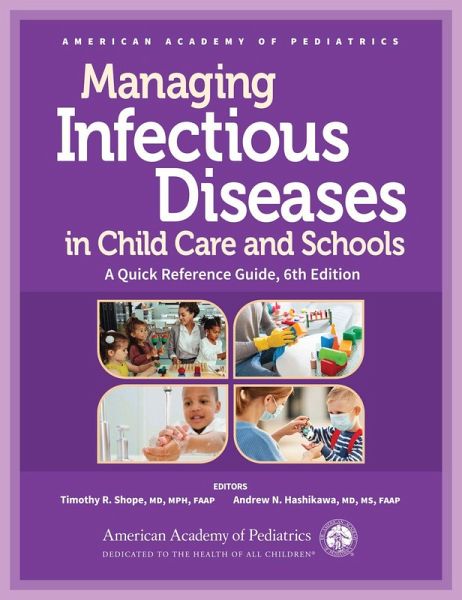
Completely revised and updated, the new sixth edition of this award-winning quick reference guide provides essential information about the prevention and management of infectious diseases in early childhood education settings, such as child care centers and schools. This edition is aligned with the most recent version of the premier American Academy of Pediatrics (AAP) source of information on infectious diseases, Red Book®: 2021–2024 Report of the Committee on Infectious Diseases, 32nd Edition. The robust section of more than 55 quick reference fact sheets on common infectious diseases…mehr
Completely revised and updated, the new sixth edition of this award-winning quick reference guide provides essential information about the prevention and management of infectious diseases in early childhood education settings, such as child care centers and schools. This edition is aligned with the most recent version of the premier American Academy of Pediatrics (AAP) source of information on infectious diseases, Red Book®: 2021–2024 Report of the Committee on Infectious Diseases, 32nd Edition. The robust section of more than 55 quick reference fact sheets on common infectious diseases and symptoms has been expanded to include a new sheet with pediatrician-approved guidance on best practices regarding COVID-19. Managing Infectious Diseases in Child Care and Schools now includes information on pandemic preparedness and introduces a new website that will be continually updated with time-sensitive information for the prevention of infectious diseases. As always, the guide is easy to use and provides clear, authoritative guidance on limiting the spread of infection.
Timothy R. Shope, MD, MPH, FAAP, is an academic general pediatrician and professor of pediatrics at UPMC Children’s Hospital of Pittsburgh. Dr Shope has over 30 years of experience consulting with early childhood educational programs and schools, the Department of Defense, and state policymakers on the topic of managing infectious diseases. He speaks regularly at national meetings and webinars and contributes to many publications on the subject. Dr Shope is a member of the American Academy of Pediatrics Council on Early Childhood. Andrew N. Hashikawa, MD, MS, FAAP, is a pediatric emergency medicine (PEM) physician and associate professor at the University of Michigan. He serves as a volunteer child care health consultant for local child care centers. He earned his medical degree and completed a pediatric residency at the Mayo Clinic. He then completed a PEM fellowship and a master’s degree in epidemiology at the Medical College of Wisconsin. Dr Hashikawa has served as the American Academy of Pediatrics (AAP) Michigan Early Childhood Champion for over a decade. He has helped create training content on injury prevention and medication administration for child care providers on the AAP e-learning platform Pedialink. He is an executive committee member of the AAP Council on Early Childhood. Dr. Hashikawa has published extensively in child care research related to health and safety. He created MCRISP (Michigan Child Care Related Surveillance Program) to assist child care centers in reporting illnesses to the local public health department. He received the Head Start 50th Anniversary Award in 2015, and in 2019, he received the AAP Council on Early Childhood Dr Susan S. Aronson Early Education and Child Advocacy Award for making a significant contribution to improving the health, safety, and development of children in early education and child care settings. Dr Hashikawa resides near Ann Arbor with his wife and 3 teenage daughters.
Inhaltsangabe
Preface About This Book What Is New in This Edition? Chapter 1 Overview of Managing Infectious Diseases in Child Care and Schools * Introduction * Keeping Children and Adults in Group Settings Healthy * Roles of Families, Staff Members, and Health Professionals in Managing Infectious Diseases for Children Enrolled in Early Education and Child Care * Planning and Policies Chapter 2 Reduce the Risk of Infection: Practice Prevention * Safe Food Preparation and Service * Hand Hygiene * Changing Diapers, Soiled Disposable Training Pants, and Soiled Underwear * Preventive Oral Health * Standard Precautions * Sanitation, Disinfection, and Maintenance * Heating, Ventilation, and Air-conditioning Chapter 3 Health of Teachers, Caregivers, and Other Staff Members * Introduction * Preemployment Requirements and Ongoing Adult Health Appraisals and Immunizations * Immunization With Recommended Vaccines * Oral Health Practices in Early Childhood Education Settings * Health Limitations for Staff Members * Policies and Procedures Related to Caring for Staff and Children Who Are Ill * Staff Learn, Teach, and Practice Minimizing Infectious Diseases Chapter 4 Recognizing the Ill Child: Inclusion/Exclusion Criteria * Daily Health Check * Elements to Observe and Information to Gather * Situations That Require Medical Attention Right Away * Conditions That Do Not Require Exclusion to Control Spread of Disease to Others * Conditions Requiring Temporary Exclusion * Procedures for a Child Who Requires Exclusion * Reportable/Notifiable Conditions * Preparing for Managing Illness Chapter 5 Signs and Symptoms Chart Chapter 6 Quick Reference Sheets * Bedbugs * Bites (Human and Animal) * Boil/Abscess/Cellulitis * Campylobacter * Chickenpox (Varicella-Zoster Infections) * Clostridium difficile (Also Called “C diff”) * COVID-19 * Croup * Cryptosporidiosis * Cytomegalovirus (CMV) Infection * Dental Caries (Early Childhood Caries, Tooth Decay, or Cavities) * Diaper Rash * Diarrhea * Diarrhea Caused by Specific Types of E coli (Escherichia coli) * Ear Infection * Fever * Fifth Disease (Human Parvovirus B19) * Giardiasis * Haemophilus influenzae Type b (Hib) * Hand-Foot-and-Mouth Disease * Hepatitis A Infection * Hepatitis B Infection * Herpes Simplex (Cold Sores) * HIV/AIDS * Impetigo * Influenza * Lice (Pediculosis Capitis) * Lyme Disease (and Other Tick-borne Diseases) * Measles * Meningitis * Molluscum Contagiosum * Mononucleosis * Mosquito-borne Diseases * Mouth Sores * Mumps * Norovirus * Pinkeye (Conjunctivitis) * Pinworms * Pneumonia * Respiratory Syncytial Virus (RSV) * Ringworm * Roseola (Human Herpesvirus 6 and 7) * Rotavirus * Rubella (German Measles) * Salmonella * Scabies * Shigella * Shingles (Herpes Zoster) * Staphylococcus aureus (Methicillin-Resistant [MRSA] and Methicillin-Sensitive [MSSA]) * Strep Throat (Streptococcal Pharyngitis) and Scarlet Fever * Sty * Thrush (Candidiasis) * Tuberculosis (TB) * Upper Respiratory Infection (Common Cold) * Urinary Tract Infection * Vomiting * Warts (Human Papillomavirus) * Whooping Cough (Pertussis) Chapter 7 Infectious Disease Outbreaks, Epidemics, Pandemics, and Bioterrorism * Why Children Are Especially Vulnerable * Planning * Types of Infectious Disease Emergencies * Closure of Group Care Facilities * Quick Communication and Initiation of Emergency Procedures * Symptom Records * Parent/Legal Guardian Notification * Tracking Procedure * Corrective Action Chapter 8 Sample Letters, Forms, and Relevant Resources * Child Health Assessment Form * Special Care Plan Form * Medication Administration Packet * Letter to Staff About Occupational Health Risks * Refusal to Vaccinate Form * Staff Health Assessment Form * Routine Schedule for Cleaning, Sanitizing, and Disinfecting * Selecting an Appropriate Sanitizer or Disinfectant * Cleaning Up Body Fluids * Sample Health Information Consent Form * Sample Food Service Cleaning Schedule * Diapering Poster * Gloving * Infections Caused by Interactions of Humans With Pets and Wild Animals * Symptom Record Form * Enrollment/Attendance/Symptom Record * Situations That Require Medical Attention Right Away * Sample Letter to Families About Exposure to Communicable Disease Glossary Index
Preface About This Book What Is New in This Edition? Chapter 1 Overview of Managing Infectious Diseases in Child Care and Schools * Introduction * Keeping Children and Adults in Group Settings Healthy * Roles of Families, Staff Members, and Health Professionals in Managing Infectious Diseases for Children Enrolled in Early Education and Child Care * Planning and Policies Chapter 2 Reduce the Risk of Infection: Practice Prevention * Safe Food Preparation and Service * Hand Hygiene * Changing Diapers, Soiled Disposable Training Pants, and Soiled Underwear * Preventive Oral Health * Standard Precautions * Sanitation, Disinfection, and Maintenance * Heating, Ventilation, and Air-conditioning Chapter 3 Health of Teachers, Caregivers, and Other Staff Members * Introduction * Preemployment Requirements and Ongoing Adult Health Appraisals and Immunizations * Immunization With Recommended Vaccines * Oral Health Practices in Early Childhood Education Settings * Health Limitations for Staff Members * Policies and Procedures Related to Caring for Staff and Children Who Are Ill * Staff Learn, Teach, and Practice Minimizing Infectious Diseases Chapter 4 Recognizing the Ill Child: Inclusion/Exclusion Criteria * Daily Health Check * Elements to Observe and Information to Gather * Situations That Require Medical Attention Right Away * Conditions That Do Not Require Exclusion to Control Spread of Disease to Others * Conditions Requiring Temporary Exclusion * Procedures for a Child Who Requires Exclusion * Reportable/Notifiable Conditions * Preparing for Managing Illness Chapter 5 Signs and Symptoms Chart Chapter 6 Quick Reference Sheets * Bedbugs * Bites (Human and Animal) * Boil/Abscess/Cellulitis * Campylobacter * Chickenpox (Varicella-Zoster Infections) * Clostridium difficile (Also Called “C diff”) * COVID-19 * Croup * Cryptosporidiosis * Cytomegalovirus (CMV) Infection * Dental Caries (Early Childhood Caries, Tooth Decay, or Cavities) * Diaper Rash * Diarrhea * Diarrhea Caused by Specific Types of E coli (Escherichia coli) * Ear Infection * Fever * Fifth Disease (Human Parvovirus B19) * Giardiasis * Haemophilus influenzae Type b (Hib) * Hand-Foot-and-Mouth Disease * Hepatitis A Infection * Hepatitis B Infection * Herpes Simplex (Cold Sores) * HIV/AIDS * Impetigo * Influenza * Lice (Pediculosis Capitis) * Lyme Disease (and Other Tick-borne Diseases) * Measles * Meningitis * Molluscum Contagiosum * Mononucleosis * Mosquito-borne Diseases * Mouth Sores * Mumps * Norovirus * Pinkeye (Conjunctivitis) * Pinworms * Pneumonia * Respiratory Syncytial Virus (RSV) * Ringworm * Roseola (Human Herpesvirus 6 and 7) * Rotavirus * Rubella (German Measles) * Salmonella * Scabies * Shigella * Shingles (Herpes Zoster) * Staphylococcus aureus (Methicillin-Resistant [MRSA] and Methicillin-Sensitive [MSSA]) * Strep Throat (Streptococcal Pharyngitis) and Scarlet Fever * Sty * Thrush (Candidiasis) * Tuberculosis (TB) * Upper Respiratory Infection (Common Cold) * Urinary Tract Infection * Vomiting * Warts (Human Papillomavirus) * Whooping Cough (Pertussis) Chapter 7 Infectious Disease Outbreaks, Epidemics, Pandemics, and Bioterrorism * Why Children Are Especially Vulnerable * Planning * Types of Infectious Disease Emergencies * Closure of Group Care Facilities * Quick Communication and Initiation of Emergency Procedures * Symptom Records * Parent/Legal Guardian Notification * Tracking Procedure * Corrective Action Chapter 8 Sample Letters, Forms, and Relevant Resources * Child Health Assessment Form * Special Care Plan Form * Medication Administration Packet * Letter to Staff About Occupational Health Risks * Refusal to Vaccinate Form * Staff Health Assessment Form * Routine Schedule for Cleaning, Sanitizing, and Disinfecting * Selecting an Appropriate Sanitizer or Disinfectant * Cleaning Up Body Fluids * Sample Health Information Consent Form * Sample Food Service Cleaning Schedule * Diapering Poster * Gloving * Infections Caused by Interactions of Humans With Pets and Wild Animals * Symptom Record Form * Enrollment/Attendance/Symptom Record * Situations That Require Medical Attention Right Away * Sample Letter to Families About Exposure to Communicable Disease Glossary Index
Es gelten unsere Allgemeinen Geschäftsbedingungen: www.buecher.de/agb
Impressum
www.buecher.de ist ein Internetauftritt der buecher.de internetstores GmbH
Geschäftsführung: Monica Sawhney | Roland Kölbl | Günter Hilger
Sitz der Gesellschaft: Batheyer Straße 115 - 117, 58099 Hagen
Postanschrift: Bürgermeister-Wegele-Str. 12, 86167 Augsburg
Amtsgericht Hagen HRB 13257
Steuernummer: 321/5800/1497
USt-IdNr: DE450055826