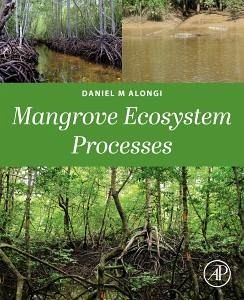
Mangrove Ecosystem Dynamics presents a comprehensive account of the various functions of mangrove habitats, from spatial dynamics of intertidal ecosystems to nutrient and biogeochemical cycling in sediments, tidal and coastal waters, and dependent species. This process-oriented approach is necessary to further understand the role of these dynamic habitats in the coastal ocean, and as a next step towards developing adequate strategies for mangrove conservation, management, and sustainable use. Written by a leading expert in mangrove biology and tropical marine ecology, this book takes an…mehr
Mangrove Ecosystem Dynamics presents a comprehensive account of the various functions of mangrove habitats, from spatial dynamics of intertidal ecosystems to nutrient and biogeochemical cycling in sediments, tidal and coastal waters, and dependent species. This process-oriented approach is necessary to further understand the role of these dynamic habitats in the coastal ocean, and as a next step towards developing adequate strategies for mangrove conservation, management, and sustainable use. Written by a leading expert in mangrove biology and tropical marine ecology, this book takes an energetics approach to summarize the latest developments and knowledge in the field of mangrove ecology. Initial chapters discuss the fundamentals of intertidal environments and the spatial and temporal dynamics of mangrove habitats. Latter chapters address recent advances in food web energetics in tidal waters, exploring benthic invertebrate, planktonic, fish, and arboreal food webs. Final sections detail decomposition of organic matter, nutrient cycling, and carbon sequestration. Mangrove Ecosystem Dynamics addresses rapidly emerging and vital issues of climate change, blue carbon, sustainable management and restoration, and the connectivity and interdependence between mangroves and other coastal habitats and species. This new work offers a comprehensive functional view of the current and future state of mangrove ecosystems that will greatly benefit coastal and marine biologists, resource managers, conservationists, and students alike.
Dr. Daniel M. Alongi is Lead Consultant at Tropical Coastal & Mangrove Consultants. He obtained his M.A. in Marine Science at the College of William & Mary, VA, and his Ph.D. in Zoology at the University of Georgia, GA. His research focuses on mangrove biology and biogeochemistry; anthropogenic impacts to coastal ecosystems; energetics and community structure of coastal food webs; and ecology of tropical coastal and marine ecosystems. Dr. Alongi brings more than 35 years of expertise to this work, including prior publications such as Coastal Ecosystem Processes (CRC, 1997), The Energetics of Mangrove Forests (2009), Mangroves of the South China Sea (Nova, 2011), Blue Carbon: Coastal Sequestration for Climate Change Mitigation (Springer, 2018), and Tropical Marine Ecology (Wiley, 2021).
Inhaltsangabe
Part I: Introduction 1. The World of Mangrove Forest Ecosystems 2. Physical Forces in the Intertidal Seascape Part II: Forests in Space and Time 3. Regeneration and Growth 4. Landscape Dynamics 5. The Role of Disturbance 6. Forest Succession Part III: Energetics of Trees and Canopies 7. Tree Physiology 8. Primary Productivity Part IV: Trophic Ecology and Energy Flow 9. Planktonic Food Webs 10. Arboreal Food Webs 11. Benthic Food Webs 12. Fisheries Part V: Decomposition and Nutrient Processes 13. Decomposition of Litter, Wood, and Roots 14. Carbon Oxidation in Intertidal Soils and Sediments 15. Micro- and Macronutrient Processes Part VI: Ecosystem Biogeochemistry 16. Material Exchanges 17. Carbon Balance 18. Whole-Ecosystem Fluxes 19. Blue Carbon and Climate Change Mitigation 20. Synthesis
Part I: Introduction 1. The World of Mangrove Forest Ecosystems 2. Physical Forces in the Intertidal Seascape Part II: Forests in Space and Time 3. Regeneration and Growth 4. Landscape Dynamics 5. The Role of Disturbance 6. Forest Succession Part III: Energetics of Trees and Canopies 7. Tree Physiology 8. Primary Productivity Part IV: Trophic Ecology and Energy Flow 9. Planktonic Food Webs 10. Arboreal Food Webs 11. Benthic Food Webs 12. Fisheries Part V: Decomposition and Nutrient Processes 13. Decomposition of Litter, Wood, and Roots 14. Carbon Oxidation in Intertidal Soils and Sediments 15. Micro- and Macronutrient Processes Part VI: Ecosystem Biogeochemistry 16. Material Exchanges 17. Carbon Balance 18. Whole-Ecosystem Fluxes 19. Blue Carbon and Climate Change Mitigation 20. Synthesis
Es gelten unsere Allgemeinen Geschäftsbedingungen: www.buecher.de/agb
Impressum
www.buecher.de ist ein Internetauftritt der buecher.de internetstores GmbH
Geschäftsführung: Monica Sawhney | Roland Kölbl | Günter Hilger
Sitz der Gesellschaft: Batheyer Straße 115 - 117, 58099 Hagen
Postanschrift: Bürgermeister-Wegele-Str. 12, 86167 Augsburg
Amtsgericht Hagen HRB 13257
Steuernummer: 321/5800/1497
USt-IdNr: DE450055826