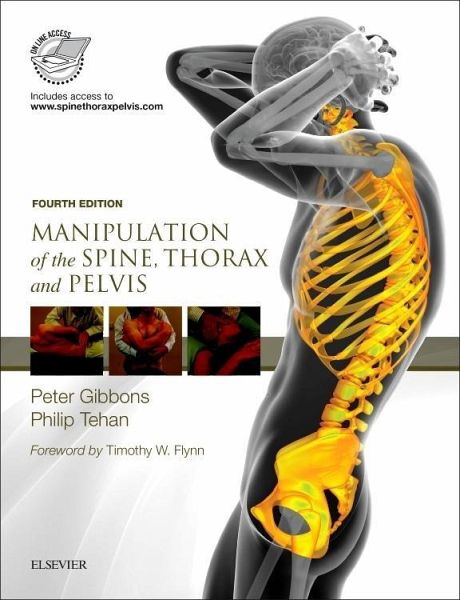
Now in its fourth edition Manipulation of the Spine, Thorax and Pelvis continues to support the practitioner in acquiring and refining their skills on safely using high-velocity low-amplitude (HVLA) thrust techniques. This trusted and highly visual resource - now with 275 images and access to a website with 56 technique videos - advocates an approach that uses minimal leverage to achieve a cavitation in a safe, comfortable and effective manner. The new edition addresses the important issues surrounding patient consent and discusses safety issues in the broader context of relative risk. New…mehr
Now in its fourth edition Manipulation of the Spine, Thorax and Pelvis continues to support the practitioner in acquiring and refining their skills on safely using high-velocity low-amplitude (HVLA) thrust techniques. This trusted and highly visual resource - now with 275 images and access to a website with 56 technique videos - advocates an approach that uses minimal leverage to achieve a cavitation in a safe, comfortable and effective manner.
The new edition addresses the important issues surrounding patient consent and discusses safety issues in the broader context of relative risk. New sections include appropriate use of manipulation when treating radiculopathy and musculoskeletal conditions in pregnant women and children. It also further encourages the practitioner to reflect on how they are performing manipulative techniques and thus focus on improving their skills. Step-by-step coverage of 41 commonly used manipulation (HVLA) thrust techniques supported by 275 photographs/drawings and 56 videosConcise technique summaries provide an innovative review processA troubleshooting section in which difficulties with technique application can be addressedComprehensive review of spinal kinematics and spinal positioning for manipulation techniquesExamines evidence relating to cavitation and the clinical effectiveness of spinal manipulation
Professor Peter Gibbons Adjunct Associate Professor Department of Rehabilitation Sciences College of Allied Health Sciences Oklahoma University Health Science Center USA
Inhaltsangabe
Foreword Preface Acknowledgements
Part A HVLA thrust techniques - an osteopathic perspective
1 Introduction 2 Osteopathic history, principles and practice 3 Kinematics and coupled motion of the spine 4 Minimal leverage positioning for HVLA thrust techniques 5 Safety and HVLA thrust techniques 6 Evidence informed practice 7 Consent
Part B HVLA thrust techniques
8 Cervical and cervicothoracic spine Note: Before reviewing up-slope and down-slope HVLA thrust techniques, the Introduction on the website should be viewed. 8.1 Atlanto-occipital joint C0-1: Contact point on occiput; Chin hold; Patient supine; Anterior and superior thrust in a curved plane; Ligamentous myofascial positioning 8.2 Atlanto-occipital joint C0-1: Contact point on atlas; Chin hold; Patient supine; Anterior and superior thrust in a curved plane; Ligamentous myofascial positioning 8.3 Atlanto-axial joint C1-2: Chin hold; Patient supine; Rotation thrust; Ligamentous myofascial positioning 8.4 Atlanto-axial joint C1-2: Cradle hold; Patient supine; Rotation thrust; Ligamentous myofascial positioning 8.5 Cervical spine C2-7: Up-slope gliding; Chin hold; Patient supine 8.6 Cervical spine C2-7: Up-slope gliding; Chin hold; Patient supine - variation 8.7 Cervical spine C2-7: Up-slope gliding; Cradle hold; Patient supine 8.8 Cervical spine C2-7: Up-slope gliding; Cradle hold; Patient supine; Reversed primary and secondary leverage 8.9 Cervical spine C2-7: Up-slope gliding; Patient sitting; Operator standing in front 8.10 Cervical spine C2-7: Up-slope gliding; Patient sitting; Operator standing to the side 8.11 Cervical spine C2-7: Down-slope gliding; Chin hold; Patient supine 8.12 Cervical spine C2-7: Down-slope gliding; Cradle hold; Patient supine 8.13 Cervical spine C2-7: Down-slope gliding; Patient sitting; Operator standing to the side 8.14 Cervicothoracic spine C7-T3: Rotation gliding; Patient prone; Operator at side of couch 8.15 Cervicothoracic spine C7-T3: Rotation gliding; Patient prone; Operator at head of couch 8.16 Cervicothoracic spine C7-T3: Rotation gliding; Patient prone; Operator at head of couch - variation 8.17 Cervicothoracic spine C7-T3: Sidebending gliding; Patient sitting 8.18 Cervicothoracic spine C7-T3: Sidebending gliding; Patient sitting; Ligamentous myofascial positioning 8.19 Cervicothoracic spine C7-T3: Sidebending gliding; Patient sidelying 8.20 Cervicothoracic spine C7-T3: Sidebending gliding; Patient sidelying; Ligamentous myofascial positioning 8.21 Cervicothoracic spine C7-T3: Extension gliding; Patient sitting; Ligamentous myofascial positioning
10 Lumbar and thoracolumbar spine Note: Before reviewing sidelying HVLA thrust techniques in the lumbar and thoracolumbar spine, the Introduction on the website should be viewed. 10.1 Thoracolumbar spine T10-L2: Neutral positioning; Patient sidelying; Rotation gliding thrust 10.2 Thoracolum
Part A HVLA thrust techniques - an osteopathic perspective 1. Introduction 2. Osteopathic history, principles and practice 3. Kinematics and coupled motion of the spine 4. Minimal leverage positioning for HVLA thrust techniques 5. Cavitation 6. Mechanisms of Effectiveness 7. Safety 8. Evidence-informed practice 9. Consent Part B HVLA thrust techniques 10 Cervical and cervicothoracic spine 11 Thoracic Spine 12 Rib Cage 13 Lumbar and thoracolumbar spine 14 Pelvis Part C Technique failure and analysis
Part A HVLA thrust techniques - an osteopathic perspective
1 Introduction 2 Osteopathic history, principles and practice 3 Kinematics and coupled motion of the spine 4 Minimal leverage positioning for HVLA thrust techniques 5 Safety and HVLA thrust techniques 6 Evidence informed practice 7 Consent
Part B HVLA thrust techniques
8 Cervical and cervicothoracic spine Note: Before reviewing up-slope and down-slope HVLA thrust techniques, the Introduction on the website should be viewed. 8.1 Atlanto-occipital joint C0-1: Contact point on occiput; Chin hold; Patient supine; Anterior and superior thrust in a curved plane; Ligamentous myofascial positioning 8.2 Atlanto-occipital joint C0-1: Contact point on atlas; Chin hold; Patient supine; Anterior and superior thrust in a curved plane; Ligamentous myofascial positioning 8.3 Atlanto-axial joint C1-2: Chin hold; Patient supine; Rotation thrust; Ligamentous myofascial positioning 8.4 Atlanto-axial joint C1-2: Cradle hold; Patient supine; Rotation thrust; Ligamentous myofascial positioning 8.5 Cervical spine C2-7: Up-slope gliding; Chin hold; Patient supine 8.6 Cervical spine C2-7: Up-slope gliding; Chin hold; Patient supine - variation 8.7 Cervical spine C2-7: Up-slope gliding; Cradle hold; Patient supine 8.8 Cervical spine C2-7: Up-slope gliding; Cradle hold; Patient supine; Reversed primary and secondary leverage 8.9 Cervical spine C2-7: Up-slope gliding; Patient sitting; Operator standing in front 8.10 Cervical spine C2-7: Up-slope gliding; Patient sitting; Operator standing to the side 8.11 Cervical spine C2-7: Down-slope gliding; Chin hold; Patient supine 8.12 Cervical spine C2-7: Down-slope gliding; Cradle hold; Patient supine 8.13 Cervical spine C2-7: Down-slope gliding; Patient sitting; Operator standing to the side 8.14 Cervicothoracic spine C7-T3: Rotation gliding; Patient prone; Operator at side of couch 8.15 Cervicothoracic spine C7-T3: Rotation gliding; Patient prone; Operator at head of couch 8.16 Cervicothoracic spine C7-T3: Rotation gliding; Patient prone; Operator at head of couch - variation 8.17 Cervicothoracic spine C7-T3: Sidebending gliding; Patient sitting 8.18 Cervicothoracic spine C7-T3: Sidebending gliding; Patient sitting; Ligamentous myofascial positioning 8.19 Cervicothoracic spine C7-T3: Sidebending gliding; Patient sidelying 8.20 Cervicothoracic spine C7-T3: Sidebending gliding; Patient sidelying; Ligamentous myofascial positioning 8.21 Cervicothoracic spine C7-T3: Extension gliding; Patient sitting; Ligamentous myofascial positioning
10 Lumbar and thoracolumbar spine Note: Before reviewing sidelying HVLA thrust techniques in the lumbar and thoracolumbar spine, the Introduction on the website should be viewed. 10.1 Thoracolumbar spine T10-L2: Neutral positioning; Patient sidelying; Rotation gliding thrust 10.2 Thoracolum
Part A HVLA thrust techniques - an osteopathic perspective 1. Introduction 2. Osteopathic history, principles and practice 3. Kinematics and coupled motion of the spine 4. Minimal leverage positioning for HVLA thrust techniques 5. Cavitation 6. Mechanisms of Effectiveness 7. Safety 8. Evidence-informed practice 9. Consent Part B HVLA thrust techniques 10 Cervical and cervicothoracic spine 11 Thoracic Spine 12 Rib Cage 13 Lumbar and thoracolumbar spine 14 Pelvis Part C Technique failure and analysis
Rezensionen
"an excellent text"
Es gelten unsere Allgemeinen Geschäftsbedingungen: www.buecher.de/agb
Impressum
www.buecher.de ist ein Internetauftritt der buecher.de internetstores GmbH
Geschäftsführung: Monica Sawhney | Roland Kölbl | Günter Hilger
Sitz der Gesellschaft: Batheyer Straße 115 - 117, 58099 Hagen
Postanschrift: Bürgermeister-Wegele-Str. 12, 86167 Augsburg
Amtsgericht Hagen HRB 13257
Steuernummer: 321/5800/1497
USt-IdNr: DE450055826