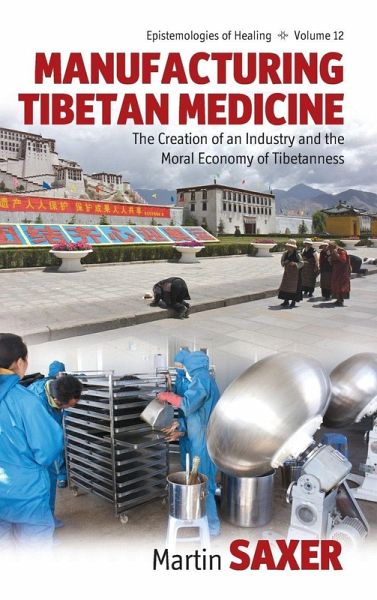
Describes how the Tibetan medicine industry has become central to the debate about Tibet's future Explains how considerations of profit and capital have transformed the industry into producing commodities for the Chinese national market
Describes how the Tibetan medicine industry has become central to the debate about Tibet's future Explains how considerations of profit and capital have transformed the industry into producing commodities for the Chinese national market
Martin Saxer received a PhD in Social and Cultural Anthropology from the University of Oxford and is currently a Marie Curie Fellow at the Ludwig Maximilian University of Munich. Since 2003, he has worked on the history and contemporary practice of Tibetan medicine in Russia (Buryatia) and Tibet. He is the director of the documentary film a¿¿Journeys with Tibetan Medicinea¿¿ and runs the visual ethnography blog .
Inhaltsangabe
List of Illustrations Preface Acknowledgements Notes on Transliteration and Transcription Acronyms Map of Tibet Cast of Main Characters Chapter 1. Introduction * Perspectives on Tibetan medicine * Aku ¿Jinpa * Official Views * The Topic of Inquiry * Industrial Modernities * Tibetanness and the Moral Space of Tradition * The Industry as Assemblage * Language and Terminology Chapter 2. The Creation of an Industry * Sowa Rigpa and TCM - Different Trajectories * Interference and Non-Interference * The Making of TCM * Tentative Integration of Sowa Rigpa * Textbooks, Standardised Practice and Pharmacy * From Pharmacy to Factory * Reform and Revival * Socialist Market Economy * Founding Shongpalhachu * Tibetan Drug Standards and Chinese Pharmacopoeia * The Introduction of Good Manufacturing Practice * Ownership and Investment * Relations Between GMP Factories and Hospitals * The SFDA and National Drug Registration * The Size of the Industry * Forces at Work Chapter 3. Manufacturing Good Practice * GMP in China * The Steps of Production * Sourcing and Storage of Raw Materials * Simple Pre-Processing: Washing, Trimming, Sorting * Complex Pre-Processing: Tsothal * Grinding, Mixing, and Making Pills * Sterilisation * Drying * Rationales, Practicalities * Validation * Self-Inspection Chapter 4. Raw Materials, Refined * Domestic Sourcing Strategies * Long-term Relations to Village Collectors * Cultivation * Commercial Traders * Transnational Trade and Border Regimes * Import licences * Trader Tactics * Taxonomy and Legibility * Business Cultures * CITES and Nepalese Authorities * Baru * Gyatig * Back to Tibet * Tactics and Strategies Chapter 5. Knowledge, Property * Owners and Pirates * The Problem of Patents * Precious Pills, Precious Properties * Filtering Knowledge * 'Old' and 'New' Knowledge * Randomised Controlled Trials * The Knowledge Commodity * Decoupling Forms of Knowledge * Property, Knowledge Chapter 6. The Aesthetic Enterprise * Disenchantment, Enchantment * Mendrup * Rituals of GMP * Packaging Remedies * Design * Materiality * Advertisement * Three Campaigns * Visual Themes * The Buddhist Company * Yuthog * Spiritual Spa * Arura's Museum * Enchanting Whom? Chapter 7. The Moral Economy of Tibetanness * The Tibetanness Economy * Preservation and Development * Civilisation, Culture * Theme Parks: Manufacturing Minzu * Exhibiting Sowa Rigpa and a Farewell to GMP * Morality and Spectacles of Authenticity * Real and Fake * Profit and the Ethics of Being a Doctor * The Problem of Trust * Balancing Profit with Altruism * Morality at Large * Building a Harmonious Society, Resisting Culture * The Moral Economy at Large Chapter 8. Conclusions * Fallacies * One - Industry and Modernism * Two - Globalisation and Sinicisation * Three - Knowledge * Assemblage, Revisited * Contemporary by Assemblage * Territorial by Assemblage Bibliography Glossary
List of Illustrations Preface Acknowledgements Notes on Transliteration and Transcription Acronyms Map of Tibet Cast of Main Characters Chapter 1. Introduction * Perspectives on Tibetan medicine * Aku ¿Jinpa * Official Views * The Topic of Inquiry * Industrial Modernities * Tibetanness and the Moral Space of Tradition * The Industry as Assemblage * Language and Terminology Chapter 2. The Creation of an Industry * Sowa Rigpa and TCM - Different Trajectories * Interference and Non-Interference * The Making of TCM * Tentative Integration of Sowa Rigpa * Textbooks, Standardised Practice and Pharmacy * From Pharmacy to Factory * Reform and Revival * Socialist Market Economy * Founding Shongpalhachu * Tibetan Drug Standards and Chinese Pharmacopoeia * The Introduction of Good Manufacturing Practice * Ownership and Investment * Relations Between GMP Factories and Hospitals * The SFDA and National Drug Registration * The Size of the Industry * Forces at Work Chapter 3. Manufacturing Good Practice * GMP in China * The Steps of Production * Sourcing and Storage of Raw Materials * Simple Pre-Processing: Washing, Trimming, Sorting * Complex Pre-Processing: Tsothal * Grinding, Mixing, and Making Pills * Sterilisation * Drying * Rationales, Practicalities * Validation * Self-Inspection Chapter 4. Raw Materials, Refined * Domestic Sourcing Strategies * Long-term Relations to Village Collectors * Cultivation * Commercial Traders * Transnational Trade and Border Regimes * Import licences * Trader Tactics * Taxonomy and Legibility * Business Cultures * CITES and Nepalese Authorities * Baru * Gyatig * Back to Tibet * Tactics and Strategies Chapter 5. Knowledge, Property * Owners and Pirates * The Problem of Patents * Precious Pills, Precious Properties * Filtering Knowledge * 'Old' and 'New' Knowledge * Randomised Controlled Trials * The Knowledge Commodity * Decoupling Forms of Knowledge * Property, Knowledge Chapter 6. The Aesthetic Enterprise * Disenchantment, Enchantment * Mendrup * Rituals of GMP * Packaging Remedies * Design * Materiality * Advertisement * Three Campaigns * Visual Themes * The Buddhist Company * Yuthog * Spiritual Spa * Arura's Museum * Enchanting Whom? Chapter 7. The Moral Economy of Tibetanness * The Tibetanness Economy * Preservation and Development * Civilisation, Culture * Theme Parks: Manufacturing Minzu * Exhibiting Sowa Rigpa and a Farewell to GMP * Morality and Spectacles of Authenticity * Real and Fake * Profit and the Ethics of Being a Doctor * The Problem of Trust * Balancing Profit with Altruism * Morality at Large * Building a Harmonious Society, Resisting Culture * The Moral Economy at Large Chapter 8. Conclusions * Fallacies * One - Industry and Modernism * Two - Globalisation and Sinicisation * Three - Knowledge * Assemblage, Revisited * Contemporary by Assemblage * Territorial by Assemblage Bibliography Glossary
Es gelten unsere Allgemeinen Geschäftsbedingungen: www.buecher.de/agb
Impressum
www.buecher.de ist ein Internetauftritt der buecher.de internetstores GmbH
Geschäftsführung: Monica Sawhney | Roland Kölbl | Günter Hilger
Sitz der Gesellschaft: Batheyer Straße 115 - 117, 58099 Hagen
Postanschrift: Bürgermeister-Wegele-Str. 12, 86167 Augsburg
Amtsgericht Hagen HRB 13257
Steuernummer: 321/5800/1497
USt-IdNr: DE450055826