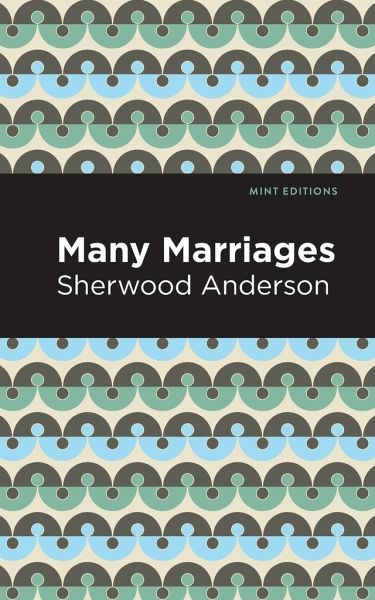
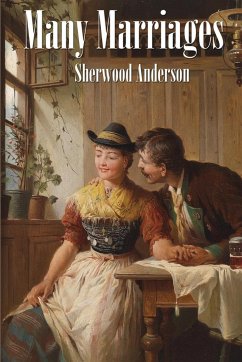
Many Marriages (1923) is a novel by Sherwood Anderson. Inspired by his own decision to abandon his family and career in order to establish himself as a professional writer, Anderson explores the guilts, routines, desires, and disappointments driving the lives of many Americans in the early-twentieth century. Although he is known today for his story collection Winesburg, Ohio, a pioneering work of Modernist fiction admired for its plainspoken language and psychological detail, Anderson's Many Marriages is a masterpiece in its own right. "There was a man named Webster lived in a town of…mehr
Many Marriages (1923) is a novel by Sherwood Anderson. Inspired by his own decision to abandon his family and career in order to establish himself as a professional writer, Anderson explores the guilts, routines, desires, and disappointments driving the lives of many Americans in the early-twentieth century. Although he is known today for his story collection Winesburg, Ohio, a pioneering work of Modernist fiction admired for its plainspoken language and psychological detail, Anderson's Many Marriages is a masterpiece in its own right. "There was a man named Webster lived in a town of twenty-five thousand people in the state of Wisconsin. He had a wife named Mary and a daughter named Jane and he was himself a fairly prosperous manufacturer of washing machines. [...] [A]t odd moments, when he was on a train going some place or perhaps on Sunday afternoons in the summer when he went alone to the deserted office of the factory and sat for several hours looking out through a window and along a railroad track, he gave way to dreams." On an otherwise average day in his office at an Ohio washing machine factory, John Webster finds himself dreaming. He contemplates an affair with his young secretary, hears a number of voices in his head, and watches an angelic woman drift down the river on a raft beneath the afternoon sun. When he returns home after work, he struggles to look his wife and daughter in the face, feeling deep in his heart he will have to leave them soon. Despite spending his whole life in service of the mundane-building his business, supporting his family, securing his finances-Webster knows he can no longer live an impassionate life. He knows he must reinvent himself from scratch. This edition of Sherwood Anderson's Many Marriages is a classic of American literature reimagined for modern readers. Since our inception in 2020, Mint Editions has kept sustainability and innovation at the forefront of our mission. Each and every Mint Edition title gets a fresh, professionally typeset manuscript and a dazzling new cover, all while maintaining the integrity of the original book. With thousands of titles in our collection, we aim to spotlight diverse public domain works to help them find modern audiences. Mint Editions celebrates a breadth of literary works, curated from both canonical and overlooked classics from writers around the globe.
Sherwood Anderson (1876 -1941) was an American writer whose meticulous character development earned him recognition as a "writer's writer." Like a number of other famous writers such as Anton Chekhov, Charles Dickens, and Louisa May Alcott, Anderson's childhood and adolescence were marked by family hardship. When his father's business failed, the family moved frequently, and his mother became an alcoholic. As a result of these hardships, Anderson left school at the age of fourteen to help support the family finances. Anderson is best known for his short stories, particularly his collection published as Winesburg, Ohio (1919). His characters, whom he describes as "grotesques" in his first story, transform experiences into truths, which can be built-up, and once embraced, turn to falsehoods. He writes almost lovingly about his own collection of "grotesques," using a writing style often compared to his literary predecessor, William Dean Howells, as naturalism. Anderson invites the reader into his process as a writer, where he unfolds his characters' views of the world, intertwined as they are, in a small midwestern town. Anderson's appealing style influenced many other writers, including Willa Cather, Henry James, Ernest Hemingway, and William Faulkner, among others. His ability to delve into the human psyche and present characters with profound depth and empathy set him apart from many of his contemporaries. Sherwood Anderson: Winesburg, Ohio, 1919 While Winesburg, Ohio is not without its critics, it remains a beloved classic. Readers often find themselves engrossed in the lives of the characters and the vivid sketches narrated by George Willard. Anderson's narrative control is evident throughout the collection, prompting readers to reflect not only on the stories themselves but also on the man behind them. His ability to write with great empathy and insight into human nature has left a lasting impact on American literature. If you have not yet read Winesburg, Ohio, I encourage you to do so. Anderson's portrayal of small-town life and his exploration of the human condition offer a rich and rewarding reading experience.
Es gelten unsere Allgemeinen Geschäftsbedingungen: www.buecher.de/agb
Impressum
www.buecher.de ist ein Internetauftritt der buecher.de internetstores GmbH
Geschäftsführung: Monica Sawhney | Roland Kölbl | Günter Hilger
Sitz der Gesellschaft: Batheyer Straße 115 - 117, 58099 Hagen
Postanschrift: Bürgermeister-Wegele-Str. 12, 86167 Augsburg
Amtsgericht Hagen HRB 13257
Steuernummer: 321/5800/1497
USt-IdNr: DE450055826