
Paul Herrick
Many Worlds of Logic
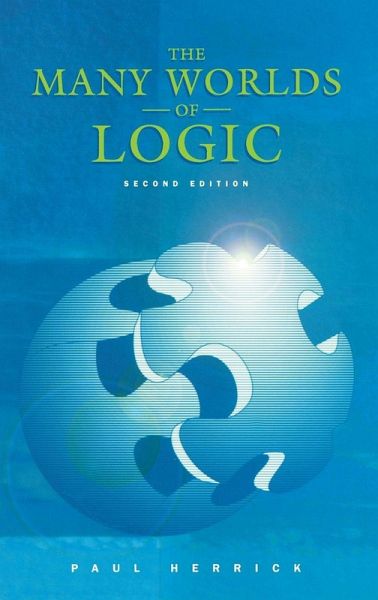

Paul Herrick
Many Worlds of Logic
- Gebundenes Buch
- Merkliste
- Auf die Merkliste
- Bewerten Bewerten
- Teilen
- Produkt teilen
- Produkterinnerung
- Produkterinnerung
With clear explanations and many examples drawn right out of day-to-day life, Paul Herrick untangles the complexities of logical theory in The Many Worlds of Logic. This new edition adds new chapters on informal logic and critical thinking. It also breaks out longer chapters from the previous edition into shorter, more focused chapters. Herrick has added many new explanations and examples; in each chapter, he covers the fundamentals completely before moving on to more challenging areas. Features * Difficult terms are highlighted and explained carefully * End-of-chapter glossaries help students…mehr
Andere Kunden interessierten sich auch für
 J. PeregrinDoing Worlds with Words77,99 €
 Charles S. ChiharaThe Worlds of Possibility77,99 €
 Dynamic Worlds76,99 €
 PareschiDynamic Worlds77,99 €
 Sheldon S. WolinTocqueville between Two Worlds53,99 €
 Robert GreenoughDo We Live in Two Worlds?32,99 €
 Charles SpinosaDisclosing New Worlds29,99 €
-
-
-
With clear explanations and many examples drawn right out of day-to-day life, Paul Herrick untangles the complexities of logical theory in The Many Worlds of Logic. This new edition adds new chapters on informal logic and critical thinking. It also breaks out longer chapters from the previous edition into shorter, more focused chapters. Herrick has added many new explanations and examples; in each chapter, he covers the fundamentals completely before moving on to more challenging areas. Features * Difficult terms are highlighted and explained carefully * End-of-chapter glossaries help students remember important terms * Hundreds of examples demonstrate the application of concepts * Hundreds of exercises help students learn logic by actually doing it * Truth-trees in an appendix help students go beyond the basics
Produktdetails
- Produktdetails
- Verlag: Oxford University Press
- 2nd edition
- Seitenzahl: 690
- Erscheinungstermin: 1. Mai 1999
- Englisch
- Abmessung: 240mm x 161mm x 41mm
- Gewicht: 1189g
- ISBN-13: 9780195155037
- ISBN-10: 0195155033
- Artikelnr.: 22165259
- Herstellerkennzeichnung
- Libri GmbH
- Europaallee 1
- 36244 Bad Hersfeld
- gpsr@libri.de
- Verlag: Oxford University Press
- 2nd edition
- Seitenzahl: 690
- Erscheinungstermin: 1. Mai 1999
- Englisch
- Abmessung: 240mm x 161mm x 41mm
- Gewicht: 1189g
- ISBN-13: 9780195155037
- ISBN-10: 0195155033
- Artikelnr.: 22165259
- Herstellerkennzeichnung
- Libri GmbH
- Europaallee 1
- 36244 Bad Hersfeld
- gpsr@libri.de
* To the Instructor
* To the Student
* Acknowledgements
* Chapter 1 Fundamentals
* Recognizing Arguments
* Some Typical Conclusion Indicators
* Some Typical Premise Indicators
* Distinguishing Sentences and Statements
* Two General Categories of Argument: Deductive and Inductive Arguments
* Deductive and Inductive Indicator Words
* Evaluating Inductive Arguments: The Strong, the Weak, and the
Inductively Sound
* Evaluating Deductive Arguments: The Valid, the Invalid, and the
Dedictively Sound
* Deciding Whether an Argument is Valid or Invalid
* Consistency and Inconsistency
* Implication
* Logical Equivalence
* Necessity
* Ideals
* Appendix: Some Logical Puzzles
* Glossary
* PART I TRUTH-FUNCTIONAL LOGIC
* Chapter 2 Introductory Truth-Functional Logic
* Simple and Compound Sentences, Sentence Operators, and the
Conjunction
* Negation
* Disjunction
* Truth-Functions and Truth-Functional Compound Sentences
* Conditional Sentences
* Biconditional Sentences
* Glossary
* Chapter 3 Translating English into Logical Symbols
* Symbolizing Sentences Containing More than One Operator
* Throwing the Tilde into the Mix
* From And to Or and Back Again--With a Few Nots Thrown In
* Some General Hints on Symbolizing
* Translating Conditionals and Biconditionals
* Symbolizing Necessary and Sufficient Conditions
* Glossary
* Chapter 4 Our New Language Gets a Name and a Formal Syntax
* The Language TL
* How to Calculate the Truth-Value of the Whole from the Values of the
Parts
* Glossary
* Chapter 5 Truth-Table Analysis
* Constructing a Truth-Table for a Formula
* Eight-Row Tables
* How to Make Your Own Tautology Detector Using Just Paper and Pencil
* How to Make an Inexpensive Contradiction Detector for Home or Office
* The Contingency Detector: Don't Leave Home without It
* Testing an Argument for Validity
* Showing an Argument Invalid with a Partial Truth-Table
* Testing a Pair of Sentences for Equivalences
* Glossary
* Chapter 6 The Concept of Logical Form
* Sentence Forms
* Argument Forms
* The Disjunctive Syllogism Form
* The Modus Ponens Form
* The Modus Tollens Form
* The Hypothetical Syllogism Form
* Valid Argument Forms
* Invalid Argument Forms
* Concluding Comments
* Appendix: Contradictory and Tautological Sentence Forms
* Glossary
* Chapter 7 Truth-Functional Natural Deduction
* The Disjunctive Syllogism Rule
* The Modus Ponens Rule
* The Modus Tollens Rule
* The Hypothetical Syllogism Rule
* Proving that a Conclusion Validly Follows
* The System TD
* Proofs
* Glossary
* Chapter 8 Four More Inference Rules
* The Simplification Rule
* The Conjunction Rule
* The Addition Rule
* The Constructive Dilemma Rule
* Some Unsolicited Advice on Learning to Construct Proofs
* Proof Strategies
* Some Additional Suggestions Concerning Strategy
* Appendix: Some Common Deduction Errors
* Chapter 9 Indirect Proofs and Conditional Proofs
* The Indirect Proof Rule
* The Conditional Proof Rule
* Nested Proofs
* Proving Sentences Tautological
* The Law of Noncontradiction
* Glossary
* Chapter 10 Replacement Rules
* The Commutative Rule
* The Associative Rule
* The Double Negation Rule
* DeMorgan's Rule
* The Distribution Rule
* Five More Replacement Rules
* The Transposition Rule
* The Implication Rule
* The Exportation Rule
* The Tautology Rule
* The Equivalence Rule
* Are Replacement Rules Worth the Bother?
* Glossary
* Chapter 11 Indirect and Conditional Proofs with Replacement Rules
* Indirect Proofs with Replacement Rules
* Conditional Proof with Replacement Rules
* Proving Tautologies
* Glossary
* PART II TWO INFORMAL TOPICS
* Chapter 12 Definition
* The Purposes of Definition
* Five Types of Definition
* Two Types of Meaning
* Constructing a Definition: Techniques
* Rules for Intensional Definitions
* Glossary
* Chapter 13 Informal Fallacies
* Fallacies of No Evidence
* Fallacies of Little Evidence
* Fallacies of Language
* Glossary
* A Summary of the Fallacies
* PART III ARISTOTELIAN CATEGORICAL LOGIC
* Chapter 14 The Logic of Categorical Statements
* Categorical Sentences
* Quality and Quantity
* The Traditional Square of Opposition
* Translating English Sentences into Standard Categorical Forms
* Equivalence Rules for Aristotelian Logic
* Dropping the Assumption of Existential Import
* The Modern Square of Opposition
* Glossary
* Chapter 15 Categorical Syllogisms
* Logical Form
* Venn Diagrams
* Testing a Categorical Syllogism for Validity with Venn Diagrams
* Diagramming Aristotelian Categorical Syllogisms
* Diagramming from the Boolean Standpoint
* The Sorites
* Testing a Sorites with Venn Diagrams
* Enthememes
* Refutation by Logical Analogy
* Appendix: Rules for Evaluating Categorical Syllogisms
* PART IV MODERN QUANTIFICATIONAL LOGIC
* Chapter 16 Quantificational Logic I: The Language QL
* Two Types of Sentences
* General Sentences
* A Syntax for our New Language
* The Vocabulary of QL
* Symbolizing General Sentences
* Categorical Sentences
* The Old "Quantifier Switch" Trick
* Switching Quantifiers on Categoricals
* Symbolizing Complicated General Sentences
* Denying Existence
* The Only Way to Go
* What is a Cat-Dog?
* Glossary
* Chapter 17 The Language of Quantificational Logic II: Relations
* Sentences with a Quantifier-Dyadic Predicate Combo
* Any and Every
* Reflexive Sentences
* Sentences with Overlapping Quantifiers
* "What Are You Talking About?" The Universe of Discourse
* Dean Martin, Universal Love, and a Summary of Logic Relations
* To Be or Not To Be: The Logic of Identity
* The Identity Sign
* Appendix: Properties of Relations
* Glossary
* Chapter 18 Proofs with Monadic Predicates
* The Universal Instantiation Rule
* Existential Generalization
* Existential Instantiation
* Memories of Geometry Class: Universal Generalization
* One New Replacement Rule: Quantifier Exchange
* Naming Our System
* Glossary
* Chapter 19 Interpretations, Invalidity, and Semantics
* Interpretations of Multiply Quantified Sentences
* Using Interpretations to Show Invalidity
* Semantics
* The Monadic Predicate Test
* Glossary
* Chapter 20 Conditional and Indirect Quantifier Proofs
* Adding Truth-Functional Replacement Rules to the Mix
* Putting QD on a Diet: A Reduced Set of Quantifier Rules
* Proving Logical Truths
* Chapter 21 Proofs with Overlapping Quantifiers
* Properties of Relations
* Chapter 22 Proofs with Identity
* Properties of the Identity Relation
* Glossary
* PART V MODAL LOGIC
* Chapter 23 Introductory Modal Logic
* To Shave or Not to Shave: That Is the Question
* Five Modal Properties
* Possible Truths, Possible Falsehoods, Contingencies
* Necessary Truths
* Necessary Falsehoods
* Putting Statements into Symbols
* Translating English Sentences into Modal Symbols
* A Name and Syntax for our Modal Language
* The Vocabulary for ML
* The Grammar for ML
* Linking Modal Operators
* "It Ain't Necessarily So," Or, Trading a Diamond for a Box and a Box
for a Diamond
* Modal Operators Need Scope, Too
* Modal Relations
* Scopes of the Dyadic Modal Operators
* Symbolizing with Dyadic Operators
* Modal Operators Are Not Truth-Functional
* Appendix: There's Nothing New under the Sun
* Glossary
* Chapter 24 Modal Logic: Methods of Proof
* Five Modal Principles
* Six Inference Rules
* The Possibility to Necessity Rule
* The Necessitation Rule
* Four Modal Replacement Rules
* Validity in S5
* Proving Theorems of S5
* Another Inference Rule: The Tautology Necessitation Rule
* Appendix 1: Putting an S5 Formula on a Diet: S5 Reduction
* Appendix 2: The Modal Fallacy
* Glossary
* PART VI INDUCTION
* Chapter 25 Inductive Reasoning
* Analogical Reasoning
* Evaluating Analogical Arguments
* Analogies as Models
* Enumerative Induction
* Statistical Inductive Generalization
* Inference to the Best Explanation
* What Makes One Explanation Better than Another?
* Glossary
* Chapter 26 Scientific Reasoning
* Scientific Reasoning
* Comments on the Steps
* Confirming and Disconfirming Scientific Hypotheses
* The Confirmation of a Scientific Hypothesis
* The Disconfirmation of a Scientific Hypothesis
* The Fact of the Cross
* What Makes One Hypothesis Better than Another?
* Case Studies
* Cause and Effect and Mill's Method
* Cause and Effect
* Mill's Method of Agreement
* Mill's Method of Difference
* The Joint Method of Agreement and Difference
* Mill's Method of Residues
* Mill's Method of Concomitant Variation
* Glossary
* Appendices
* 1: Truth-Trees
* 2: Truth
* Answers to Selected Exercises
* Index
* To the Student
* Acknowledgements
* Chapter 1 Fundamentals
* Recognizing Arguments
* Some Typical Conclusion Indicators
* Some Typical Premise Indicators
* Distinguishing Sentences and Statements
* Two General Categories of Argument: Deductive and Inductive Arguments
* Deductive and Inductive Indicator Words
* Evaluating Inductive Arguments: The Strong, the Weak, and the
Inductively Sound
* Evaluating Deductive Arguments: The Valid, the Invalid, and the
Dedictively Sound
* Deciding Whether an Argument is Valid or Invalid
* Consistency and Inconsistency
* Implication
* Logical Equivalence
* Necessity
* Ideals
* Appendix: Some Logical Puzzles
* Glossary
* PART I TRUTH-FUNCTIONAL LOGIC
* Chapter 2 Introductory Truth-Functional Logic
* Simple and Compound Sentences, Sentence Operators, and the
Conjunction
* Negation
* Disjunction
* Truth-Functions and Truth-Functional Compound Sentences
* Conditional Sentences
* Biconditional Sentences
* Glossary
* Chapter 3 Translating English into Logical Symbols
* Symbolizing Sentences Containing More than One Operator
* Throwing the Tilde into the Mix
* From And to Or and Back Again--With a Few Nots Thrown In
* Some General Hints on Symbolizing
* Translating Conditionals and Biconditionals
* Symbolizing Necessary and Sufficient Conditions
* Glossary
* Chapter 4 Our New Language Gets a Name and a Formal Syntax
* The Language TL
* How to Calculate the Truth-Value of the Whole from the Values of the
Parts
* Glossary
* Chapter 5 Truth-Table Analysis
* Constructing a Truth-Table for a Formula
* Eight-Row Tables
* How to Make Your Own Tautology Detector Using Just Paper and Pencil
* How to Make an Inexpensive Contradiction Detector for Home or Office
* The Contingency Detector: Don't Leave Home without It
* Testing an Argument for Validity
* Showing an Argument Invalid with a Partial Truth-Table
* Testing a Pair of Sentences for Equivalences
* Glossary
* Chapter 6 The Concept of Logical Form
* Sentence Forms
* Argument Forms
* The Disjunctive Syllogism Form
* The Modus Ponens Form
* The Modus Tollens Form
* The Hypothetical Syllogism Form
* Valid Argument Forms
* Invalid Argument Forms
* Concluding Comments
* Appendix: Contradictory and Tautological Sentence Forms
* Glossary
* Chapter 7 Truth-Functional Natural Deduction
* The Disjunctive Syllogism Rule
* The Modus Ponens Rule
* The Modus Tollens Rule
* The Hypothetical Syllogism Rule
* Proving that a Conclusion Validly Follows
* The System TD
* Proofs
* Glossary
* Chapter 8 Four More Inference Rules
* The Simplification Rule
* The Conjunction Rule
* The Addition Rule
* The Constructive Dilemma Rule
* Some Unsolicited Advice on Learning to Construct Proofs
* Proof Strategies
* Some Additional Suggestions Concerning Strategy
* Appendix: Some Common Deduction Errors
* Chapter 9 Indirect Proofs and Conditional Proofs
* The Indirect Proof Rule
* The Conditional Proof Rule
* Nested Proofs
* Proving Sentences Tautological
* The Law of Noncontradiction
* Glossary
* Chapter 10 Replacement Rules
* The Commutative Rule
* The Associative Rule
* The Double Negation Rule
* DeMorgan's Rule
* The Distribution Rule
* Five More Replacement Rules
* The Transposition Rule
* The Implication Rule
* The Exportation Rule
* The Tautology Rule
* The Equivalence Rule
* Are Replacement Rules Worth the Bother?
* Glossary
* Chapter 11 Indirect and Conditional Proofs with Replacement Rules
* Indirect Proofs with Replacement Rules
* Conditional Proof with Replacement Rules
* Proving Tautologies
* Glossary
* PART II TWO INFORMAL TOPICS
* Chapter 12 Definition
* The Purposes of Definition
* Five Types of Definition
* Two Types of Meaning
* Constructing a Definition: Techniques
* Rules for Intensional Definitions
* Glossary
* Chapter 13 Informal Fallacies
* Fallacies of No Evidence
* Fallacies of Little Evidence
* Fallacies of Language
* Glossary
* A Summary of the Fallacies
* PART III ARISTOTELIAN CATEGORICAL LOGIC
* Chapter 14 The Logic of Categorical Statements
* Categorical Sentences
* Quality and Quantity
* The Traditional Square of Opposition
* Translating English Sentences into Standard Categorical Forms
* Equivalence Rules for Aristotelian Logic
* Dropping the Assumption of Existential Import
* The Modern Square of Opposition
* Glossary
* Chapter 15 Categorical Syllogisms
* Logical Form
* Venn Diagrams
* Testing a Categorical Syllogism for Validity with Venn Diagrams
* Diagramming Aristotelian Categorical Syllogisms
* Diagramming from the Boolean Standpoint
* The Sorites
* Testing a Sorites with Venn Diagrams
* Enthememes
* Refutation by Logical Analogy
* Appendix: Rules for Evaluating Categorical Syllogisms
* PART IV MODERN QUANTIFICATIONAL LOGIC
* Chapter 16 Quantificational Logic I: The Language QL
* Two Types of Sentences
* General Sentences
* A Syntax for our New Language
* The Vocabulary of QL
* Symbolizing General Sentences
* Categorical Sentences
* The Old "Quantifier Switch" Trick
* Switching Quantifiers on Categoricals
* Symbolizing Complicated General Sentences
* Denying Existence
* The Only Way to Go
* What is a Cat-Dog?
* Glossary
* Chapter 17 The Language of Quantificational Logic II: Relations
* Sentences with a Quantifier-Dyadic Predicate Combo
* Any and Every
* Reflexive Sentences
* Sentences with Overlapping Quantifiers
* "What Are You Talking About?" The Universe of Discourse
* Dean Martin, Universal Love, and a Summary of Logic Relations
* To Be or Not To Be: The Logic of Identity
* The Identity Sign
* Appendix: Properties of Relations
* Glossary
* Chapter 18 Proofs with Monadic Predicates
* The Universal Instantiation Rule
* Existential Generalization
* Existential Instantiation
* Memories of Geometry Class: Universal Generalization
* One New Replacement Rule: Quantifier Exchange
* Naming Our System
* Glossary
* Chapter 19 Interpretations, Invalidity, and Semantics
* Interpretations of Multiply Quantified Sentences
* Using Interpretations to Show Invalidity
* Semantics
* The Monadic Predicate Test
* Glossary
* Chapter 20 Conditional and Indirect Quantifier Proofs
* Adding Truth-Functional Replacement Rules to the Mix
* Putting QD on a Diet: A Reduced Set of Quantifier Rules
* Proving Logical Truths
* Chapter 21 Proofs with Overlapping Quantifiers
* Properties of Relations
* Chapter 22 Proofs with Identity
* Properties of the Identity Relation
* Glossary
* PART V MODAL LOGIC
* Chapter 23 Introductory Modal Logic
* To Shave or Not to Shave: That Is the Question
* Five Modal Properties
* Possible Truths, Possible Falsehoods, Contingencies
* Necessary Truths
* Necessary Falsehoods
* Putting Statements into Symbols
* Translating English Sentences into Modal Symbols
* A Name and Syntax for our Modal Language
* The Vocabulary for ML
* The Grammar for ML
* Linking Modal Operators
* "It Ain't Necessarily So," Or, Trading a Diamond for a Box and a Box
for a Diamond
* Modal Operators Need Scope, Too
* Modal Relations
* Scopes of the Dyadic Modal Operators
* Symbolizing with Dyadic Operators
* Modal Operators Are Not Truth-Functional
* Appendix: There's Nothing New under the Sun
* Glossary
* Chapter 24 Modal Logic: Methods of Proof
* Five Modal Principles
* Six Inference Rules
* The Possibility to Necessity Rule
* The Necessitation Rule
* Four Modal Replacement Rules
* Validity in S5
* Proving Theorems of S5
* Another Inference Rule: The Tautology Necessitation Rule
* Appendix 1: Putting an S5 Formula on a Diet: S5 Reduction
* Appendix 2: The Modal Fallacy
* Glossary
* PART VI INDUCTION
* Chapter 25 Inductive Reasoning
* Analogical Reasoning
* Evaluating Analogical Arguments
* Analogies as Models
* Enumerative Induction
* Statistical Inductive Generalization
* Inference to the Best Explanation
* What Makes One Explanation Better than Another?
* Glossary
* Chapter 26 Scientific Reasoning
* Scientific Reasoning
* Comments on the Steps
* Confirming and Disconfirming Scientific Hypotheses
* The Confirmation of a Scientific Hypothesis
* The Disconfirmation of a Scientific Hypothesis
* The Fact of the Cross
* What Makes One Hypothesis Better than Another?
* Case Studies
* Cause and Effect and Mill's Method
* Cause and Effect
* Mill's Method of Agreement
* Mill's Method of Difference
* The Joint Method of Agreement and Difference
* Mill's Method of Residues
* Mill's Method of Concomitant Variation
* Glossary
* Appendices
* 1: Truth-Trees
* 2: Truth
* Answers to Selected Exercises
* Index
* To the Instructor
* To the Student
* Acknowledgements
* Chapter 1 Fundamentals
* Recognizing Arguments
* Some Typical Conclusion Indicators
* Some Typical Premise Indicators
* Distinguishing Sentences and Statements
* Two General Categories of Argument: Deductive and Inductive Arguments
* Deductive and Inductive Indicator Words
* Evaluating Inductive Arguments: The Strong, the Weak, and the
Inductively Sound
* Evaluating Deductive Arguments: The Valid, the Invalid, and the
Dedictively Sound
* Deciding Whether an Argument is Valid or Invalid
* Consistency and Inconsistency
* Implication
* Logical Equivalence
* Necessity
* Ideals
* Appendix: Some Logical Puzzles
* Glossary
* PART I TRUTH-FUNCTIONAL LOGIC
* Chapter 2 Introductory Truth-Functional Logic
* Simple and Compound Sentences, Sentence Operators, and the
Conjunction
* Negation
* Disjunction
* Truth-Functions and Truth-Functional Compound Sentences
* Conditional Sentences
* Biconditional Sentences
* Glossary
* Chapter 3 Translating English into Logical Symbols
* Symbolizing Sentences Containing More than One Operator
* Throwing the Tilde into the Mix
* From And to Or and Back Again--With a Few Nots Thrown In
* Some General Hints on Symbolizing
* Translating Conditionals and Biconditionals
* Symbolizing Necessary and Sufficient Conditions
* Glossary
* Chapter 4 Our New Language Gets a Name and a Formal Syntax
* The Language TL
* How to Calculate the Truth-Value of the Whole from the Values of the
Parts
* Glossary
* Chapter 5 Truth-Table Analysis
* Constructing a Truth-Table for a Formula
* Eight-Row Tables
* How to Make Your Own Tautology Detector Using Just Paper and Pencil
* How to Make an Inexpensive Contradiction Detector for Home or Office
* The Contingency Detector: Don't Leave Home without It
* Testing an Argument for Validity
* Showing an Argument Invalid with a Partial Truth-Table
* Testing a Pair of Sentences for Equivalences
* Glossary
* Chapter 6 The Concept of Logical Form
* Sentence Forms
* Argument Forms
* The Disjunctive Syllogism Form
* The Modus Ponens Form
* The Modus Tollens Form
* The Hypothetical Syllogism Form
* Valid Argument Forms
* Invalid Argument Forms
* Concluding Comments
* Appendix: Contradictory and Tautological Sentence Forms
* Glossary
* Chapter 7 Truth-Functional Natural Deduction
* The Disjunctive Syllogism Rule
* The Modus Ponens Rule
* The Modus Tollens Rule
* The Hypothetical Syllogism Rule
* Proving that a Conclusion Validly Follows
* The System TD
* Proofs
* Glossary
* Chapter 8 Four More Inference Rules
* The Simplification Rule
* The Conjunction Rule
* The Addition Rule
* The Constructive Dilemma Rule
* Some Unsolicited Advice on Learning to Construct Proofs
* Proof Strategies
* Some Additional Suggestions Concerning Strategy
* Appendix: Some Common Deduction Errors
* Chapter 9 Indirect Proofs and Conditional Proofs
* The Indirect Proof Rule
* The Conditional Proof Rule
* Nested Proofs
* Proving Sentences Tautological
* The Law of Noncontradiction
* Glossary
* Chapter 10 Replacement Rules
* The Commutative Rule
* The Associative Rule
* The Double Negation Rule
* DeMorgan's Rule
* The Distribution Rule
* Five More Replacement Rules
* The Transposition Rule
* The Implication Rule
* The Exportation Rule
* The Tautology Rule
* The Equivalence Rule
* Are Replacement Rules Worth the Bother?
* Glossary
* Chapter 11 Indirect and Conditional Proofs with Replacement Rules
* Indirect Proofs with Replacement Rules
* Conditional Proof with Replacement Rules
* Proving Tautologies
* Glossary
* PART II TWO INFORMAL TOPICS
* Chapter 12 Definition
* The Purposes of Definition
* Five Types of Definition
* Two Types of Meaning
* Constructing a Definition: Techniques
* Rules for Intensional Definitions
* Glossary
* Chapter 13 Informal Fallacies
* Fallacies of No Evidence
* Fallacies of Little Evidence
* Fallacies of Language
* Glossary
* A Summary of the Fallacies
* PART III ARISTOTELIAN CATEGORICAL LOGIC
* Chapter 14 The Logic of Categorical Statements
* Categorical Sentences
* Quality and Quantity
* The Traditional Square of Opposition
* Translating English Sentences into Standard Categorical Forms
* Equivalence Rules for Aristotelian Logic
* Dropping the Assumption of Existential Import
* The Modern Square of Opposition
* Glossary
* Chapter 15 Categorical Syllogisms
* Logical Form
* Venn Diagrams
* Testing a Categorical Syllogism for Validity with Venn Diagrams
* Diagramming Aristotelian Categorical Syllogisms
* Diagramming from the Boolean Standpoint
* The Sorites
* Testing a Sorites with Venn Diagrams
* Enthememes
* Refutation by Logical Analogy
* Appendix: Rules for Evaluating Categorical Syllogisms
* PART IV MODERN QUANTIFICATIONAL LOGIC
* Chapter 16 Quantificational Logic I: The Language QL
* Two Types of Sentences
* General Sentences
* A Syntax for our New Language
* The Vocabulary of QL
* Symbolizing General Sentences
* Categorical Sentences
* The Old "Quantifier Switch" Trick
* Switching Quantifiers on Categoricals
* Symbolizing Complicated General Sentences
* Denying Existence
* The Only Way to Go
* What is a Cat-Dog?
* Glossary
* Chapter 17 The Language of Quantificational Logic II: Relations
* Sentences with a Quantifier-Dyadic Predicate Combo
* Any and Every
* Reflexive Sentences
* Sentences with Overlapping Quantifiers
* "What Are You Talking About?" The Universe of Discourse
* Dean Martin, Universal Love, and a Summary of Logic Relations
* To Be or Not To Be: The Logic of Identity
* The Identity Sign
* Appendix: Properties of Relations
* Glossary
* Chapter 18 Proofs with Monadic Predicates
* The Universal Instantiation Rule
* Existential Generalization
* Existential Instantiation
* Memories of Geometry Class: Universal Generalization
* One New Replacement Rule: Quantifier Exchange
* Naming Our System
* Glossary
* Chapter 19 Interpretations, Invalidity, and Semantics
* Interpretations of Multiply Quantified Sentences
* Using Interpretations to Show Invalidity
* Semantics
* The Monadic Predicate Test
* Glossary
* Chapter 20 Conditional and Indirect Quantifier Proofs
* Adding Truth-Functional Replacement Rules to the Mix
* Putting QD on a Diet: A Reduced Set of Quantifier Rules
* Proving Logical Truths
* Chapter 21 Proofs with Overlapping Quantifiers
* Properties of Relations
* Chapter 22 Proofs with Identity
* Properties of the Identity Relation
* Glossary
* PART V MODAL LOGIC
* Chapter 23 Introductory Modal Logic
* To Shave or Not to Shave: That Is the Question
* Five Modal Properties
* Possible Truths, Possible Falsehoods, Contingencies
* Necessary Truths
* Necessary Falsehoods
* Putting Statements into Symbols
* Translating English Sentences into Modal Symbols
* A Name and Syntax for our Modal Language
* The Vocabulary for ML
* The Grammar for ML
* Linking Modal Operators
* "It Ain't Necessarily So," Or, Trading a Diamond for a Box and a Box
for a Diamond
* Modal Operators Need Scope, Too
* Modal Relations
* Scopes of the Dyadic Modal Operators
* Symbolizing with Dyadic Operators
* Modal Operators Are Not Truth-Functional
* Appendix: There's Nothing New under the Sun
* Glossary
* Chapter 24 Modal Logic: Methods of Proof
* Five Modal Principles
* Six Inference Rules
* The Possibility to Necessity Rule
* The Necessitation Rule
* Four Modal Replacement Rules
* Validity in S5
* Proving Theorems of S5
* Another Inference Rule: The Tautology Necessitation Rule
* Appendix 1: Putting an S5 Formula on a Diet: S5 Reduction
* Appendix 2: The Modal Fallacy
* Glossary
* PART VI INDUCTION
* Chapter 25 Inductive Reasoning
* Analogical Reasoning
* Evaluating Analogical Arguments
* Analogies as Models
* Enumerative Induction
* Statistical Inductive Generalization
* Inference to the Best Explanation
* What Makes One Explanation Better than Another?
* Glossary
* Chapter 26 Scientific Reasoning
* Scientific Reasoning
* Comments on the Steps
* Confirming and Disconfirming Scientific Hypotheses
* The Confirmation of a Scientific Hypothesis
* The Disconfirmation of a Scientific Hypothesis
* The Fact of the Cross
* What Makes One Hypothesis Better than Another?
* Case Studies
* Cause and Effect and Mill's Method
* Cause and Effect
* Mill's Method of Agreement
* Mill's Method of Difference
* The Joint Method of Agreement and Difference
* Mill's Method of Residues
* Mill's Method of Concomitant Variation
* Glossary
* Appendices
* 1: Truth-Trees
* 2: Truth
* Answers to Selected Exercises
* Index
* To the Student
* Acknowledgements
* Chapter 1 Fundamentals
* Recognizing Arguments
* Some Typical Conclusion Indicators
* Some Typical Premise Indicators
* Distinguishing Sentences and Statements
* Two General Categories of Argument: Deductive and Inductive Arguments
* Deductive and Inductive Indicator Words
* Evaluating Inductive Arguments: The Strong, the Weak, and the
Inductively Sound
* Evaluating Deductive Arguments: The Valid, the Invalid, and the
Dedictively Sound
* Deciding Whether an Argument is Valid or Invalid
* Consistency and Inconsistency
* Implication
* Logical Equivalence
* Necessity
* Ideals
* Appendix: Some Logical Puzzles
* Glossary
* PART I TRUTH-FUNCTIONAL LOGIC
* Chapter 2 Introductory Truth-Functional Logic
* Simple and Compound Sentences, Sentence Operators, and the
Conjunction
* Negation
* Disjunction
* Truth-Functions and Truth-Functional Compound Sentences
* Conditional Sentences
* Biconditional Sentences
* Glossary
* Chapter 3 Translating English into Logical Symbols
* Symbolizing Sentences Containing More than One Operator
* Throwing the Tilde into the Mix
* From And to Or and Back Again--With a Few Nots Thrown In
* Some General Hints on Symbolizing
* Translating Conditionals and Biconditionals
* Symbolizing Necessary and Sufficient Conditions
* Glossary
* Chapter 4 Our New Language Gets a Name and a Formal Syntax
* The Language TL
* How to Calculate the Truth-Value of the Whole from the Values of the
Parts
* Glossary
* Chapter 5 Truth-Table Analysis
* Constructing a Truth-Table for a Formula
* Eight-Row Tables
* How to Make Your Own Tautology Detector Using Just Paper and Pencil
* How to Make an Inexpensive Contradiction Detector for Home or Office
* The Contingency Detector: Don't Leave Home without It
* Testing an Argument for Validity
* Showing an Argument Invalid with a Partial Truth-Table
* Testing a Pair of Sentences for Equivalences
* Glossary
* Chapter 6 The Concept of Logical Form
* Sentence Forms
* Argument Forms
* The Disjunctive Syllogism Form
* The Modus Ponens Form
* The Modus Tollens Form
* The Hypothetical Syllogism Form
* Valid Argument Forms
* Invalid Argument Forms
* Concluding Comments
* Appendix: Contradictory and Tautological Sentence Forms
* Glossary
* Chapter 7 Truth-Functional Natural Deduction
* The Disjunctive Syllogism Rule
* The Modus Ponens Rule
* The Modus Tollens Rule
* The Hypothetical Syllogism Rule
* Proving that a Conclusion Validly Follows
* The System TD
* Proofs
* Glossary
* Chapter 8 Four More Inference Rules
* The Simplification Rule
* The Conjunction Rule
* The Addition Rule
* The Constructive Dilemma Rule
* Some Unsolicited Advice on Learning to Construct Proofs
* Proof Strategies
* Some Additional Suggestions Concerning Strategy
* Appendix: Some Common Deduction Errors
* Chapter 9 Indirect Proofs and Conditional Proofs
* The Indirect Proof Rule
* The Conditional Proof Rule
* Nested Proofs
* Proving Sentences Tautological
* The Law of Noncontradiction
* Glossary
* Chapter 10 Replacement Rules
* The Commutative Rule
* The Associative Rule
* The Double Negation Rule
* DeMorgan's Rule
* The Distribution Rule
* Five More Replacement Rules
* The Transposition Rule
* The Implication Rule
* The Exportation Rule
* The Tautology Rule
* The Equivalence Rule
* Are Replacement Rules Worth the Bother?
* Glossary
* Chapter 11 Indirect and Conditional Proofs with Replacement Rules
* Indirect Proofs with Replacement Rules
* Conditional Proof with Replacement Rules
* Proving Tautologies
* Glossary
* PART II TWO INFORMAL TOPICS
* Chapter 12 Definition
* The Purposes of Definition
* Five Types of Definition
* Two Types of Meaning
* Constructing a Definition: Techniques
* Rules for Intensional Definitions
* Glossary
* Chapter 13 Informal Fallacies
* Fallacies of No Evidence
* Fallacies of Little Evidence
* Fallacies of Language
* Glossary
* A Summary of the Fallacies
* PART III ARISTOTELIAN CATEGORICAL LOGIC
* Chapter 14 The Logic of Categorical Statements
* Categorical Sentences
* Quality and Quantity
* The Traditional Square of Opposition
* Translating English Sentences into Standard Categorical Forms
* Equivalence Rules for Aristotelian Logic
* Dropping the Assumption of Existential Import
* The Modern Square of Opposition
* Glossary
* Chapter 15 Categorical Syllogisms
* Logical Form
* Venn Diagrams
* Testing a Categorical Syllogism for Validity with Venn Diagrams
* Diagramming Aristotelian Categorical Syllogisms
* Diagramming from the Boolean Standpoint
* The Sorites
* Testing a Sorites with Venn Diagrams
* Enthememes
* Refutation by Logical Analogy
* Appendix: Rules for Evaluating Categorical Syllogisms
* PART IV MODERN QUANTIFICATIONAL LOGIC
* Chapter 16 Quantificational Logic I: The Language QL
* Two Types of Sentences
* General Sentences
* A Syntax for our New Language
* The Vocabulary of QL
* Symbolizing General Sentences
* Categorical Sentences
* The Old "Quantifier Switch" Trick
* Switching Quantifiers on Categoricals
* Symbolizing Complicated General Sentences
* Denying Existence
* The Only Way to Go
* What is a Cat-Dog?
* Glossary
* Chapter 17 The Language of Quantificational Logic II: Relations
* Sentences with a Quantifier-Dyadic Predicate Combo
* Any and Every
* Reflexive Sentences
* Sentences with Overlapping Quantifiers
* "What Are You Talking About?" The Universe of Discourse
* Dean Martin, Universal Love, and a Summary of Logic Relations
* To Be or Not To Be: The Logic of Identity
* The Identity Sign
* Appendix: Properties of Relations
* Glossary
* Chapter 18 Proofs with Monadic Predicates
* The Universal Instantiation Rule
* Existential Generalization
* Existential Instantiation
* Memories of Geometry Class: Universal Generalization
* One New Replacement Rule: Quantifier Exchange
* Naming Our System
* Glossary
* Chapter 19 Interpretations, Invalidity, and Semantics
* Interpretations of Multiply Quantified Sentences
* Using Interpretations to Show Invalidity
* Semantics
* The Monadic Predicate Test
* Glossary
* Chapter 20 Conditional and Indirect Quantifier Proofs
* Adding Truth-Functional Replacement Rules to the Mix
* Putting QD on a Diet: A Reduced Set of Quantifier Rules
* Proving Logical Truths
* Chapter 21 Proofs with Overlapping Quantifiers
* Properties of Relations
* Chapter 22 Proofs with Identity
* Properties of the Identity Relation
* Glossary
* PART V MODAL LOGIC
* Chapter 23 Introductory Modal Logic
* To Shave or Not to Shave: That Is the Question
* Five Modal Properties
* Possible Truths, Possible Falsehoods, Contingencies
* Necessary Truths
* Necessary Falsehoods
* Putting Statements into Symbols
* Translating English Sentences into Modal Symbols
* A Name and Syntax for our Modal Language
* The Vocabulary for ML
* The Grammar for ML
* Linking Modal Operators
* "It Ain't Necessarily So," Or, Trading a Diamond for a Box and a Box
for a Diamond
* Modal Operators Need Scope, Too
* Modal Relations
* Scopes of the Dyadic Modal Operators
* Symbolizing with Dyadic Operators
* Modal Operators Are Not Truth-Functional
* Appendix: There's Nothing New under the Sun
* Glossary
* Chapter 24 Modal Logic: Methods of Proof
* Five Modal Principles
* Six Inference Rules
* The Possibility to Necessity Rule
* The Necessitation Rule
* Four Modal Replacement Rules
* Validity in S5
* Proving Theorems of S5
* Another Inference Rule: The Tautology Necessitation Rule
* Appendix 1: Putting an S5 Formula on a Diet: S5 Reduction
* Appendix 2: The Modal Fallacy
* Glossary
* PART VI INDUCTION
* Chapter 25 Inductive Reasoning
* Analogical Reasoning
* Evaluating Analogical Arguments
* Analogies as Models
* Enumerative Induction
* Statistical Inductive Generalization
* Inference to the Best Explanation
* What Makes One Explanation Better than Another?
* Glossary
* Chapter 26 Scientific Reasoning
* Scientific Reasoning
* Comments on the Steps
* Confirming and Disconfirming Scientific Hypotheses
* The Confirmation of a Scientific Hypothesis
* The Disconfirmation of a Scientific Hypothesis
* The Fact of the Cross
* What Makes One Hypothesis Better than Another?
* Case Studies
* Cause and Effect and Mill's Method
* Cause and Effect
* Mill's Method of Agreement
* Mill's Method of Difference
* The Joint Method of Agreement and Difference
* Mill's Method of Residues
* Mill's Method of Concomitant Variation
* Glossary
* Appendices
* 1: Truth-Trees
* 2: Truth
* Answers to Selected Exercises
* Index