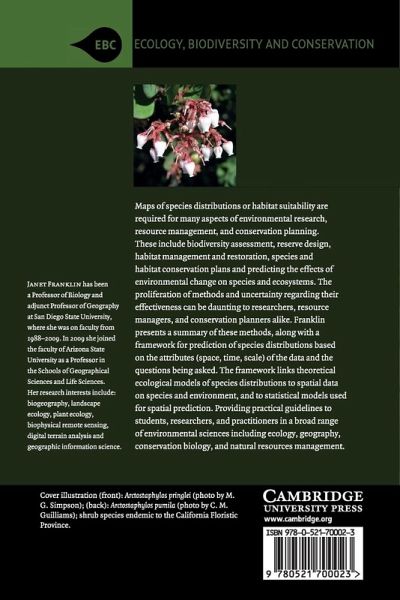
Comprehensive summary of species distribution modeling methods integrating ecological and statistical models with spatial data, and a framework for implementation.
Comprehensive summary of species distribution modeling methods integrating ecological and statistical models with spatial data, and a framework for implementation.
Janet Franklin has been a Professor of Biology and Adjunct Professor of Geography at San Diego State University, where she was on the faculty from 1988-2009. In 2009 she joined the faculty of Arizona State University as a Professor in the Schools of Geographical Sciences and Life Sciences. She received the Bachelors' degree on Environmental Biology (1979), the Master of Arts (1983), and the PhD (1988) in Geography, all from the University of California, Santa Barbara. Her research interests include biogeography, landscape ecology, plant ecology, biophysical remote sensing, digital terrain analysis, and geographic information science. She has conducted research on plant community composition, structure, dynamics and spatio-temporal patterns in Mediterranean-climate ecosystems, deserts, tropical dry forests and rain forests. She was the Editor of The Professional Geographer (1997-2000) Board Member of Landscape Ecology (2000-5), and Associate Editor of Journal of Vegetation Science (1999-2006). She is currently a Board Member of Ecology and Diversity and Distributions. She has published more than 80 refereed book chapters and papers in journals Ecological Applications, Ecological Modelling, the Journal of Vegetation Science, Ecology, Diversity and Distributions, the Journal of Tropical Ecology and Conservation Biology. She has received research support from NSF, NASA, USGS, Forest Service, California State Parks, National Geographic Society, and others.
Inhaltsangabe
Part I. History and Ecological Basis of Species' Distribution Modeling: 1. Species distribution modeling 2. Why do we need species' distribution models? 3. Ecological understanding of species' distributions Part II. The Data Needed for Modeling Species' Distributions: 4. Data for species' distribution models: the biological data 5. Data for species' distribution models: the environmental data Part III. An Overview of the Modeling Methods: 6. Statistical models - modern regression 7. Machine learning methods 8. Classification, similarity and other methods for presence-only data Part IV. Model Evaluation and Implementation: 9. Model evaluation 10. Implementation of species' distribution models.
Part I. History and Ecological Basis of Species' Distribution Modeling: 1. Species distribution modeling 2. Why do we need species' distribution models? 3. Ecological understanding of species' distributions Part II. The Data Needed for Modeling Species' Distributions: 4. Data for species' distribution models: the biological data 5. Data for species' distribution models: the environmental data Part III. An Overview of the Modeling Methods: 6. Statistical models - modern regression 7. Machine learning methods 8. Classification, similarity and other methods for presence-only data Part IV. Model Evaluation and Implementation: 9. Model evaluation 10. Implementation of species' distribution models.
Es gelten unsere Allgemeinen Geschäftsbedingungen: www.buecher.de/agb
Impressum
www.buecher.de ist ein Internetauftritt der buecher.de internetstores GmbH
Geschäftsführung: Monica Sawhney | Roland Kölbl | Günter Hilger
Sitz der Gesellschaft: Batheyer Straße 115 - 117, 58099 Hagen
Postanschrift: Bürgermeister-Wegele-Str. 12, 86167 Augsburg
Amtsgericht Hagen HRB 13257
Steuernummer: 321/5800/1497
USt-IdNr: DE450055826