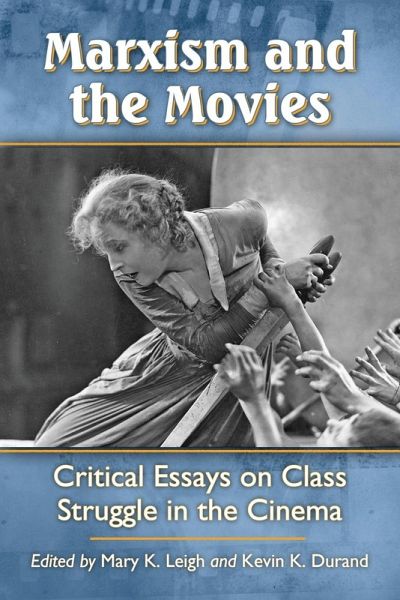
The work of Karl Marx is revered in social philosophy, political science and literary criticism, but there is an area where Marxism seems not to have penetrated. That area is the study of popular culture, especially the cinema, where Marxism provides a useful lens through which seemingly disparate films can be explored. As a whole the new essays assembled here approach a wide cross-section of cinematic history and provide analysis of blockbusters, cult hits, comedies, suspenseful dramas and history-making films within a framework of power, power relations and class struggle. The collection…mehr
The work of Karl Marx is revered in social philosophy, political science and literary criticism, but there is an area where Marxism seems not to have penetrated. That area is the study of popular culture, especially the cinema, where Marxism provides a useful lens through which seemingly disparate films can be explored. As a whole the new essays assembled here approach a wide cross-section of cinematic history and provide analysis of blockbusters, cult hits, comedies, suspenseful dramas and history-making films within a framework of power, power relations and class struggle. The collection brings to popular culture studies the same scholarly weight that attends the work of Aristotle or Plato or Derrida and, at the same time, presents that scholarship in an accessible style.
Mary K. Leigh is a doctoral academy fellow at the University of Arkansas. Kevin K. Durand is the dean of academics at the LISA Academy College Preparatory School in Little Rock, Arkansas. He has published broadly in philosophy, religion, and ethics.
Inhaltsangabe
Table of Contents Preface (Kevin K. Durand) Introduction: Marx, Critical Theory and the Cinema (Kevin K. Durand) Part I: The Pre-War/Silent Marx and Metropolis: The Farce of Religion in the Face of Dystopia (Mary K. Leigh) Metropolis: Proletarian Triumph or Opiate of the Masses? (Alan Williams) Love in the Time of Capitalism: A Marxist Feminist Reading of Modern Times (Brooke Beloso) Part II: The Post-War "She look like a wrong one to you?" BloodyMoneyBody-Marxist Subversion in Hitchcock's Psycho and Frear's The Grifters (Gregory Borse) Replicants and the Commodity Form: A Marxian Reading of Blade Runner (J. Eric Lambert) "Somewhere That's Green": The Dream of the Middle Class in Frank Oz's Little Shop of Horrors (Traci J. Cohen) Apocalyptic Redux: (Re)Vision and Recognition in Terry Gilliam's Twelve Monkeys (Jeremy Burns) Part III: The New Millennium TechNoir and the Critical Dystopia in the 21st Century: Wimmer's Equilibrium (Alexander Charles Oliver Hall) Who's Coming for Dinner? An Examination of A History of Violence (Leslie Seawright) A Marxist Look at Avatar (Tim Delaney and Ellen Reed) A Myth (Not So) Betrayed: Ridley Scott's Robin Hood and the Political Evolution of the Greenwood (Jacob Lewis) About the Contributors Index
Table of Contents Preface (Kevin K. Durand) Introduction: Marx, Critical Theory and the Cinema (Kevin K. Durand) Part I: The Pre-War/Silent Marx and Metropolis: The Farce of Religion in the Face of Dystopia (Mary K. Leigh) Metropolis: Proletarian Triumph or Opiate of the Masses? (Alan Williams) Love in the Time of Capitalism: A Marxist Feminist Reading of Modern Times (Brooke Beloso) Part II: The Post-War "She look like a wrong one to you?" BloodyMoneyBody-Marxist Subversion in Hitchcock's Psycho and Frear's The Grifters (Gregory Borse) Replicants and the Commodity Form: A Marxian Reading of Blade Runner (J. Eric Lambert) "Somewhere That's Green": The Dream of the Middle Class in Frank Oz's Little Shop of Horrors (Traci J. Cohen) Apocalyptic Redux: (Re)Vision and Recognition in Terry Gilliam's Twelve Monkeys (Jeremy Burns) Part III: The New Millennium TechNoir and the Critical Dystopia in the 21st Century: Wimmer's Equilibrium (Alexander Charles Oliver Hall) Who's Coming for Dinner? An Examination of A History of Violence (Leslie Seawright) A Marxist Look at Avatar (Tim Delaney and Ellen Reed) A Myth (Not So) Betrayed: Ridley Scott's Robin Hood and the Political Evolution of the Greenwood (Jacob Lewis) About the Contributors Index
Es gelten unsere Allgemeinen Geschäftsbedingungen: www.buecher.de/agb
Impressum
www.buecher.de ist ein Internetauftritt der buecher.de internetstores GmbH
Geschäftsführung: Monica Sawhney | Roland Kölbl | Günter Hilger
Sitz der Gesellschaft: Batheyer Straße 115 - 117, 58099 Hagen
Postanschrift: Bürgermeister-Wegele-Str. 12, 86167 Augsburg
Amtsgericht Hagen HRB 13257
Steuernummer: 321/5800/1497
USt-IdNr: DE450055826