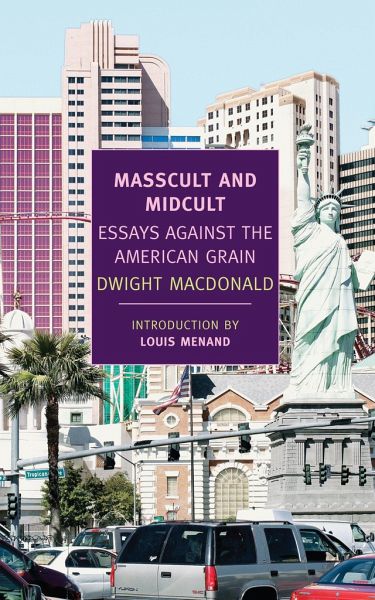
A New York Review Books Original Political radical, trenchant essayist, and impresario of the New York intellectuals, Dwight Macdonald was one of the towering figures of twentieth-century American letters. In his most famous and controversial essay, "Masscult and Midcult," MacDonald turns his formidable critical attention to what he sees as a new, and potentially catastrophic, development in the history of Western civilization: the influence--by turns distorting, destructive, and inadvertently ridiculous--of mass culture on high culture. In this new collection of essays, ranging in subject…mehr
A New York Review Books Original Political radical, trenchant essayist, and impresario of the New York intellectuals, Dwight Macdonald was one of the towering figures of twentieth-century American letters. In his most famous and controversial essay, "Masscult and Midcult," MacDonald turns his formidable critical attention to what he sees as a new, and potentially catastrophic, development in the history of Western civilization: the influence--by turns distorting, destructive, and inadvertently ridiculous--of mass culture on high culture. In this new collection of essays, ranging in subject matter from Ernest Hemingway, James Agee, and Tom Wolfe to Webster's Dictionary and the Revised Standard Version of the Bible, Macdonald is shrewd, passionate, and bracingly alive to the complexities of his subject, which he defines as being "not the dead sea of masscult but rather the life of the tide line where higher and lower organisms compete for survival."Hinweis: Dieser Artikel kann nur an eine deutsche Lieferadresse ausgeliefert werden.
Dwight Macdonald (1906–1982) was born in New York City and educated at Exeter and Yale. On graduating from college, he enrolled in Macy’s executive training program, but soon left to work for Henry Luce at Time and Fortune, quitting in 1936 because of cuts that had been made to an article he had written criticizing U.S. Steel. From 1937 to 1943, Macdonald was an editor of Partisan Review and in 1944, he started a journal of his own, Politics, whose contributors included Albert Camus, Victor Serge, Simone Weil, Bruno Bettelheim, James Agee, John Berryman, Meyer Schapiro, and Mary McCarthy. In later years, Macdonald reviewed books for The New Yorker, movies for Esquire, and wrote frequently for The New York Review of Books. John Summers is the editor of The Baffler. Louis Menand is the Anne T. and Robert M. Bass Professor of English at Harvard University and a staff writer at The New Yorker. He is the author of Discovering Modernism, The Metaphysical Club, American Studies, and The Marketplace of Ideas.
Es gelten unsere Allgemeinen Geschäftsbedingungen: www.buecher.de/agb
Impressum
www.buecher.de ist ein Internetauftritt der buecher.de internetstores GmbH
Geschäftsführung: Monica Sawhney | Roland Kölbl | Günter Hilger
Sitz der Gesellschaft: Batheyer Straße 115 - 117, 58099 Hagen
Postanschrift: Bürgermeister-Wegele-Str. 12, 86167 Augsburg
Amtsgericht Hagen HRB 13257
Steuernummer: 321/5800/1497
USt-IdNr: DE450055826