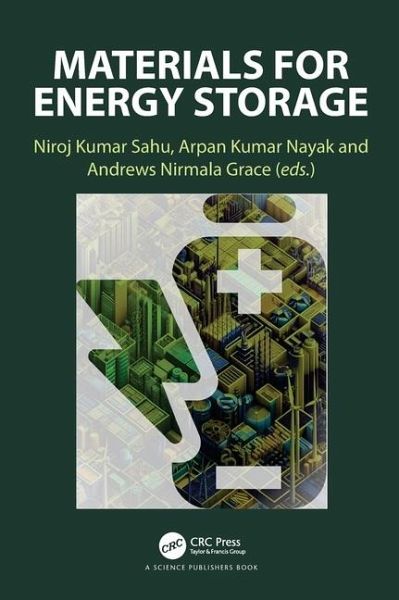
Materials for Energy Storage offers a combinatorial understanding of materials science and electrochemistry in electrochemical energy storage devices with a holistic overview of the status, research gaps, and future opportunities.
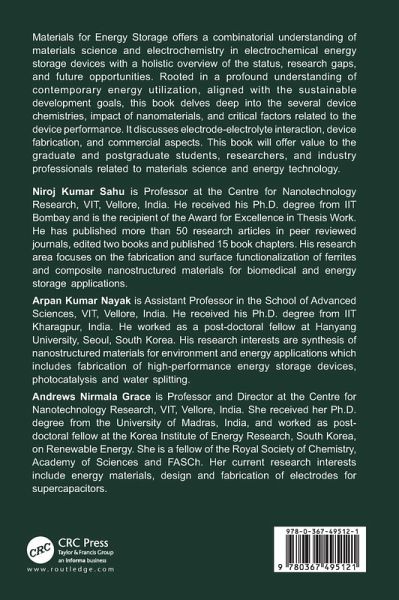
Materials for Energy Storage offers a combinatorial understanding of materials science and electrochemistry in electrochemical energy storage devices with a holistic overview of the status, research gaps, and future opportunities.
Niroj Kumar Sahu is Professor at the Centre for Nanotechnology Research, VIT, Vellore, India. He received his Ph.D. degree from IIT Bombay and is the recipient of the Award for Excellence in Thesis Work. He has published more than 50 research articles in peer reviewed journals, edited two books and published 15 book chapters. His research area focuses on the fabrication and surface functionalization of ferrites and composite nanostructured materials for biomedical and energy storage applications. Arpan Kumar Nayak is Assistant Professor in the School of Advanced Sciences, VIT, Vellore, India. He received his Ph.D. degree from IIT Kharagpur, India. He worked as a post-doctoral fellow at Hanyang University, Seoul, South Korea. His research interests are synthesis of nanostructured materials for environment and energy applications which includes fabrication of high-performance energy storage devices, photocatalysis and water splitting. Andrews Nirmala Grace is Professor and Director at the Centre for Nanotechnology Research, VIT, Vellore, India. She received her Ph.D. degree from the University of Madras, India, and worked as post-doctoral fellow at the Korea Institute of Energy Research, South Korea, on Renewable Energy. She is a fellow of the Royal Society of Chemistry, Academy of Sciences and FASCh. Her current research interests include energy materials, design and fabrication of electrodes for supercapacitors.
Inhaltsangabe
Preface. Fundamental Principle of Electrochemical Energy Storage. Electrode-Electrolyte Interface for Energy Storage. Carbon Based Nanomaterials for Energy Storage. Transition Metal Oxide Nanomaterials for Sodium-Ion Batteries and Hybrid Capacitors. Metal Carbides and Nitrides for Energy Storage Application. Ferrite Nanomaterials for Energy Storage Applications. Polymers for Efficient Electrochemical Energy Storage. Hybrid Materials for Energy Storage. Role of Defects in Nanomaterials and Their Effect on Energy Storage. 0D, 1D and 2D Materials for Energy Storage. Fabrication of Supercapacitor Devices and Their Applications. All Solid State Flexible Supercapacitors: Materials Synthesis and Fabrication. State of Art Comprising Nanomaterials for Asymmetric Solid State Supercapacitors. Current Status, Research Gaps, and Future Scope for Nanomaterials in Energy Storage Technologies. Index.
Preface. Fundamental Principle of Electrochemical Energy Storage. Electrode-Electrolyte Interface for Energy Storage. Carbon Based Nanomaterials for Energy Storage. Transition Metal Oxide Nanomaterials for Sodium-Ion Batteries and Hybrid Capacitors. Metal Carbides and Nitrides for Energy Storage Application. Ferrite Nanomaterials for Energy Storage Applications. Polymers for Efficient Electrochemical Energy Storage. Hybrid Materials for Energy Storage. Role of Defects in Nanomaterials and Their Effect on Energy Storage. 0D, 1D and 2D Materials for Energy Storage. Fabrication of Supercapacitor Devices and Their Applications. All Solid State Flexible Supercapacitors: Materials Synthesis and Fabrication. State of Art Comprising Nanomaterials for Asymmetric Solid State Supercapacitors. Current Status, Research Gaps, and Future Scope for Nanomaterials in Energy Storage Technologies. Index.
Es gelten unsere Allgemeinen Geschäftsbedingungen: www.buecher.de/agb
Impressum
www.buecher.de ist ein Internetauftritt der buecher.de internetstores GmbH
Geschäftsführung: Monica Sawhney | Roland Kölbl | Günter Hilger
Sitz der Gesellschaft: Batheyer Straße 115 - 117, 58099 Hagen
Postanschrift: Bürgermeister-Wegele-Str. 12, 86167 Augsburg
Amtsgericht Hagen HRB 13257
Steuernummer: 321/5800/1497
USt-IdNr: DE450055826