
Andere Kunden interessierten sich auch für
 Spectral and High Order Methods for Partial Differential Equations ICOSAHOM 2020+1174,99 €
 Nodal Discontinuous Galerkin Methods49,99 €
 An Invitation to the Theory of the Hybridizable Discontinuous Galerkin Method53,99 €
 Symmetric Discontinuous Galerkin Methods for 1-D Waves38,99 €
 Discontinuous Galerkin Method23,99 €
 Galerkin Finite Element Methods for Parabolic Problems39,99 €
 Galerkin Finite Element Methods for Parabolic Problems136,99 €
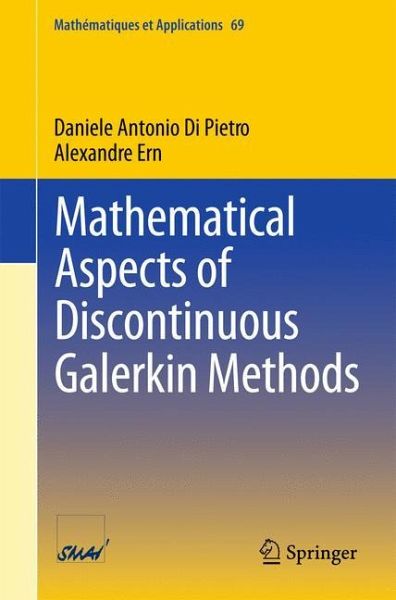
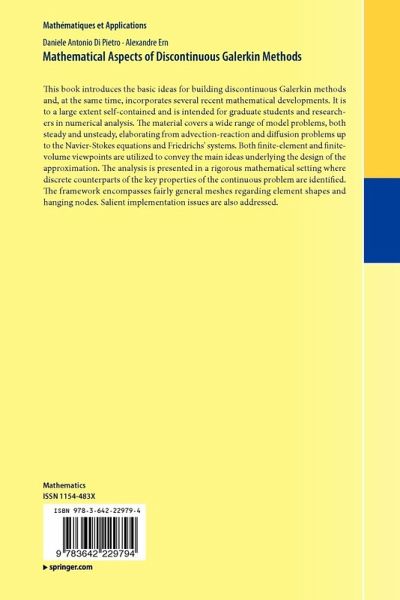
This book introduces the basic ideas to build discontinuous Galerkin methods and, at the same time, incorporates several recent mathematical developments. The presentation is to a large extent self-contained and is intended for graduate students and researchers in numerical analysis. The material covers a wide range of model problems, both steady and unsteady, elaborating from advection-reaction and diffusion problems up to the Navier-Stokes equations and Friedrichs' systems. Both finite element and finite volume viewpoints are exploited to convey the main ideas underlying the design of the approximation. The analysis is presented in a rigorous mathematical setting where discrete counterparts of the key properties of the continuous problem are identified. The framework encompasses fairly general meshes regarding element shapes and hanging nodes. Salient implementation issues are also addressed.
From the reviews: "This new monograph is an extremely valuable collection of the mathematical treatment of discontinuous Galerkin methods with 300 references and providing profound insight into the required techniques. It collects and presents also several recent results for elliptic and non-elliptic, stationary and non-stationary partial differential equations in a unified framework. Thus it is strongly recommendable for researchers in the field." (Christian Wieners, Zeitschrift für Angewandte Mathematik und Mechanik, Vol. 92 (7), 2012) "The aim of the book is 'to provide the reader with the basic mathematical concepts to design and analyze discontinuous Galerkin methods for various model problems, starting at an introductory level and further elaborating on more advanced topics'. ... Some useful practical implementation aspects are considered in an Appendix. The bibliography contains more than 300 entries." (Calin Ioan Gheorghiu, Zentralblatt MATH, Vol. 1231, 2012) "The goal of this book is to provide graduate students and researchers in numerical methods with the basic mathematical concepts to design and analyze discontinuous Galerkin (DG) methods for various model problems, starting at an introductory level and further elaborating on more advanced topics, considering that DG methods have tremendously developed in the last decade." (Rémi Vaillancourt, Mathematical Reviews, January, 2013)