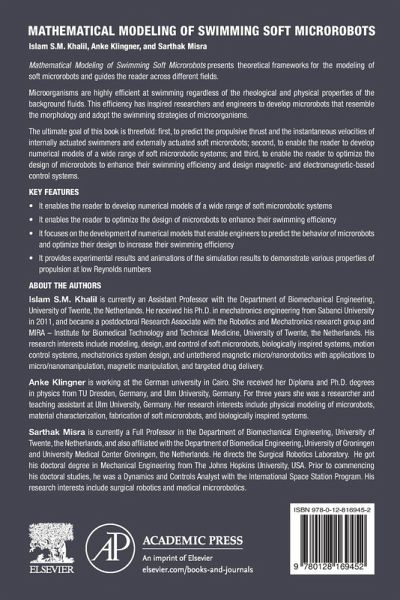
Mathematical Modelling of Swimming Soft Microrobots presents a theoretical framework for modelling of soft microrobotic systems based on resistive-force theory. Microorganisms are highly efficient at swimming regardless of the rheological and physical properties of the background fluids. This efficiency has inspired researchers and Engineers to develop microrobots that resemble the morphology and swimming strategies of microorganisms. The ultimate goal of this book is threefold: first, to relate resistive-force theory to externally and internally actuated microrobotic systems; second, to…mehr
Mathematical Modelling of Swimming Soft Microrobots presents a theoretical framework for modelling of soft microrobotic systems based on resistive-force theory. Microorganisms are highly efficient at swimming regardless of the rheological and physical properties of the background fluids. This efficiency has inspired researchers and Engineers to develop microrobots that resemble the morphology and swimming strategies of microorganisms. The ultimate goal of this book is threefold: first, to relate resistive-force theory to externally and internally actuated microrobotic systems; second, to enable the readers to develop numerical models of a wide range of microrobotic systems; third, to enable the reader to optimize the design of the microrobot to enhance its swimming efficiency.
IIslam S.M. Khalil received his Ph.D. degree in mechatronics engineering from Sabanci University in 2011 and became a postdoctoral research associate with the Robotics and Mechatronics research group and MIRA-Institute for Biomedical Technology and Technical Medicine, University of Twente, The Netherlands. In 2014, he became an assistant professor with the German University in Cairo, Egypt, Department of Mechatronics, where he directed the Medical Micro and Nano Robotics Laboratory. In 2018, he was appointed as associate professor at the same department. In 2019, he became an assistant professor with the University of Twente, Department of Biomechanical Engineering. His research interests include modeling, design, and control of soft microrobots, biologically inspired systems, motion control systems, mechatronics system design, and untethered magnetic micro/nanorobotics with applications to micro/nanomanipulation, magnetic manipulation, and targeted drug delivery.
Inhaltsangabe
1. Introduction
Part I Fundamentals of the Theory of Elasticity2. Review of Classical Mechanics3. Two-Dimensional Deformations
Part II Fundamentals of Electromagnetics4. Electrostatic and Magnetostatic Fields5. Magnetic forces and materials
Part III Fundamentals of Fluid Mechanics6. Viscous fluids7. Flow with small Reynolds numbers
Part IV Soft Microrobotic Systems8. Resistive-Force Theory9. Modelling of Internally Actuated Soft Microrobots10. Modelling of Externally Actuated Rigid and Soft Microrobots
Part V AppendixesA: Review of Vector calculusB: Units Appendix C: Material Constants
Part I Fundamentals of the Theory of Elasticity2. Review of Classical Mechanics3. Two-Dimensional Deformations
Part II Fundamentals of Electromagnetics4. Electrostatic and Magnetostatic Fields5. Magnetic forces and materials
Part III Fundamentals of Fluid Mechanics6. Viscous fluids7. Flow with small Reynolds numbers
Part IV Soft Microrobotic Systems8. Resistive-Force Theory9. Modelling of Internally Actuated Soft Microrobots10. Modelling of Externally Actuated Rigid and Soft Microrobots
Part V AppendixesA: Review of Vector calculusB: Units Appendix C: Material Constants
Es gelten unsere Allgemeinen Geschäftsbedingungen: www.buecher.de/agb
Impressum
www.buecher.de ist ein Internetauftritt der buecher.de internetstores GmbH
Geschäftsführung: Monica Sawhney | Roland Kölbl | Günter Hilger
Sitz der Gesellschaft: Batheyer Straße 115 - 117, 58099 Hagen
Postanschrift: Bürgermeister-Wegele-Str. 12, 86167 Augsburg
Amtsgericht Hagen HRB 13257
Steuernummer: 321/5800/1497
USt-IdNr: DE450055826