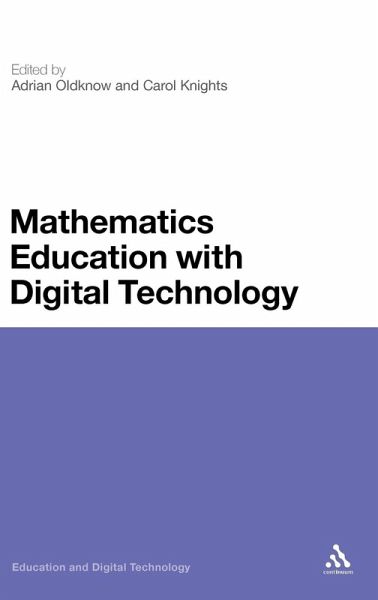
Mathematics Education with Digital Technology examines ways in which widely available digital technologies can be used to benefit the teaching and learning of mathematics. The contributors offer their insights to locate the value of digital technology for mathematics learning within the context of evidence from documented practice, prior research and of educational policy making. Key pedagogical uses of digital technologies are evaluated in relation to effective mathematics learning and practical ideas for teaching and learning mathematics with digital technology are critically analysed. The…mehr
Mathematics Education with Digital Technology examines ways in which widely available digital technologies can be used to benefit the teaching and learning of mathematics. The contributors offer their insights to locate the value of digital technology for mathematics learning within the context of evidence from documented practice, prior research and of educational policy making. Key pedagogical uses of digital technologies are evaluated in relation to effective mathematics learning and practical ideas for teaching and learning mathematics with digital technology are critically analysed. The volume concludes by looking at future developments and by considering the ways in which ICT could be used as a catalyst for cross-curricular work to achieve greater curricular coherence.
Adrian Oldknow is Professor Emeritus at the University of Chichester, UK.
Inhaltsangabe
Notes on Contributors \ Series Editor's Foreword \ Acknowledgements \ Introduction \ Part 1: Where Are We Now? \ 1. The NeuroScience of Connections Edward D. Laughbaum \ 2. ICT in the United States: Where We Are Today and a Possibility for Tomorrow Gail Burrill \ 3. ICT in France: Development of Usages, Institutional Hesitations and Research Questions Luc Trouche and Ghislaine Gueudet \ 4. ICT and the English Mathematics Curriculum Sue Pope \ Part 2: What Does Research Tell Us? \ 5. The Value of Learning Geometry with ICT: Lessons from Innovative Educational Research Keith Jones \ 6. Learning Mathematics Using Digital Resources: Impacts on Learning and Teaching for 11- to 14-year old Pupils Don Passey \ 7. Improving on Expectations: Preliminary Results from Using Network-supported Function-based Algebra Walter Stroup \ Part 3: Key Pedagogical Issues in Embedding ICT in Teaching and Learning Mathematics \ 8. Designing Substantial Tasks to Utilize ICT in Mathematics Lessons Colette Laborde \ 9. Learning from Acting on Objects John Mason \ 10. A Case Study of Using Multiple Resources to Teach Straight Line Graphs Rosemary Deaney and Sarah Hennessy \ Part 4: Description of a Range of ICT Tools \ 11. Emerging Technologies for Learning and Teaching Vanessa Pittard \ 12. Home and School - Bridging the Gap Russell Prue \ 13. Personal Portable Technology Adrian Oldknow and Peter Hamilton \ Part 5: Practical Ideas of ICT to Enhance Teaching and Learning \ 14. Linking the Mathematics Curriculum to Software, Resources and Strategies to Engage Teachers and Learners in Using ICT in the Classroom Linda Tetlow \ 15. The Uses of Online Resources for Teaching and Learning Mathematics at Advanced Level Bryan Dye \ What Do the Subject Associations Offer? Ruth Tanner \ 17. Modelling, Functions and Estimation: A Pizza Problem Chris Olley \ Part 6: ICT Supporting Cross-curricular Work with Mathematics \ 18. Using Video Analysis to Develop Modelling Skills in Physics Steve Hearn \ 19. Bloodhound SSC: A Vehicle for STEM Ian Galloway \ 20. Modelling Action in Sports and Leisure Matt Pauling and Adrian Oldknow \ Part 7: Case Studies of Teachers Engaging with ICT \ 21. Teaching International Baccalaureate Mathematics with Technology Jim Fensom \ 22. Why Use Technology to Teach Mathematics? Andy Kemp \ 23. Using ICT to Support Learning Mathematics in the Primary Classroom Mel Bradford and Tina Davidson \ 24. The Role of a Head of Mathematics Department in Ensuring ICT Provision and Use within Lessons Dawn Denyer and Carol Knights \ 25. Developing Problem Solving Skills and Cross-curricular Approaches in Mathematics Utilizing ICT Michael Hartnell and Carol Knights \ Part 8: Implications for Professional Development \ 26. Supporting Developments within a Local Authority Ron Taylor \ 27. Supporting Teachers in Introducing New Technologies Alison Clark-Wilson \ 28. Implications for Professional Development: Supporting Individuals Pip Huyton \ 29. What Are the Significant Factors Which Support the Integration of ICT in the Mathematics Classroom? David Wright and Pat Woolner \ Glossary \ Index
Notes on Contributors \ Series Editor's Foreword \ Acknowledgements \ Introduction \ Part 1: Where Are We Now? \ 1. The NeuroScience of Connections Edward D. Laughbaum \ 2. ICT in the United States: Where We Are Today and a Possibility for Tomorrow Gail Burrill \ 3. ICT in France: Development of Usages, Institutional Hesitations and Research Questions Luc Trouche and Ghislaine Gueudet \ 4. ICT and the English Mathematics Curriculum Sue Pope \ Part 2: What Does Research Tell Us? \ 5. The Value of Learning Geometry with ICT: Lessons from Innovative Educational Research Keith Jones \ 6. Learning Mathematics Using Digital Resources: Impacts on Learning and Teaching for 11- to 14-year old Pupils Don Passey \ 7. Improving on Expectations: Preliminary Results from Using Network-supported Function-based Algebra Walter Stroup \ Part 3: Key Pedagogical Issues in Embedding ICT in Teaching and Learning Mathematics \ 8. Designing Substantial Tasks to Utilize ICT in Mathematics Lessons Colette Laborde \ 9. Learning from Acting on Objects John Mason \ 10. A Case Study of Using Multiple Resources to Teach Straight Line Graphs Rosemary Deaney and Sarah Hennessy \ Part 4: Description of a Range of ICT Tools \ 11. Emerging Technologies for Learning and Teaching Vanessa Pittard \ 12. Home and School - Bridging the Gap Russell Prue \ 13. Personal Portable Technology Adrian Oldknow and Peter Hamilton \ Part 5: Practical Ideas of ICT to Enhance Teaching and Learning \ 14. Linking the Mathematics Curriculum to Software, Resources and Strategies to Engage Teachers and Learners in Using ICT in the Classroom Linda Tetlow \ 15. The Uses of Online Resources for Teaching and Learning Mathematics at Advanced Level Bryan Dye \ What Do the Subject Associations Offer? Ruth Tanner \ 17. Modelling, Functions and Estimation: A Pizza Problem Chris Olley \ Part 6: ICT Supporting Cross-curricular Work with Mathematics \ 18. Using Video Analysis to Develop Modelling Skills in Physics Steve Hearn \ 19. Bloodhound SSC: A Vehicle for STEM Ian Galloway \ 20. Modelling Action in Sports and Leisure Matt Pauling and Adrian Oldknow \ Part 7: Case Studies of Teachers Engaging with ICT \ 21. Teaching International Baccalaureate Mathematics with Technology Jim Fensom \ 22. Why Use Technology to Teach Mathematics? Andy Kemp \ 23. Using ICT to Support Learning Mathematics in the Primary Classroom Mel Bradford and Tina Davidson \ 24. The Role of a Head of Mathematics Department in Ensuring ICT Provision and Use within Lessons Dawn Denyer and Carol Knights \ 25. Developing Problem Solving Skills and Cross-curricular Approaches in Mathematics Utilizing ICT Michael Hartnell and Carol Knights \ Part 8: Implications for Professional Development \ 26. Supporting Developments within a Local Authority Ron Taylor \ 27. Supporting Teachers in Introducing New Technologies Alison Clark-Wilson \ 28. Implications for Professional Development: Supporting Individuals Pip Huyton \ 29. What Are the Significant Factors Which Support the Integration of ICT in the Mathematics Classroom? David Wright and Pat Woolner \ Glossary \ Index
Es gelten unsere Allgemeinen Geschäftsbedingungen: www.buecher.de/agb
Impressum
www.buecher.de ist ein Internetauftritt der buecher.de internetstores GmbH
Geschäftsführung: Monica Sawhney | Roland Kölbl | Günter Hilger
Sitz der Gesellschaft: Batheyer Straße 115 - 117, 58099 Hagen
Postanschrift: Bürgermeister-Wegele-Str. 12, 86167 Augsburg
Amtsgericht Hagen HRB 13257
Steuernummer: 321/5800/1497
USt-IdNr: DE450055826