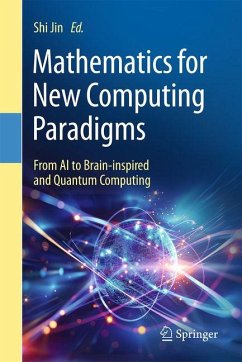
98,99 €
inkl. MwSt.
Versandkostenfrei*Erscheint vorauss. 11. September 2026
Melden Sie sich
hier
hier
für den Produktalarm an, um über die Verfügbarkeit des Produkts informiert zu werden.

49 °P sammeln
Andere Kunden interessierten sich auch für
 Quantum Supremacy22,99 €
 Quantum Computing for Everyone15,99 €
 Computer Algebra Recipes76,99 €
 Advancing Innovation Through AI and Machine Learning Algorithms147,99 €
 Proceedings of the 5th International Conference on Data Science, Machine Learning and Applications; Volume 1277,99 €
 Proceedings of the 5th International Conference on Data Science, Machine Learning and Applications; Volume 2305,99 €
 Computer Algebra Recipes52,99 €


The relentless evolution of computing from classical algorithms to artificial intelligence (AI), brain-inspired architectures, and quantum systems demands a reimagining of the mathematical foundations that underpin these transformative technologies. Edited by Prof. Shi Jin from Shanghai Jiao Tong University, this volume bridges abstract mathematical theory and cutting-edge computational practice, equipping researchers, engineers, and students with fundamental understanding to navigate and shape the future of scientific computing.
This book unifies interdisciplinary advances in quantum computation, neural and brain-inspired systems, AI-driven molecular modeling, and data-intensive particle dynamics under a cohesive mathematical framework. It synthesizes insights from 9 meticulously structured chapters, each authored by leading experts, to address the mathematical challenges and innovations arising in:
- Quantum advantage for solving partial differential equations(PDEs),
- Biologically plausible AI modeling brain dynamics and protein engineering,
- Statistical rigor in randomized experiments and observational studies,
- Operator learning for kinetic equations and interacting particle systems,
- Graph/hypergraph neural networks via phase-transition physics.
The book aims to reveal the mathematical "language" of next-generation computing paradigms. As computing paradigms fracture into specialized niches, this volume is a unifying compass. It transforms isolated breakthroughs such as particle-based graph networks, operator learning for chemistry, or quantum PDE solvers into a coherent mathematical arsenal. For mathematicians, it reveals uncharted problems in computation; for engineers, it provides rigor to harness AI, quantum, and bio-inspired tools; for students, it maps the emerging landscape where equations meet evolution.
This book unifies interdisciplinary advances in quantum computation, neural and brain-inspired systems, AI-driven molecular modeling, and data-intensive particle dynamics under a cohesive mathematical framework. It synthesizes insights from 9 meticulously structured chapters, each authored by leading experts, to address the mathematical challenges and innovations arising in:
- Quantum advantage for solving partial differential equations(PDEs),
- Biologically plausible AI modeling brain dynamics and protein engineering,
- Statistical rigor in randomized experiments and observational studies,
- Operator learning for kinetic equations and interacting particle systems,
- Graph/hypergraph neural networks via phase-transition physics.
The book aims to reveal the mathematical "language" of next-generation computing paradigms. As computing paradigms fracture into specialized niches, this volume is a unifying compass. It transforms isolated breakthroughs such as particle-based graph networks, operator learning for chemistry, or quantum PDE solvers into a coherent mathematical arsenal. For mathematicians, it reveals uncharted problems in computation; for engineers, it provides rigor to harness AI, quantum, and bio-inspired tools; for students, it maps the emerging landscape where equations meet evolution.