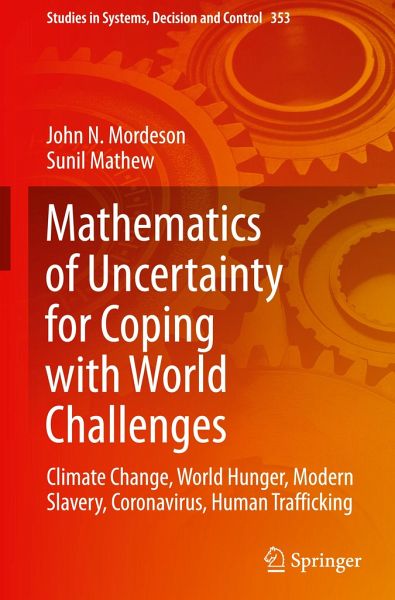
This book ranks countries with respect to their achievement of the Sustainable Development Goals and their vulnerability to climate change. Human livelihoods, stable economies, health, and high quality of life all depend on a stable climate and earth system, and a diversity of species and ecosystems. Climate change significantly impacts human trafficking, modern slavery, and global hunger. This book examines these global problems using techniques from mathematics of uncertainty. Since accurate data concerning human trafficking and modern slavery is impossible to obtain, mathematics of…mehr
This book ranks countries with respect to their achievement of the Sustainable Development Goals and their vulnerability to climate change. Human livelihoods, stable economies, health, and high quality of life all depend on a stable climate and earth system, and a diversity of species and ecosystems. Climate change significantly impacts human trafficking, modern slavery, and global hunger. This book examines these global problems using techniques from mathematics of uncertainty. Since accurate data concerning human trafficking and modern slavery is impossible to obtain, mathematics of uncertainty is an ideal discipline to study these problems. The book also considers the interconnection between climate change, world hunger, human trafficking, modern slavery, and the coronavirus. Connectivity properties of fuzzy graphs are used to examine trafficking flow between regions in the world. The book is an excellent reference source for advanced undergraduate and graduate students in mathematics and the social sciences as well as for researchers and teachers.
Dr. John N. Mordeson is Professor Emeritus of Mathematics at Creighton University. He received his B.S., M.S., and Ph.D. from Iowa State University. He is a member of Phi Kappa Phi. He has published 19 books and over 200 journal articles, and is on the editorial board of numerous journals. He has served as an external examiner for Ph.D. candidates from India, South Africa, Bulgaria and Pakistan, and has also served as a referee for numerous journals and grant agencies. He is particularly interested in applying mathematics of uncertainty to combat the problem of human träcking. Dr. Sunil Mathew is a faculty member at the Department of Mathematics, NIT Calicut, India. He has holds a master's degree from St. Josephs College, Calicut, and a Ph.D. in Fuzzy Graph Theory from the National Institute of Technology Calicut. He has 20 years of teaching and research experience, and his current research focuses on fuzzy graph theory, bio-computational modeling, graph theory, fractal geometry, and chaos. He has published more than 100 research papers and written ¿ve books, and is an editor and reviewer for several international journals. He is a member of numerous academic bodies and associations.
Inhaltsangabe
Preliminaries.- Sustainable Development Goals.- Global Climate Risk.- Human Tra cking and Modern Slavery.- Modern Slavery, Environmental Destruction and Climate Change.- Modern Slavery.- Global Starvation and Coronavirus.- Fuzzy Graphs and Human Tra cking.- Connectivity and Human Tra cking.
Preliminaries.- Sustainable Development Goals.- Global Climate Risk.- Human Tra cking and Modern Slavery.- Modern Slavery, Environmental Destruction and Climate Change.- Modern Slavery.- Global Starvation and Coronavirus.- Fuzzy Graphs and Human Tra cking.- Connectivity and Human Tra cking.
Es gelten unsere Allgemeinen Geschäftsbedingungen: www.buecher.de/agb
Impressum
www.buecher.de ist ein Internetauftritt der buecher.de internetstores GmbH
Geschäftsführung: Monica Sawhney | Roland Kölbl | Günter Hilger
Sitz der Gesellschaft: Batheyer Straße 115 - 117, 58099 Hagen
Postanschrift: Bürgermeister-Wegele-Str. 12, 86167 Augsburg
Amtsgericht Hagen HRB 13257
Steuernummer: 321/5800/1497
USt-IdNr: DE450055826