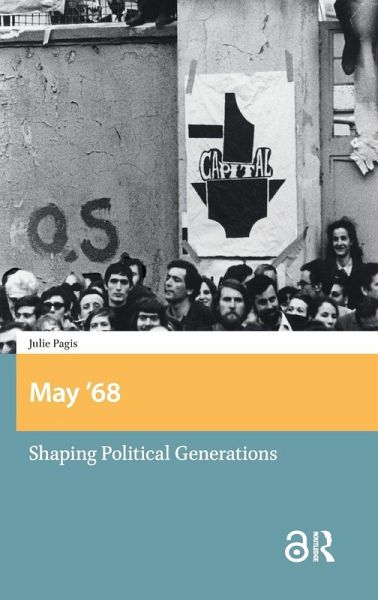
This book studies the life trajectories of protestors during the May '68 civil uprising in France, using statistics and personal narratives to analyse how this activism arose, its impact, and its transmission through generations.
This book studies the life trajectories of protestors during the May '68 civil uprising in France, using statistics and personal narratives to analyse how this activism arose, its impact, and its transmission through generations.
Julie Pagis is a researcher in political sociology at the French National Center for Scientific Research (CNRS), member of the Institute for Interdisciplinary Research on Social Issues (IRIS, EHESS, Paris). Her research on the biographical consequences of activism in May'68 led to the publication of her PhD: Mai 68, un pavé dans leur histoire (Presses de Sciences Po, 2014). She devotes another part of her research to children perceptions of the social and political order, and recently published, with Wilfried Lignier, L'enfance de l'ordre. Comment les enfants perçoivent le monde social (Seuil, 2017).
Inhaltsangabe
List of acronyms and political organisation, List of documents, Introduction The autobiographical origins of my study Partially unsatisfying representations of May '68 The biographical consequences of activism in May '68 History of the study Chapter 1 The roots of participation in May '68 The matrixes of participation in May '68 Politics and religion: a family affair The transformations of conditions for students and women Conclusion Chapter 2: Shaping the event: Socialisation effects and registers of participation May '68: the same event for everyone? How did the event influence the participants? Conclusion Chapter 3 The long-term consequences of May '68 The social space of '68ers' destinies Generational impact forty years later Chapter 4 Working to avoid social reproduction Students in factories and workers in universities: inversed trajectories Activism through popular education Conclusion - activism and social mobility Chapter 5 Changing one's life to change the world? The politicisation of the private sphere Politicising the private sphere Anne: remaining faithful to the break Conclusion Chapter 6 Micro-units of Generation '68 Social conditions for the identification with generation '68 What became of the '68ers: a range of futures Chapter 7 A ricochet effect on the next generation? Strong family political transmission Different inheritors, different profiles Transmission of activism: intergenerational (dis)continuities? Conclusion: The Event: a frame for political resocialisation, Bibliography, Appendix 1. List of interviews conducted with the ex-'68ers cited, Appendix 2. List of interviews conducted with the children of ex-'68ers cited, Appendix 3. Micro-generational units of May '68, Notes
List of acronyms and political organisation, List of documents, Introduction The autobiographical origins of my study Partially unsatisfying representations of May '68 The biographical consequences of activism in May '68 History of the study Chapter 1 The roots of participation in May '68 The matrixes of participation in May '68 Politics and religion: a family affair The transformations of conditions for students and women Conclusion Chapter 2: Shaping the event: Socialisation effects and registers of participation May '68: the same event for everyone? How did the event influence the participants? Conclusion Chapter 3 The long-term consequences of May '68 The social space of '68ers' destinies Generational impact forty years later Chapter 4 Working to avoid social reproduction Students in factories and workers in universities: inversed trajectories Activism through popular education Conclusion - activism and social mobility Chapter 5 Changing one's life to change the world? The politicisation of the private sphere Politicising the private sphere Anne: remaining faithful to the break Conclusion Chapter 6 Micro-units of Generation '68 Social conditions for the identification with generation '68 What became of the '68ers: a range of futures Chapter 7 A ricochet effect on the next generation? Strong family political transmission Different inheritors, different profiles Transmission of activism: intergenerational (dis)continuities? Conclusion: The Event: a frame for political resocialisation, Bibliography, Appendix 1. List of interviews conducted with the ex-'68ers cited, Appendix 2. List of interviews conducted with the children of ex-'68ers cited, Appendix 3. Micro-generational units of May '68, Notes
Es gelten unsere Allgemeinen Geschäftsbedingungen: www.buecher.de/agb
Impressum
www.buecher.de ist ein Internetauftritt der buecher.de internetstores GmbH
Geschäftsführung: Monica Sawhney | Roland Kölbl | Günter Hilger
Sitz der Gesellschaft: Batheyer Straße 115 - 117, 58099 Hagen
Postanschrift: Bürgermeister-Wegele-Str. 12, 86167 Augsburg
Amtsgericht Hagen HRB 13257
Steuernummer: 321/5800/1497
USt-IdNr: DE450055826