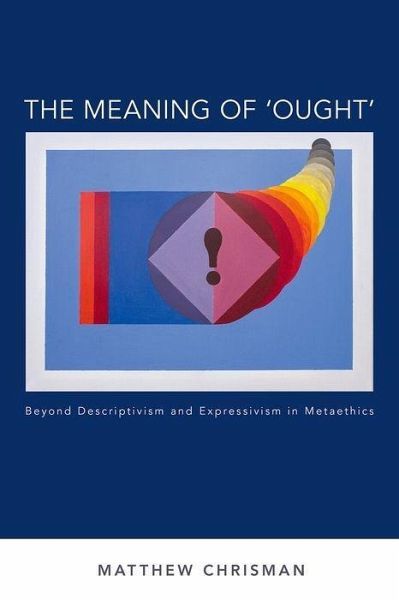
The word 'ought' is one of the core normative terms, but it is also a modal word. In this book Matthew Chrisman develops a careful account of the semantics of 'ought' as a modal operator, and uses this to motivate a novel inferentialist account of why ought-sentences have the meaning that they have. This is a metanormative account that agrees with traditional descriptivist theories in metaethics that specifying the truth-conditions of normative sentences is a central part of the explanation of their meaning. But Chrisman argues that this leaves important metasemantic questions about what it is…mehr
The word 'ought' is one of the core normative terms, but it is also a modal word. In this book Matthew Chrisman develops a careful account of the semantics of 'ought' as a modal operator, and uses this to motivate a novel inferentialist account of why ought-sentences have the meaning that they have. This is a metanormative account that agrees with traditional descriptivist theories in metaethics that specifying the truth-conditions of normative sentences is a central part of the explanation of their meaning. But Chrisman argues that this leaves important metasemantic questions about what it is in virtue of which ought-sentences have the meanings that they have unanswered. His appeal to inferentialism aims to provide a viable anti-descriptivist but also anti-expressivist answer to these questions. "This is a remarkably bold and interesting book. Chrisman challenges nothing less than the entire conceptual framework within which most previous metaethics (and indeed, much other contemporary philosophy) has been done, and advances a very ambitious rethinking of the theoretical space. It's not only ambitious, but also extremely imaginative and smart, and Chrisman's scholarship is at a rare level, as he has assimilated a literature that is unusually broad both in terms of field and historical scope."-Stephen Finlay, Professor of Philosophy, University of Southern California
Matthew Chrisman is a Reader in Philosophy at the University of Edinburgh. He came to Edinburgh after earning his PhD and MA at the University of North Carolina at Chapel Hill and his BA at Rice University. His research is focused on ethical theory, the philosophy of language, and epistemology. He has published widely in these areas, including articles in the Journal of Philosophy, the Australasian Journal of Philosophy, Oxford Studies in Metaethics, Philosophy and Phenomenological Research, Philosophers' Imprint and Philosophical Studies.
Inhaltsangabe
* 1. Introduction * 1.1. The Ubiquity of 'Ought' * 1.2. Some Initial Theoretical Cartography * 1.3. Metanormative Theorizing and the Philosophy of Language * 1.4. Compositional Semantics, Some Basics * 1.5. The Word 'Ought' * 1.6. Plan * 2. 'Ought's, Obligations, Reasons, and Values * 2.1. Introduction * 2.2. Formal Framework and Toy Analysis of 'Ought' * 2.3. An Initial Ambiguity View * 2.4. Analyzing 'Ought' in Terms of Reasons * 2.5. Analyzing 'Ought' in Terms of Values * 2.6. Conclusion * 3. A Possible Worlds Semantics for 'Ought' * 3.1. Introduction * 3.2. From Modal Logic to Deontic Necessity and Possibility * 3.3. From Deontic Necessity to a Simple Possible Worlds Semantics for 'Ought' * 3.4. Some Reasons to Complicate the Analysis * 3.5. Kratzer's Improvements * 3.6. Application of Kratzer's Framework to 'Ought' * 3.7. The Weakness of 'Ought' Compared to 'Must' * 3.8. Conclusion * 4. Problems with Possible Worlds * 4.1. Introduction * 4.2. The Challenge of Dilemmas * 4.3. The Challenge of 'Ought-to-Do' * 4.4. Conclusion * 5. A New Semantic Rule for 'Ought' * 5.1. Introduction * 5.2. Is 'Ought' Polysemous between Agentive and Non-Agentive Readings? * 5.3. Imperatival Content * 5.4. A New Semantic Rule for 'Ought' * 5.5. Conclusion * 6. Metanormative Debate Renewed * 6.1. Introduction * 6.2. Truth Conditions as Ways Reality Could Be * 6.3. Truth Conditions as What One Ought to Think * 6.4. Truth Conditions as Positions in a Space of Implications * 6.5. Conclusion * 7. Conclusion * 7.1. Introduction * 7.2. Should the Metalanguage of Metanormative Theory be Nonnormative? * 7.3. What about Other Normative and Evaluative Words and Concepts? * 7.4. Moral Psychology * 7.5. The Epistemology of Normativity * 7.6. Conclusion * Appendix of Proposed Rules * Bibliography
Es gelten unsere Allgemeinen Geschäftsbedingungen: www.buecher.de/agb
Impressum
www.buecher.de ist ein Internetauftritt der buecher.de internetstores GmbH
Geschäftsführung: Monica Sawhney | Roland Kölbl | Günter Hilger
Sitz der Gesellschaft: Batheyer Straße 115 - 117, 58099 Hagen
Postanschrift: Bürgermeister-Wegele-Str. 12, 86167 Augsburg
Amtsgericht Hagen HRB 13257
Steuernummer: 321/5800/1497
USt-IdNr: DE450055826