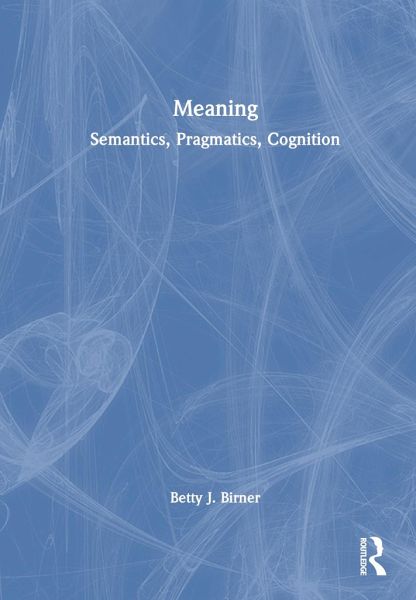
Meaning addresses the fundamental question of human language interaction: what it is to mean, and how we communicate our meanings to others. Experienced textbook writer and eminent researcher Betty J. Birner gives balanced coverage to semantics and pragmatics, emphasizing interactions between the two.
Meaning addresses the fundamental question of human language interaction: what it is to mean, and how we communicate our meanings to others. Experienced textbook writer and eminent researcher Betty J. Birner gives balanced coverage to semantics and pragmatics, emphasizing interactions between the two.
Betty J. Birner is a professor of Linguistics and Cognitive Science in the Department of English at Northern Illinois University, DeKalb, IL. She received her Ph.D. in 1992 from Northwestern University, and has written extensively on pragmatics, the semantics/pragmatics interface, and information structure.
Inhaltsangabe
List of boxes List of figures List of truth tables Preface Acknowledgments 1. What is language? Linguistics The rules of language Language change Research in linguistics Philosophy of language: How meaning works Types of meaning Where is meaning located? The philosophers weigh in, beginning with: Frege Russell Strawson Donnellan The upshot Semantics and pragmatics Discourse models and possible worlds Exercises 2. Semantics I: Word meaning What is a word? Where words come from Historical descent Other sources of new words Lexical relations Approaches to word meaning Componential analysis Other primitive-based approaches Prototype theory and The Great Sandwich Controversy Exercises 3. Semantics II: Sentence meaning Truth and meaning Sentential relations Logical operators Negation Conjunction Disjunction The conditional The biconditional Propositional logic Analytic statements Synthetic statements Predicate logic Predicates and constants Variables Quantifiers Ambiguity and scope Exercises 4. Pragmatics I: The Cooperative Principle Reprise: Semantics vs. pragmatics The Cooperative Principle The maxims The maxim of Quantity The maxim of Quality The maxim of Relation The maxim of Manner Revisiting Grice's problem Tests for conversational implicature Implicature and pragmatic theory Conventional implicature The Gricean world view Pragmatics after Grice Explicature Impliciture Neo-Gricean theory Relevance theory Boundary disputes Exercises 5. Pragmatics II: Speech acts Speech acts Performatives Constatives Types of speech acts: first pass Indirect speech acts Felicity conditions Felicity conditions, speech acts, and the Cooperative Principle Types of speech acts: second pass Politeness theory Exercises 6. Language structure The Chomskyan revolution Sound structure Word structure Morphemes Allomorphs Words Parts of speech Structure and function Representing word structure Other ways of building words Sentence structure Ambiguity and constituency Representing sentence structure Expanding our grammar Structural ambiguity So what's the point? Exercises 7. Interfaces I: Semantics, pragmatics, and philosophy Reference and the semantics/pragmatics boundary What do we refer to when we refer? Deixis and anaphora Indexicals Deixis Personal deixis Spatial deixis Temporal deixis Discourse deixis Anaphora Reference resolution Cataphora Anaphora and phrase types Definiteness Definiteness as uniqueness Definiteness as familiarity Presupposition Testing for presupposition Presupposition triggers Theories of presupposition Accommodation Exercises 8. Interfaces II: Structure and meaning Semantic roles Argument-structure alternations Information structure Preposing Postposing Argument reversal Inference Open propositions Constructions The type/token distinction Exercises 9. Meaning and human cognition Language and the brain Brain structure Neurons Aphasia Language and thought Does the language I speak affect my view of reality? Language use and world view Advertising Politics and public policy Language and prejudice Connecting the dots Exercises 10. Meaning, minds, and machines The nuts and bolts Natural-language processing Artificial intelligence Data mining Deep learning Meaning and the self Bodies and minds Language and consciousness Exercises References Index
List of boxes List of figures List of truth tables Preface Acknowledgments 1. What is language? Linguistics The rules of language Language change Research in linguistics Philosophy of language: How meaning works Types of meaning Where is meaning located? The philosophers weigh in, beginning with: Frege Russell Strawson Donnellan The upshot Semantics and pragmatics Discourse models and possible worlds Exercises 2. Semantics I: Word meaning What is a word? Where words come from Historical descent Other sources of new words Lexical relations Approaches to word meaning Componential analysis Other primitive-based approaches Prototype theory and The Great Sandwich Controversy Exercises 3. Semantics II: Sentence meaning Truth and meaning Sentential relations Logical operators Negation Conjunction Disjunction The conditional The biconditional Propositional logic Analytic statements Synthetic statements Predicate logic Predicates and constants Variables Quantifiers Ambiguity and scope Exercises 4. Pragmatics I: The Cooperative Principle Reprise: Semantics vs. pragmatics The Cooperative Principle The maxims The maxim of Quantity The maxim of Quality The maxim of Relation The maxim of Manner Revisiting Grice's problem Tests for conversational implicature Implicature and pragmatic theory Conventional implicature The Gricean world view Pragmatics after Grice Explicature Impliciture Neo-Gricean theory Relevance theory Boundary disputes Exercises 5. Pragmatics II: Speech acts Speech acts Performatives Constatives Types of speech acts: first pass Indirect speech acts Felicity conditions Felicity conditions, speech acts, and the Cooperative Principle Types of speech acts: second pass Politeness theory Exercises 6. Language structure The Chomskyan revolution Sound structure Word structure Morphemes Allomorphs Words Parts of speech Structure and function Representing word structure Other ways of building words Sentence structure Ambiguity and constituency Representing sentence structure Expanding our grammar Structural ambiguity So what's the point? Exercises 7. Interfaces I: Semantics, pragmatics, and philosophy Reference and the semantics/pragmatics boundary What do we refer to when we refer? Deixis and anaphora Indexicals Deixis Personal deixis Spatial deixis Temporal deixis Discourse deixis Anaphora Reference resolution Cataphora Anaphora and phrase types Definiteness Definiteness as uniqueness Definiteness as familiarity Presupposition Testing for presupposition Presupposition triggers Theories of presupposition Accommodation Exercises 8. Interfaces II: Structure and meaning Semantic roles Argument-structure alternations Information structure Preposing Postposing Argument reversal Inference Open propositions Constructions The type/token distinction Exercises 9. Meaning and human cognition Language and the brain Brain structure Neurons Aphasia Language and thought Does the language I speak affect my view of reality? Language use and world view Advertising Politics and public policy Language and prejudice Connecting the dots Exercises 10. Meaning, minds, and machines The nuts and bolts Natural-language processing Artificial intelligence Data mining Deep learning Meaning and the self Bodies and minds Language and consciousness Exercises References Index
Rezensionen
"Betty Birner's new book is an ideal guide for students' magical mystery tour of the fascinating intricacies of pragmatics and semantics. Professor Birner clearly introduces landmark research in linguistics, philosophy, and other relevant disciplines, inspiring and helping students begin exploring meaning-language connections for themselves."
Sally McConnell-Ginet, Linguistics, Cornell University, USA
Es gelten unsere Allgemeinen Geschäftsbedingungen: www.buecher.de/agb
Impressum
www.buecher.de ist ein Internetauftritt der buecher.de internetstores GmbH
Geschäftsführung: Monica Sawhney | Roland Kölbl | Günter Hilger
Sitz der Gesellschaft: Batheyer Straße 115 - 117, 58099 Hagen
Postanschrift: Bürgermeister-Wegele-Str. 12, 86167 Augsburg
Amtsgericht Hagen HRB 13257
Steuernummer: 321/5800/1497
USt-IdNr: DE450055826