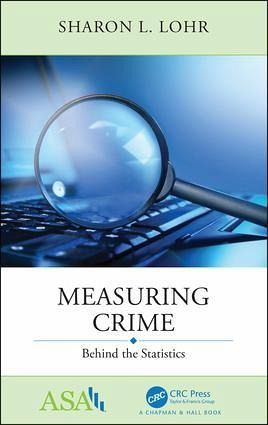
Every day, newspapers, magazines, web sites, and social media feature articles about the prevalence of crime. Some of these contradict each other; others use inaccurate statistics. Many people who see wildly diverging statistics conclude that no statistics should be trusted. However, the essence of the statistical discipline is that all statistics should be accompanied by a measure of their accuracy. This book looks at crime statistics from a statistical point of view, and evaluates the different sources of crime statistics with respect to completeness (i.e. missing data), measurement error,…mehr
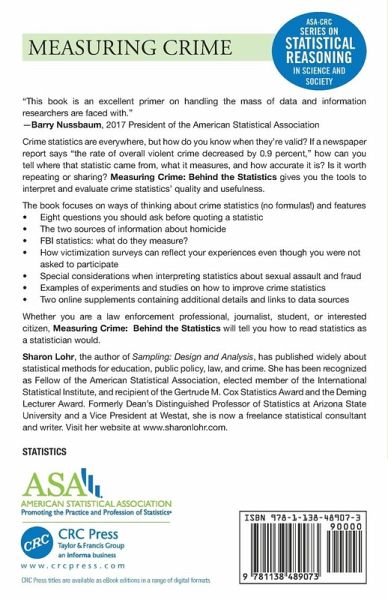
Every day, newspapers, magazines, web sites, and social media feature articles about the prevalence of crime. Some of these contradict each other; others use inaccurate statistics. Many people who see wildly diverging statistics conclude that no statistics should be trusted. However, the essence of the statistical discipline is that all statistics should be accompanied by a measure of their accuracy. This book looks at crime statistics from a statistical point of view, and evaluates the different sources of crime statistics with respect to completeness (i.e. missing data), measurement error, and sampling variability. The goal of the book is to promote statistical reasoning about statistics.
Sharon Lohr, the author of Sampling: Design and Analysis, has published widely about statistical methods for education, public policy, law, and crime. She has been recognized as Fellow of the American Statistical Association, elected member of the International Statistical Institute, and recipient of the Gertrude M. Cox Statistics Award and the Deming Lecturer Award. Formerly Dean's Distinguished Professor of Statistics at Arizona State University and a Vice President at Westat, she is now a freelance statistical consultant and writer. Visit her website at www.sharonlohr.com.
Inhaltsangabe
1. Measuring Crime. 2. Homicide Statistics. 3. Crime Statistics from Law Enforcement Agencies. 4. The Dark Figure of Unreported Crime. 5. The National Crime Victimization Survey: Selecting the Sample. 6. The National Crime Victimization Survey: Estimating Victimization Rates. 7. The National Crime Victimization Survey: Measurement Error and Missing Data. 8. Sexual Assault. 9. Fraud and Identity Theft. 10. "Big Data" and Crime. 11. Going Forward: Improving Crime Statistics.
Es gelten unsere Allgemeinen Geschäftsbedingungen: www.buecher.de/agb
Impressum
www.buecher.de ist ein Internetauftritt der buecher.de internetstores GmbH
Geschäftsführung: Monica Sawhney | Roland Kölbl | Günter Hilger
Sitz der Gesellschaft: Batheyer Straße 115 - 117, 58099 Hagen
Postanschrift: Bürgermeister-Wegele-Str. 12, 86167 Augsburg
Amtsgericht Hagen HRB 13257
Steuernummer: 321/5800/1497
USt-IdNr: DE450055826