
Andere Kunden interessierten sich auch für
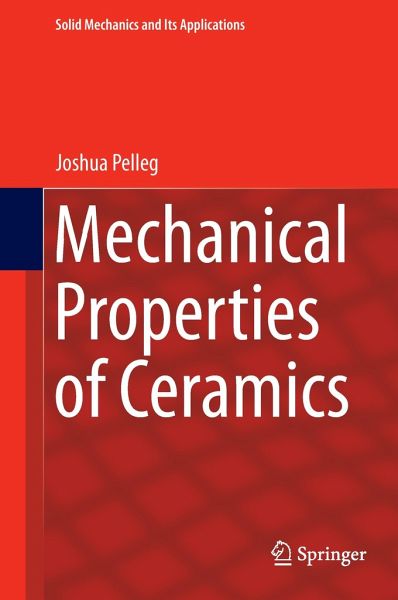
 Multiphased Ceramic Materials77,99 €
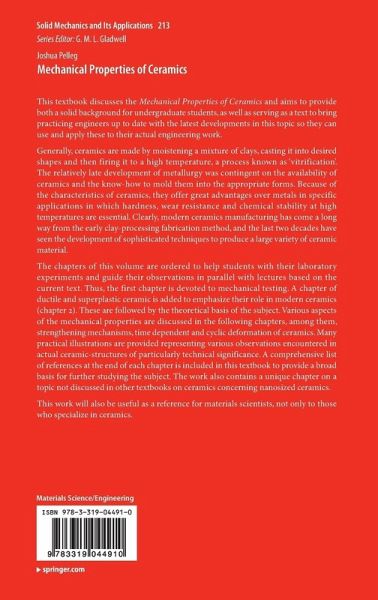
 Thermal Stress Resistance of Materials112,99 €
 - Al2O3 Komposite aus metastabilen Pulvern") Synthese und mechanische Eigenschaften ultrafeinkörniger ZrO2(Y2O3) - Al2O3 Komposite aus metastabilen Pulvern30,90 €
Synthese und mechanische Eigenschaften ultrafeinkörniger ZrO2(Y2O3) - Al2O3 Komposite aus metastabilen Pulvern30,90 € Handbook of Materials Structures, Properties, Processing and Performance372,99 €
 Werkstoffe44,99 €
 Werkstoff Glas24,99 €
 The Modelling of Microstructure and its Potential for Studying Transport Properties and Durability229,99 €
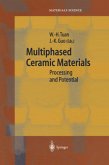

This book discusses the mechanical properties of ceramics and aims to provide both a solid background for undergraduate students, as well as serving as a text to bring practicing engineers up to date with the latest developments in this topic so they can use and apply these to their actual engineering work.
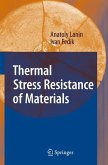
Generally, ceramics are made by moistening a mixture of clays, casting it into desired shapes and then firing it to a high temperature, a process known as 'vitrification'. The relatively late development of metallurgy was contingent on the availability of ceramics and the know-how to mold them into the appropriate forms. Because of the characteristics of ceramics, they offer great advantages over metals in specific applications in which hardness, wear resistance and chemical stability at high temperatures are essential. Clearly, modern ceramics manufacturing has come a long way from the early clay-processing fabrication method, and the last two decades have seen thedevelopment of sophisticated techniques to produce a large variety of ceramic material.
The chapters of this volume are ordered to help students with their laboratory experiments and guide their observations in parallel with lectures based on the current text. Thus, the first chapter is devoted to mechanical testing. A chapter of ductile and superplastic ceramic is added to emphasize their role in modern ceramics (chapter 2). These are followed by the theoretical basis of the subject. Various aspects of the mechanical properties are discussed in the following chapters, among them, strengthening mechanisms, time dependent and cyclic deformation of ceramics. Many practical illustrations are provided representing various observations encountered in actual ceramic-structures of particularly technical significance. A comprehensive list of references at the end of each chapter is included in this textbook to provide a broad basis for further studying the subject. The work also contains a unique chapter on a topic not discussed in other textbooks on ceramics concerning nanosized ceramics.
This work will also be useful as a reference for materials scientists, not only to those who specialize in ceramics.
Generally, ceramics are made by moistening a mixture of clays, casting it into desired shapes and then firing it to a high temperature, a process known as 'vitrification'. The relatively late development of metallurgy was contingent on the availability of ceramics and the know-how to mold them into the appropriate forms. Because of the characteristics of ceramics, they offer great advantages over metals in specific applications in which hardness, wear resistance and chemical stability at high temperatures are essential. Clearly, modern ceramics manufacturing has come a long way from the early clay-processing fabrication method, and the last two decades have seen thedevelopment of sophisticated techniques to produce a large variety of ceramic material.
The chapters of this volume are ordered to help students with their laboratory experiments and guide their observations in parallel with lectures based on the current text. Thus, the first chapter is devoted to mechanical testing. A chapter of ductile and superplastic ceramic is added to emphasize their role in modern ceramics (chapter 2). These are followed by the theoretical basis of the subject. Various aspects of the mechanical properties are discussed in the following chapters, among them, strengthening mechanisms, time dependent and cyclic deformation of ceramics. Many practical illustrations are provided representing various observations encountered in actual ceramic-structures of particularly technical significance. A comprehensive list of references at the end of each chapter is included in this textbook to provide a broad basis for further studying the subject. The work also contains a unique chapter on a topic not discussed in other textbooks on ceramics concerning nanosized ceramics.
This work will also be useful as a reference for materials scientists, not only to those who specialize in ceramics.