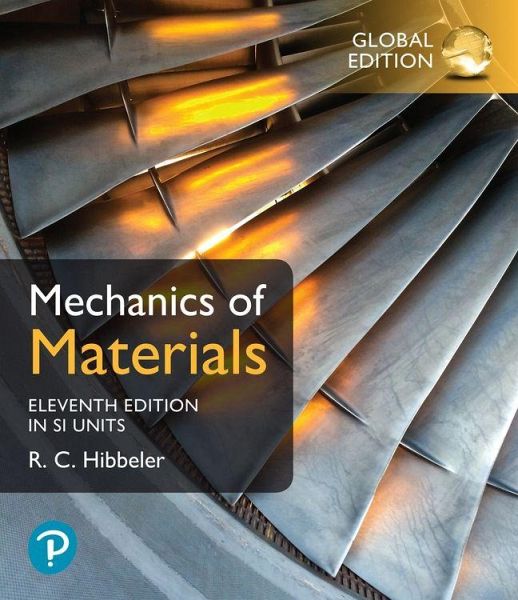
Mechanics of Materials excels in providing a clear and thorough presentation of the theory and application of mechanics of materials principles. Drawing upon his decades of classroom experience and his knowledge of how students learn, Professor Hibbeler provides highly visual, methodical applications to help you conceptualize and master difficult concepts. A variety of problem types stress realistic situations encountered in the field, with several levels of difficulty to give you the practice you need to excel in your courses and career. The 11th Edition in SI units features approximately…mehr
Mechanics of Materials excels in providing a clear and thorough presentation of the theory and application of mechanics of materials principles. Drawing upon his decades of classroom experience and his knowledge of how students learn, Professor Hibbeler provides highly visual, methodical applications to help you conceptualize and master difficult concepts. A variety of problem types stress realistic situations encountered in the field, with several levels of difficulty to give you the practice you need to excel in your courses and career.
The 11th Edition in SI units features approximately 30% new problems which involve applications to many different fields of engineering.
Die Herstellerinformationen sind derzeit nicht verfügbar.
Autorenporträt
R. C. Hibbeler graduated from the University of Illinois at Urbana with a BS in Civil Engineering (majoring in Structures) and an MS in Nuclear Engineering. He obtained his PhD in Theoretical and Applied Mechanics from Northwestern University. Professor Hibbeler's professional experience includes postdoctoral work in reactor safety and analysis at Argonne National Laboratory, and structural and stress analysis work at Chicago Bridge and Iron, as well as at Sargent and Lundy in Chicago. He has practiced engineering in Ohio, New York, and Louisiana. Professor Hibbeler currently teaches both civil and mechanical engineering courses at the University of LouisianaLafayette. In the past, he has taught at the University of Illinois at Urbana, Youngstown State University, Illinois Institute of Technology, and Union College.
Inhaltsangabe
1. Stress o 1.1 Introduction o 1.2 Equilibrium of a Deformable Body o 1.3 Stress o 1.4 Average Normal Stress in an Axially Loaded Bar o 1.5 Average Shear Stress o 1.6 Allowable Stress Design o 1.7 Limit State Design 2. Strain o 2.1 Deformation o 2.2 Strain 3. Mechanical Properties of Materials o 3.1 The Tension and Compression Test o 3.2 The Stress--Strain Diagram o 3.3 Stress--Strain Behavior of Ductile and Brittle Materials o 3.4 Strain Energy o 3.5 Poisson's Ratio o 3.6 The Shear Stress--Strain Diagram o *3.7 Failure of Materials Due to Creep and Fatigue 4. Axial Load o 4.1 Saint-Venant's Principle o 4.2 Elastic Deformation of an Axially Loaded Member o 4.3 Principle of Superposition o 4.4 Statically Indeterminate Axially Loaded Members o 4.5 The Force Method of Analysis for Axially Loaded Members o 4.6 Thermal Stress o 4.7 Stress Concentrations o *4.8 Inelastic Axial Deformation o *4.9 Residual Stress 5. Torsion o 5.1 Torsional Deformation of a Circular Shaft o 5.2 The Torsion Formula o 5.3 Power Transmission o 5.4 Angle of Twist o 5.5 Statically Indeterminate Torque-Loaded Members o *5.6 Solid Noncircular Shafts o *5.7 Thin-Walled Tubes Having Closed Cross Sections o 5.8 Stress Concentration o *5.9 Inelastic Torsion o *5.10 Residual Stress 6. Bending o 6.1 Shear and Moment Diagrams o 6.2 Graphical Method for Constructing Shear and Moment Diagrams o 6.3 Bending Deformation of a Straight Member o 6.4 The Flexure Formula o 6.5 Unsymmetric Bending o *6.6 Composite Beams o *6.7 Reinforced Concrete Beams o *6.8 Curved Beams o 6.9 Stress Concentrations o *6.10 Inelastic Bending 7. Transverse Shear o 7.1 Shear in Straight Members o 7.2 The Shear Formula o 7.3 Shear Flow in Built-Up Members o 7.4 Shear Flow in Thin-Walled Members o *7.5 Shear Center for Open Thin-Walled Members 8. Combined Loadings o 8.1 Thin-Walled Pressure Vessels o 8.2 State of Stress Caused by Combined Loadings 9. Stress Transformation o 9.1 Plane-Stress Transformation o 9.2 General Equations of Plane-Stress Transformation o 9.3 Principal Stresses and Maximum In-Plane Shear Stress o 9.4 Mohr's Circle-Plane Stress o 9.5 Absolute Maximum Shear Stress 10. Strain Transformation o 10.1 Plane Strain o 10.2 General Equations of Plane-Strain Transformation o *10.3 Mohr's Circle-Plane Strain o *10.4 Absolute Maximum Shear Strain o 10.5 Strain Rosettes o 10.6 Material Property Relationships o *10.7 Theories of Failure 11. Design of Beams and Shafts o 11.1 Basis for Beam Design o 11.2 Prismatic Beam Design o *11.3 Fully Stressed Beams o *11.4 Shaft Design 12. Deflection of Beams and Shafts o 12.1 The Elastic Curve o 12.2 Slope and Displacement by Integration o *12.3 Discontinuity Functions o *12.4 Slope and Displacement by the Moment-Area Method o 12.5 Method of Superposition o 12.6 Statically Indeterminate Beams and Shafts o 12.7 Statically Indeterminate Beams and Shafts - Method of Integration o *12.8 Statically Indeterminate Beams and Shafts - Moment-Area Method o 12.9 Statically Indeterminate Beams and Shafts - Method of Superposition 13. Buckling of Columns o 13.1 Critical Load o 13.2 Ideal Column with Pin Supports o 13.3 Columns Having Various Types of Supports o *13.4 The Secant Formula o *13.5 Inelastic Buckling o *13.6 Design of Columns for Concentric Loading o *13.7 Design of Columns for Eccentric Loading 14. Energy Methods * 14.1 External Work and Strain Energy * 14.2 Elastic Strain Energy for Various Types of Loading * 14.3 Impact Loading * *14.4 Principle of Virtual Work * *14.5 Method of Virtual Forces Applied to Trusses * *14.6 Method of Virtual Forces Applied to Beams * *14.7 Castigliano's Theorem * *14.8 Castigliano's Theorem Applied to Trusses * *14.9 Castigliano's Theorem Applied to Beams APPENDICES 1. Geometric Properties of an Area 2. Geometric Properties of Structural Shapes 3. Slopes and Deflections of Beams Fundamental Problems Partial Solutions and AnswersSelected Answers Index Sections of the book that contain more advanced material are indicated by a star (*).
1. Stress o 1.1 Introduction o 1.2 Equilibrium of a Deformable Body o 1.3 Stress o 1.4 Average Normal Stress in an Axially Loaded Bar o 1.5 Average Shear Stress o 1.6 Allowable Stress Design o 1.7 Limit State Design 2. Strain o 2.1 Deformation o 2.2 Strain 3. Mechanical Properties of Materials o 3.1 The Tension and Compression Test o 3.2 The Stress--Strain Diagram o 3.3 Stress--Strain Behavior of Ductile and Brittle Materials o 3.4 Strain Energy o 3.5 Poisson's Ratio o 3.6 The Shear Stress--Strain Diagram o *3.7 Failure of Materials Due to Creep and Fatigue 4. Axial Load o 4.1 Saint-Venant's Principle o 4.2 Elastic Deformation of an Axially Loaded Member o 4.3 Principle of Superposition o 4.4 Statically Indeterminate Axially Loaded Members o 4.5 The Force Method of Analysis for Axially Loaded Members o 4.6 Thermal Stress o 4.7 Stress Concentrations o *4.8 Inelastic Axial Deformation o *4.9 Residual Stress 5. Torsion o 5.1 Torsional Deformation of a Circular Shaft o 5.2 The Torsion Formula o 5.3 Power Transmission o 5.4 Angle of Twist o 5.5 Statically Indeterminate Torque-Loaded Members o *5.6 Solid Noncircular Shafts o *5.7 Thin-Walled Tubes Having Closed Cross Sections o 5.8 Stress Concentration o *5.9 Inelastic Torsion o *5.10 Residual Stress 6. Bending o 6.1 Shear and Moment Diagrams o 6.2 Graphical Method for Constructing Shear and Moment Diagrams o 6.3 Bending Deformation of a Straight Member o 6.4 The Flexure Formula o 6.5 Unsymmetric Bending o *6.6 Composite Beams o *6.7 Reinforced Concrete Beams o *6.8 Curved Beams o 6.9 Stress Concentrations o *6.10 Inelastic Bending 7. Transverse Shear o 7.1 Shear in Straight Members o 7.2 The Shear Formula o 7.3 Shear Flow in Built-Up Members o 7.4 Shear Flow in Thin-Walled Members o *7.5 Shear Center for Open Thin-Walled Members 8. Combined Loadings o 8.1 Thin-Walled Pressure Vessels o 8.2 State of Stress Caused by Combined Loadings 9. Stress Transformation o 9.1 Plane-Stress Transformation o 9.2 General Equations of Plane-Stress Transformation o 9.3 Principal Stresses and Maximum In-Plane Shear Stress o 9.4 Mohr's Circle-Plane Stress o 9.5 Absolute Maximum Shear Stress 10. Strain Transformation o 10.1 Plane Strain o 10.2 General Equations of Plane-Strain Transformation o *10.3 Mohr's Circle-Plane Strain o *10.4 Absolute Maximum Shear Strain o 10.5 Strain Rosettes o 10.6 Material Property Relationships o *10.7 Theories of Failure 11. Design of Beams and Shafts o 11.1 Basis for Beam Design o 11.2 Prismatic Beam Design o *11.3 Fully Stressed Beams o *11.4 Shaft Design 12. Deflection of Beams and Shafts o 12.1 The Elastic Curve o 12.2 Slope and Displacement by Integration o *12.3 Discontinuity Functions o *12.4 Slope and Displacement by the Moment-Area Method o 12.5 Method of Superposition o 12.6 Statically Indeterminate Beams and Shafts o 12.7 Statically Indeterminate Beams and Shafts - Method of Integration o *12.8 Statically Indeterminate Beams and Shafts - Moment-Area Method o 12.9 Statically Indeterminate Beams and Shafts - Method of Superposition 13. Buckling of Columns o 13.1 Critical Load o 13.2 Ideal Column with Pin Supports o 13.3 Columns Having Various Types of Supports o *13.4 The Secant Formula o *13.5 Inelastic Buckling o *13.6 Design of Columns for Concentric Loading o *13.7 Design of Columns for Eccentric Loading 14. Energy Methods * 14.1 External Work and Strain Energy * 14.2 Elastic Strain Energy for Various Types of Loading * 14.3 Impact Loading * *14.4 Principle of Virtual Work * *14.5 Method of Virtual Forces Applied to Trusses * *14.6 Method of Virtual Forces Applied to Beams * *14.7 Castigliano's Theorem * *14.8 Castigliano's Theorem Applied to Trusses * *14.9 Castigliano's Theorem Applied to Beams APPENDICES 1. Geometric Properties of an Area 2. Geometric Properties of Structural Shapes 3. Slopes and Deflections of Beams Fundamental Problems Partial Solutions and AnswersSelected Answers Index Sections of the book that contain more advanced material are indicated by a star (*).
Es gelten unsere Allgemeinen Geschäftsbedingungen: www.buecher.de/agb
Impressum
www.buecher.de ist ein Internetauftritt der buecher.de internetstores GmbH
Geschäftsführung: Monica Sawhney | Roland Kölbl | Günter Hilger
Sitz der Gesellschaft: Batheyer Straße 115 - 117, 58099 Hagen
Postanschrift: Bürgermeister-Wegele-Str. 12, 86167 Augsburg
Amtsgericht Hagen HRB 13257
Steuernummer: 321/5800/1497
USt-IdNr: DE450055826